



 Ha Long
Best Time to Visit Halong Bay, Month Guide
Planning your Halong Bay trip? Compare spring, summer, autumn, and winter weather, crowd levels, and booking tips to find your ideal travel month.
Last updated: July 2026
Most people book Halong Bay twice. Once online. Then again on the drive out, when they start wondering whether the bay they paid for is the one they pictured.
This Halong Bay travel guide exists to close that gap. We run boats out here. We know which pier your driver should be heading to, what the government ticket really costs, and why 11am at Sung Sot Cave feels nothing like 8am.
Quick summary: Your first decision is day trip or overnight. The Ha Long Bay Day Tour, Sung Sot Cave, Luon Cave & Titop Island (Beka Travel, from $34) covers the headline sights in one go. Our Lan Ha Bay overnight cruises are for people who want the water mostly to themselves.

Halong Bay earned UNESCO status for its geology and its sheer strangeness. Thousands of limestone towers, drowned by rising seas, left standing in shallow green water. In 2023 the boundary was redrawn to take in the Cat Ba Archipelago, and that quietly changed how you should choose a route.
Here is the timeline that matters:
The place is now officially Ha Long Bay – Cat Ba Archipelago.
Any Halong Bay travel guide written before that date describes a smaller site than the one you will sail into. The practical upshot is simple. Lan Ha Bay now sits inside the same World Heritage listing, with the same karst, and a fraction of the traffic.
The numbers back this up. In 2025 the core Halong area took roughly 3.4 million visitors, 2.2 million of them international (Source: Ha Long Bay – Yen Tu World Heritage Management Board).
That is a lot of boats in one basin. Our Halong Bay vs Lan Ha Bay comparison breaks down what you gain and lose by heading south instead.
One caveat before you get excited. The listing merged. The ticketing and the departure ports did not. A Lan Ha cruise still leaves from a different marina on a different licence.
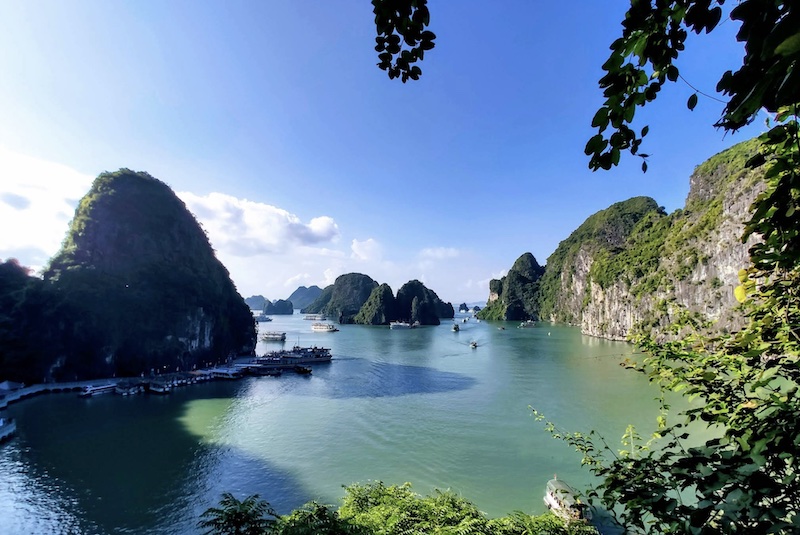
October and November are the best months to visit Halong Bay. Dry air, flat water, temperatures around 20–25°C. March to May is the runner-up. Skip July and August if you can, because that is when storms cancel the most sailings.
Autumn is the season people photograph and remember. The haze lifts, the water turns properly green, and the deck stops being somewhere you flee from.
Spring is warm and forgiving. You may get a grey morning drizzle that burns off by ten. If you are planning a Halong Bay 2026 trip, either shoulder season will treat you well.
Summer is a different proposition. It is busy with domestic travellers, hot, and humid enough that the sundeck empties by noon. More to the point, it is typhoon season in the Gulf of Tonkin. The port authority will ground the entire fleet on short notice, and no operator can overrule that.
You may also read about the "Song hoi anh sang" Festival of Lights, held 28 April to 2 May 2026. It has not been made an annual event, so do not build a trip around it. For a month-by-month view, read our guide on the best time to visit Halong Bay.
Yes, and the rules got stricter this year. Every tourist vessel now has to carry GPS, AIS and VHF radio, and keep a 24-hour rescue team on call. A single-use plastic ban covers the whole bay.
This is not paperwork. In March 2026 the port authority inspected 332 vessels and penalised 9 of them. Ships that pass are ships that have actually been checked, on hull, fire systems and crew.
The plastic rule has teeth too. It has been in force since September 2019. In May 2025 a boat was pulled from service for seven days because guests carried plastic bottles aboard.
So: bring a refillable bottle. Every boat we work with refills them free. It also saves you paying bar prices for water you could have had for nothing. Our guide on responsible travel in Halong Bay goes further into this.

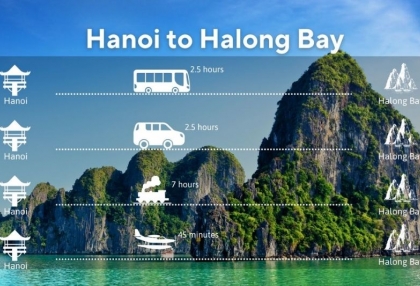
Hanoi to the coast takes 2.5 to 3 hours on the expressway, covering 150 to 160 kilometres. Which pier you want depends entirely on which bay your boat sails.
If you are mapping out a Halong Bay itinerary, plan on driving. The air options are gone:
That leaves shuttle buses and private cars. Both are straightforward on the new road.
Now the part that ruins mornings. Tuan Chau and Got are about 40 kilometres apart. If your driver takes you to the wrong one, you will not make the boat. There is no second sailing.
Get the pier name in writing when you book. Not on the day. Our guide on getting from Hanoi to Halong Bay covers transfer options and pricing in detail.
A Halong Bay travel guide that lists one departure port is out of date. Four marinas now serve four different kinds of trip.
| Departure port | Driving time from Hanoi | Bay served | Best suited for |
|---|---|---|---|
| Tuan Chau Marina | About 2.5 to 3 hours | Halong Bay (core zone) | First-timers who want the classic sights |
| Got Port (Hai Phong) | About 2.5 hours | Lan Ha Bay | Mid-range and luxury overnight cruises heading south |
| Ben Beo (Cat Ba) | About 3 to 3.5 hours including ferry | Lan Ha Bay | Boutique day cruises and Cat Ba island stays |
| Hon Gai Port | About 2.5 to 3 hours | Bai Tu Long Bay | Quieter routes, further from the crowds |
Driving times are approximate and assume normal expressway traffic. Confirm your exact pier and pickup time with your operator.
Treat the government sightseeing ticket as its own line item. A day route costs 250,000 VND. An overnight route costs 550,000 VND. Your cruise fare, your Hanoi transfer and your tips all sit on top of that.
Most listings blur these together. We keep them apart, because that is where the surprises live.
If you book a cheap day tour on the street, ask one question: is the VHL ticket included? Reputable agencies build it into the invoice. Others let you discover it at the pier.
Your cruise fare itself swings widely with the class of ship and the cabin. Rather than list a hundred prices here, we put the full calculation in our complete Halong Bay trip cost breakdown.
Overnight fees already include sightseeing access. They are not charged on top of a day ticket.
| Route designation | Included attractions | Fee per person |
|---|---|---|
| VHL1 | Thien Cung, Dau Go, Hon Cho Da, Ba Hang, Dinh Huong | 250,000 VND |
| VHL2 | Soi Sim, Ti Top, Sung Sot, Me Cung | 250,000 VND |
| VHL3 | Cua Van, Tien Ong, Ho Ba Ham | 200,000 VND |
| VHL4 | Hang Co, Hang Thay, Cap La, Vong Vieng | 200,000 VND |
| VHL5 | Thien Cung to Gia Luan pier (Cat Ba) | 250,000 VND |
| VHL6 | Hon Chan Voi, Vung Ba Cua, Tung Lam island | 150,000 VND/day |
| VHL7 | Full access to VHL1, VHL2, VHL3 and VHL4 | 600,000 VND |
| VHL8 | Coastal zone only | 70,000 VND |
| VHL2 overnight | Core zone, 1 night | 550,000 VND |
| VHL2 overnight | Core zone, 2 nights | 750,000 VND |
| VHL3 and VHL4 overnight | 1 night | 500,000 VND |
| VHL3 and VHL4 overnight | 2 nights | 650,000 VND |
Updated July 2026. Source: Ha Long Bay – Yen Tu World Heritage Management Board.
Who pays less:
That last line catches almost every international family. Worth knowing before you argue at the ticket window.

Your day is shaped by the route your captain is licensed to sail. Expect caves, a kayak session, and a climb to a viewpoint. What changes is how many you fit in, and how many other people are there with you.
You cannot negotiate this on board. The captain cannot add a cave that is not on the licence. Check the stops before you pay, not after.
For the full range, from night squid fishing to floating villages, see our post on things to do in Halong Bay.
Sung Sot Cave is the big one. Three chambers, the last one cavernous enough to swallow the noise of a hundred people. Locals call it Surprise Cave, and the name earns itself at the second doorway.
Thien Cung Cave is finer and more theatrical. Tighter formations, heavier lighting, a short hop from Tuan Chau pier.
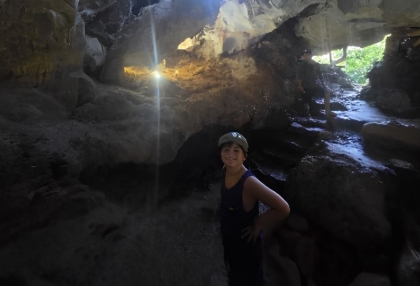
Want fewer elbows? Me Cung Cave holds real archaeological interest and a fraction of the footfall. Dau Go Cave trades detail for scale. Out in Bai Tu Long, Thien Canh Son Cave sits well off the main circuit.
Here is the tip that changes the day. The crush at Sung Sot and Ti Top runs from roughly 10am to 2pm, when the day boats and the overnight fleet arrive together. An early or late slot is a different cave entirely.
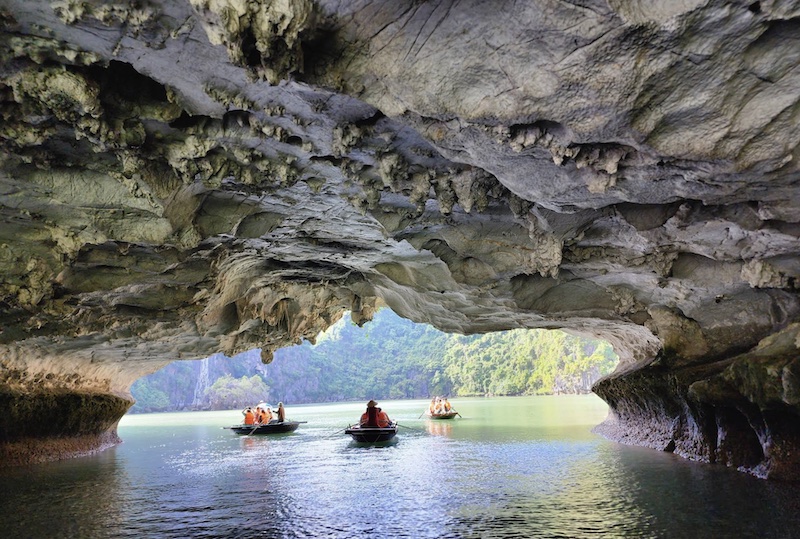
Kayaking is how the bay stops being scenery and starts being a place. There are 8 designated kayaking areas, regulated under Decision 6643/QD-UBND (2017).
Luon Cave is the one people remember. A flooded tunnel through a limestone wall, low enough that you duck. No engines allowed — kayak or bamboo rowboat only, which is exactly why it stays quiet inside.
Swimming is another matter. The bay has hundreds of beaches. In the core zone, Ti Top Island is the only one where you are permitted to swim. Ti Top also has the viewpoint everyone photographs, about 400 stone steps up.
If swimming is high on your list, that single rule should push you towards a Lan Ha itinerary. There, stopping to swim is the routine, not the exception.
Budget, route, cabin. Get those three right and the rest sorts itself out.
Be honest about what you will actually use. A family needs connecting rooms and something for the kids to do. A couple usually wants a small boat and a balcony. Most of the money between a $150 ship and a $290 ship buys space and quiet, not better scenery. The view is the same from every deck.
Our dedicated guide on how to choose a Halong Bay cruise compares ships side by side. Three to start from:
| Cruise or tour name | Price | Best feature |
|---|---|---|
| Ha Long Bay Day Tour, Sung Sot Cave, Luon Cave & Titop Island | From $34 | Covers the main VHL2 highlights in one day |
| Capella Halong Bay Cruise | Contact us | Water slide and pool, built for families |
| Orchid Premium | From $290 | Five suites only, for people who want no crowd at all |
Travelling with children brings extra child-pricing and safety questions. Read our advice on visiting Halong Bay with kids first.
Yes. The 2023 UNESCO expansion brought the Cat Ba Archipelago into the same listing, which opens up quieter water without leaving the heritage site. The expressway has cut the drive, and the 2026 safety rules mean the fleet is better regulated than it has been in years.
Yes, but the water does the heavy lifting and it changes. On a clear autumn day it is a deep emerald that photographs beautifully. In January and February the bay turns grey and misty, which is atmospheric in person and disappointing on camera. Book autumn if the photos matter.
No. The Hanoi seaplane service was permanently discontinued on 1 April 2026, and helicopter sightseeing ended back in 2023. Any guide still listing air transfers is out of date. Everyone now travels overland, which takes 2.5 to 3 hours from Hanoi on the expressway.
Two days and one night is the standard, and it covers the main caves and one night on the water. Three days and two nights is the one worth paying for. That is when you reach deep-water kayaking, remote fishing villages, and an afternoon on deck with nowhere to be.
No. In the core zone, Ti Top Island is the only beach where swimming is permitted, and that rule is enforced. If getting in the water matters to you, book a Lan Ha Bay itinerary instead. The water is cleaner there and swimming stops are built into the route.
Light breathable clothes, a swimsuit, and shoes with grip for the cave steps. Most importantly, a refillable water bottle, because single-use plastic is banned across the bay and boats have been suspended over it. Our full Halong Bay packing list has a seasonal breakdown.
A day trip works if time is short and you are based in Bai Chay or Hanoi. An overnight cruise is a different experience altogether. You get sunset, sunrise, and the hours after the day boats leave, which is when the bay finally goes quiet.
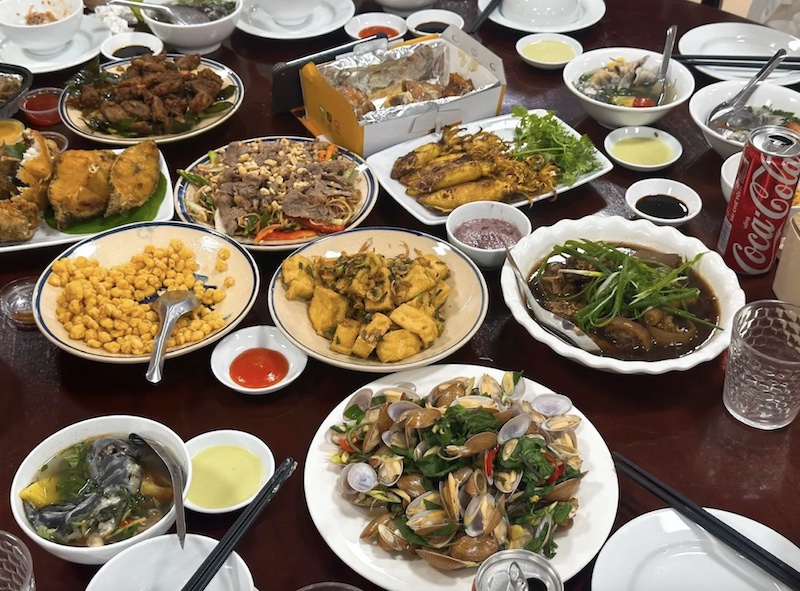
Thanks for reading our Halong Bay travel guide. If you want to eat well while you are up here, start with our guide on what to eat in Halong Bay.
Ready to pick dates? Browse our Lan Ha Bay cruises, or head back to bekatravel.com for the full range of Vietnam itineraries.
Ha Long
Planning your Halong Bay trip? Compare spring, summer, autumn, and winter weather, crowd levels, and booking tips to find your ideal travel month.
 Ha Long
Dau Go Cave is one of Ha Long Bay's largest historic caves, tied to a 13th-century Tran Hung Dao legend. Find the Route 1 ticket price, accessibility notes, and what to expect inside.
 Ha Long
Planning to cruise Halong Bay with kids? Compare family cabins, child pricing by age, kid-friendly itineraries, and safety tips for a stress-free trip.
 Ha Long
Wondering what to pack for Halong Bay? Check out our ultimate packing list, including travel essentials and seasonal tips for your cruise vacation.
 Ha Long
Discover how to practice responsible travel in Halong Bay, from the bay's single-use plastic ban to supporting local communities on a sustainable cruise.
 Ha Long
Exploring Halong Bay cuisine on your cruise? Discover must-try seafood like Cha Muc, Sa Sung, and Sam Bien, plus dining formats and dietary tips.
 Ha Long
Looking to stay active in Halong Bay? Explore our top 5 experiences including kayaking, cave trekking, cycling, and more, plus what changed under the 2026 safety rules.
 Ha Long
Complete 2026 guide to traveling from Hanoi to Halong Bay: bus, minivan, private car, and helicopter options, distance, price, and which port to use.
 Ha Long
A practical guide to choosing a Halong Bay cruise: which bay to sail (Halong, Lan Ha, or Bai Tu Long), how many days, which comfort tier fits your budget, and when to go.
 Ha Long
Thien Canh Son Cave (Hang Co) sits on Hon Co Island in quiet Bai Tu Long Bay, reached by a jungle climb of about 100 stone steps. Find directions, prices, and how it compares to Ha Long Bay's main caves.