



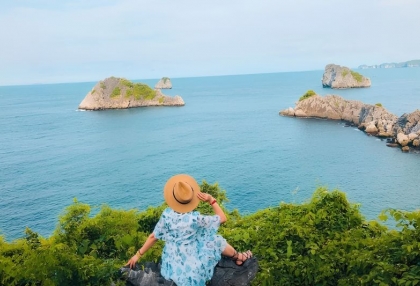
 Cat Ba - Lan Ha Bay
Monkey Island Cat Ba: What to Know Before You Go
A practical guide to Monkey Island in Lan Ha Bay: how to get there, what the monkeys are like, the viewpoint hike, and which Beka tours stop there.
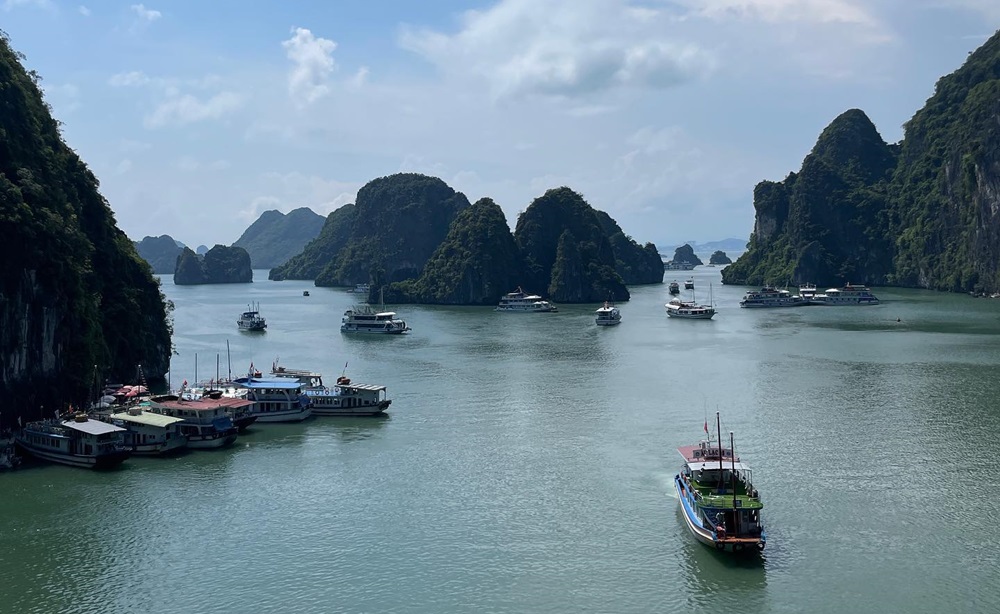
The three bays are located in the same sea area, on the same flooded limestone islands, and they look the same. With the labels removed from three photos, most travelers could not tell which bay is which. The useful question is therefore not which bay is prettier. This Halong Bay vs Lan Ha Bay and Bai Tu Long comparison explains what changes a day on the water. It is based on the Lan Ha Bay tours that Beka Travel runs from Cat Ba every week.
All three bays share one continuous limestone landscape. Halong Bay has the large walk-in caves and the heaviest boat traffic. Lan Ha Bay has the same scenery with far fewer boats, cleaner swimming water, and more freedom to anchor and swim. Bai Tu Long is quiet and needs no ferry, but it has the fewest boats to choose from and it is located outside the official World Heritage boundary. For most travelers, Lan Ha Bay is the better choice.
Geologists do not draw a line between these bays, because there is no natural border between them. The whole area is one limestone system that formed over roughly 20 million years and was flooded when the sea rose after the last ice age. The islands seen today are the tops of old limestone hills above the water.
UNESCO describes the area as "the most extensive and best-known example of marine-invaded tower karst" in the world (UNESCO World Heritage Centre). That description covers the whole landscape. The rock and the water are the same in every bay.
When a tour seller says that one bay has "more dramatic scenery" than another, it is mostly marketing. The real differences are the number of boats sharing the view, whether swimming is allowed, and the travel time to get there.
Lan Ha Bay and Halong Bay are the same in nature but not in administration. Halong Bay belongs to Quang Ninh Province, while Lan Ha Bay belongs to Hai Phong City and covers the south and east of Cat Ba Island. Nothing separates them in the water, only a line on a management map.
That line matters because each side sells its own sightseeing tickets and licenses its own boats. Boats leaving from Halong Bay can cross over and anchor in Lan Ha Bay on a registered route. Boats leaving from Cat Ba cannot do the same in reverse, which is why a Cat Ba cruise does not visit Sung Sot Cave.
The practical result is one trip, one bay, unless the tour is a cross-bay program that includes both regional tickets. Travelers who want to move between the two bays on their own can use the Tuan Chau to Cat Ba ferry.
The 2023 decision is the strongest evidence that the bays are one landscape. On 16 September 2023, at the 45th session of the World Heritage Committee in Riyadh, Saudi Arabia, UNESCO expanded the existing Ha Long Bay listing to include the Cat Ba Archipelago. The site is now officially called Ha Long Bay - Cat Ba Archipelago, according to the Vietnam Ministry of Culture, Sports and Tourism and the UNESCO World Heritage List.
The listed property covers 1,133 limestone islands, of which 775 are in Ha Long Bay and 358 are in the Cat Ba Archipelago. It also includes more than 17,000 hectares of mangrove forest and seven tropical marine habitats. It was Vietnam's first World Heritage site to cover two provinces, and it is now jointly managed by Quang Ninh Province and Hai Phong City. UNESCO lists it under criterion (vii) for natural beauty and criterion (viii) for its geological record, with a core zone of 65,650 hectares and a buffer zone of 34,140 hectares.
One detail is often missed. Those 1,133 islands are the ones inside the listed boundary, not the total. Ha Long Bay as a whole contains around 1,969 islands and the Cat Ba Archipelago around 389. Part of both areas is therefore inside the same limestone system but outside the World Heritage line, which is useful to know when a brochure quotes island counts.
Bai Tu Long Bay is located northeast of Halong Bay, in the same province and the same geological formation. It is not, however, inside the listed World Heritage property. The core zone runs from Dau Go Island in the west to Cong Tay Island in the east, and Bai Tu Long begins beyond that eastern edge.
This is not a judgment of quality. Bai Tu Long has its own protection as a national park and has seen less development than either neighbor. Travelers who want to say they slept inside a UNESCO World Heritage Site should note that Bai Tu Long does not qualify, while both Halong Bay and Lan Ha Bay do.
The heritage listing is a management framework, not a guarantee of a quiet trip. UNESCO documents also note that the critically endangered Cat Ba langur remains under pressure from tourism. This is why Lan Ha Bay operators are asked to spread out and not gather at the same few stops.
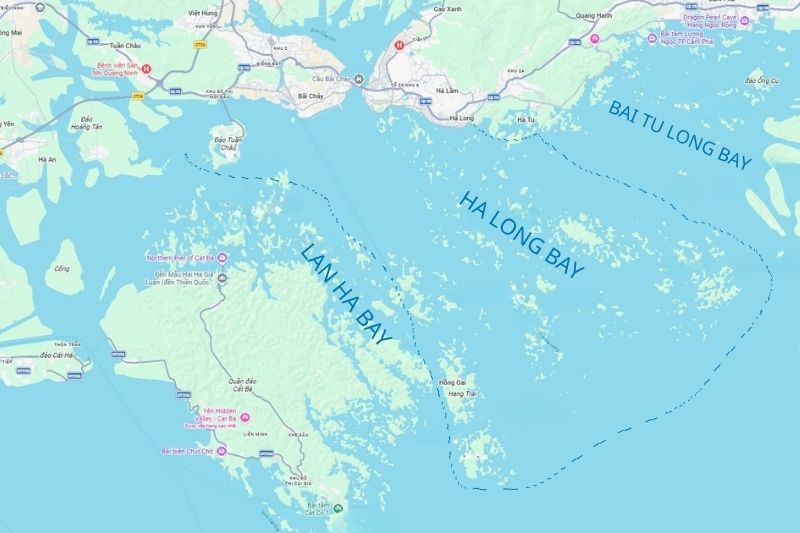
The table below compares the three bays on the points that change a trip the most, from boat traffic and swimming rules to travel time from Hanoi and starting prices.
| Feature | Halong Bay cruises | Lan Ha Bay cruise | Bai Tu Long Bay |
|---|---|---|---|
| Province | Quang Ninh | Hai Phong (Cat Ba) | Quang Ninh |
| Inside UNESCO listing | Yes, 775 islands | Yes, 358 islands | No, outside the boundary |
| Islands in the wider area | About 1,969 | About 389 | About 600 |
| Overall feel | Grand, open, busy | Quiet, less touristy, active | Quiet, slow, empty |
| Boat traffic | High | Low | Very low |
| Main highlights | Sung Sot Cave, Thien Cung Cave | Hidden lagoons, natural beaches | Thien Canh Son Cave, Vung Vieng |
| Anchoring rules | Fixed stops only | Free anchoring on registered routes | Fixed stops only |
| Swimming | Man-made beaches | Open water and natural beaches | Designated spots only |
| Kayaking | Short, supervised | Long, open exploration | Short, supervised |
| Viewpoint hike | Ti Top Island | Monkey Island, Navy Peak | None |
| Cruise fleet | Older refitted boats and new large ships | Newer boutique boats and classic cruises | Few options |
| Cabins per boat | 20-60 | 10-22 | 12-30 |
| Ferry needed | No | Yes from Cat Ba Island, no when the cruise departs from Halong | No |
| Time from Hanoi | 2.5-3 hours | 3.5-4.5 hours | 3-3.5 hours |
| Day tour cost | $30-70 | $40-100 | Almost none available |
| Overnight from | About $99 | About $99 | About $130 |
| Best for | Relaxing, luxury cruises | Swimmers, couples, repeat visitors, active travelers | Travelers who want silence |
The scale of the landscape here is larger than anywhere else in Vietnam. Nearly 2,000 limestone towers rise from the Gulf of Tonkin. As the boat moves through the main channels, the islands keep changing position against each other, creating the wide, open seascape seen on classic Vietnamese postcards.
The defining feature of this bay is its large cave system that visitors can walk through. Sung Sot Cave has three large chambers where stalactites have formed over millions of years. Visitors can walk up to Thien Cung Cave for its rock formations or climb the 400 steps of Ti Top Island for the well-known panoramic view of the cruise fleet below. Neither Lan Ha Bay nor Bai Tu Long has dry caves of this size.

Halong Bay is worth it for the scenery, but the crowds reduce the experience on day tours. Most day tours run Route 2 from 11:30 to 17:30, so the number of visitors at the same stops is very high. Travelers rarely complain about the scenery itself. What leaves them less satisfied is the crowding, which is hard to control.
Overnight Halong Bay cruises are the better way to see the bay. The boat stays on the water after the day boats return to port, so the evening and early morning are much calmer.
Lan Ha Bay is known as a place where visitors can swim freely from the boat, while Halong Bay moves visitors between fixed sightseeing stops. Because the bay is sheltered by Cat Ba Island, the water is noticeably cleaner and calmer, which makes swimming one of the main reasons to come.
The scale feels smaller and closer. The boat often passes through narrow channels between limestone islands, not wide shipping lanes. Kayaks can pass under low rock ceilings into enclosed, silent areas of water such as Dark and Bright Cave. The floating fishing villages here are still working communities, not cultural stops arranged for tourists.
A trip based here also gives direct access to Cat Ba Island, which adds a second part to the program. Time on the water can be combined with jungle trekking in the national park, cycling to the remote Viet Hai Village, or looking for Cat Ba bioluminescent plankton at night.

Most travel blogs state that Lan Ha Bay is quieter but do not explain the reason. The main difference is the sightseeing areas that boats are permitted to use within a route.
Halong Bay fixes its visits to Sung Sot Cave, Ti Top Island, and Luon Cave. Lan Ha Bay has more flexible rules. Guests can move between several beach areas and kayak in different places as long as they stay within the sightseeing route. They can also visit floating farms and cycle in Viet Hai village. Because of this, Lan Ha Bay cruise boats can adjust their routes so that fewer visitors gather in one place.
When travelers want to avoid the large crowds, the decision usually comes down to these two bays. Both offer a quiet experience, but they achieve it in different ways.
| Feature | Lan Ha Bay | Bai Tu Long Bay |
|---|---|---|
| Transfer to the boat | Highway and ferry to the island | Highway only, no ferry |
| Swim and kayak stops | Free anchoring, flexible | Designated stops only |
| Natural beaches | Many | Very few |
| Caves | Water caves by kayak | Thien Canh Son Cave on foot |
| Choice of cruises | Wide, many boutique options | Small, very few operators |
| Starting price | Budget options available | Mostly higher prices |
Lan Ha Bay and Cat Ba Island suit travelers who want to jump from the boat into the sea, kayak freely through quiet lagoons, and reach dozens of small sandy beaches. Bai Tu Long suits travelers who want silence, are traveling with elderly parents who would find a ferry transfer tiring, and do not mind a fixed sightseeing schedule.
Daily activities change a lot depending on the bay. Halong Bay focuses on classic, structured sightseeing. Visitors walk through Sung Sot Cave and Thien Cung Cave, climb Ti Top Island for panoramic photos, join short supervised kayak sessions near Luon Cave, and try squid fishing from the deck at night.
Lan Ha Bay suits active travelers. The program includes long kayaking routes, several swims a day from the boat, and time on natural beaches such as Ba Trai Dao Beach.
Visitors can also hike the trails of Cat Ba Monkey Island for sea views or trek in the national park on Cat Ba, where the critically endangered Cat Ba langur is sometimes seen. Bai Tu Long is between the two. It offers clean scenery, Thien Canh Son Cave, which can be visited on foot, and visits to Vung Vieng fishing village, but it follows the same fixed-stop rules as Halong Bay.
| Activity | Halong Bay | Lan Ha Bay | Bai Tu Long Bay |
|---|---|---|---|
| Caves on foot | Excellent, very large | Limited | Good (Thien Canh Son) |
| Kayaking | Basic, short routes | Excellent, free exploration | Basic, short routes |
| Free swimming | No | Excellent | No |
| Natural beaches | Rare | Many | Rare |
| Panoramic viewpoints | Ti Top Island | Monkey Island | None |
| Jungle trekking | None | Excellent (national park) | None |
| Squid fishing | Standard on cruises | Standard on cruises | Standard on cruises |
| Fishing villages | Mostly relocated | Active communities | Active communities |
Both bays have high-quality cruises, but luxury means something different in each. Halong Bay has a large fleet that is upgraded often, including 5-star ships and a few very large ships marketed as 6-star. Luxury here means size and resort-style facilities such as large suites, fine-dining restaurants, and spas.
Lan Ha Bay specializes in small and medium boutique cruises. Their size allows them to enter small bays where ships with more than 25 cabins cannot go. A Lan Ha Bay luxury cruise is about privacy and personal service. Boats usually have only 10 to 15 cabins, and captains can anchor in quiet places where no other ship is visible from the cabin balcony.
Prices in the two bays overlap more than most travelers expect. A premium Lan Ha Bay cabin generally costs $145 to $200 per guest. Chartering a whole private boutique boat for a family in Lan Ha Bay is often cheaper than booking two top suites on a large Halong Bay ship.
The table below shows typical market rates for the three bays. The figures are starting costs in USD per passenger with reliable operators, and they can be used to check any quote.
| Trip style | Halong Bay | Lan Ha Bay | Bai Tu Long Bay |
|---|---|---|---|
| Half day or sunset boat trip | $35-50 | $15-30 | Not available |
| Day tour (full day) | $50-80 | $30-50 | $60-90 |
| Cross-bay day trip | $60-90 | $60-90 | Not available |
| 2D1N budget cruise | $110-130 | $99-120 | $140-150 |
| 2D1N mid-range cruise | $150-180 | $130-170 | $160-200 |
| 2D1N luxury cruise | $190-350+ | $180-300+ | $220-400+ |
| 3D2N cruise | $250-400 | $230-380 | $280-450 |
Getting to the Halong Bay ports is easy. Buses and limousine vans leave Hanoi at around 8:00 and take about 2.5 hours to Tuan Chau Marina. For Bai Tu Long Bay, the bus can drop passengers directly at the pier.
Getting to Cat Ba Island for Lan Ha Bay takes longer and needs more than one type of transport, because no road connects directly to the island. A full-package bus from Hanoi to Cat Ba already includes the sea crossing.
The crossing is by ferry, speedboat, or the Cat Ba cable car, depending on the bus company. The travel time is about 3.5 hours, and buses leave Hanoi one hour earlier than those going to Tuan Chau Marina.
Long-term backpackers and repeat visitors on Reddit mostly recommend Lan Ha Bay. Their reason is simple: the scenery is the same, with far less boat traffic. First-time visitors and families with young children often prefer Halong Bay. The large steel ships are easier to move around with strollers, and visitors who skip well-known places such as Sung Sot Cave often regret it later. Reddit opinions are a useful measure of crowd levels, not a ranking of quality. For travelers whose priority is the world-famous landmarks, Halong Bay remains a good choice.
The right bay depends on who is traveling and what they want from the trip. The four groups below cover the most common cases.
Travelers who have only one night and want to see the very large caves and the famous panoramic views should book the Halong Bay route. They will leave without feeling that they missed a world-famous place. With a spare day, a day trip to Lan Ha Bay can be added later.
The answer depends on the age of the children. For children under eight, the large ships in Halong Bay are the better choice, with wide shaded decks, stable sailing, and plenty of space to walk. For teenagers, Lan Ha Bay is the better choice, because jumping from the boat and kayaking on their own keeps them busy.
Lan Ha Bay is the stronger choice for couples. The modern boutique cruises have private balconies and small dining rooms, and they can anchor alone in a silent lagoon. Photos also come out better without dozens of other tourist boats in the background.
Cat Ba Island is the best base for Lan Ha Bay on a budget. The island has low-cost accommodation, lively nightlife, and good jungle trekking. A shared boat trip costs from as little as $15. Travelers returning to Vietnam for a second time can skip the central tourist routes.
Yes, two bays can be visited in one trip, and for many travelers this is the best plan. Halong Bay and Lan Ha Bay are only about an hour apart by boat. A cross-bay day trip starts at around $50. It allows visitors to photograph the classic Halong Bay caves in the morning and swim in the clean water of Lan Ha Bay in the afternoon.
The second method is to use Cat Ba Island as a base. This gives two or three days on the water, access to the national park, and a wide choice of restaurants on the island, without paying for two separate cruise transfers. Three days is the ideal length for this combined plan.
Travelers visiting Vietnam for the first time, with only two days, who want to see the famous caves and landscapes should choose a classic Halong Bay tour. A newer, well-reviewed boat that sails slightly away from the main channel reduces the effect of the midday crowds.
With more time, the best plan is both. Sleep one night on Lan Ha Bay, then take a day trip across the border between the bays to photograph the Halong Bay caves. Both bays follow the same seasonal pattern, so the choice is not a weather question. The monthly conditions are explained under the best time to visit Halong Bay.
No. Lan Ha Bay is not part of Halong Bay in administrative terms, although both are part of the same continuous limestone landscape. The two bays are managed by two different local governments, with different tickets and separate boat licenses.
Halong Bay is better for travelers who want to explore very large caves on foot and do not mind sharing the views with crowds. Lan Ha Bay is better for travelers who prefer quiet water, free swimming, long kayaking routes, and newer boutique boats.
Yes. Halong Bay is worth visiting for travelers who expect crowds at the main stops. To get the most from it, avoid cheap midday tours, book an overnight cruise to wake up on the water, or ask for a boat that follows the longer, less busy outer routes.
Lan Ha Bay is better for travelers who like jumping from the boat to swim and kayaking freely through quiet lagoons. Bai Tu Long Bay is better for travelers who want silence, do not plan to swim, and want to avoid a ferry transfer.
Yes, but only at designated man-made beaches such as Ti Top, which are often very crowded. Jumping from a cruise boat into open water is prohibited in Halong Bay under local rules.
Yes. Lan Ha Bay offers a different, more active experience than Halong Bay. It focuses on free swimming, long kayaking routes, and natural beaches that are not part of a Halong Bay trip.
The best time to visit Halong Bay and Lan Ha Bay is spring (March to May) and autumn (September to November), when skies are clear and the water is calm. July and August are less reliable, because tropical storms often close the ports. Month-by-month details are covered under the best time to visit Cat Ba Island.
Yes. Halong Bay and Lan Ha Bay belong to different provinces, so a sightseeing ticket for one area is not valid in the other. On a cross-bay tour, the operator buys both regional tickets for the guests.
Cat Ba - Lan Ha Bay
A practical guide to Monkey Island in Lan Ha Bay: how to get there, what the monkeys are like, the viewpoint hike, and which Beka tours stop there.
 Cat Ba - Lan Ha Bay
Around 90 Cat Ba langurs are left in the wild, all on one island. What they are, why you probably won't see one, and how to visit responsibly.
 Cat Ba - Lan Ha Bay
The Cat Hai-Phu Long cable car crosses 3,955 metres of open water in 10-15 minutes, running 09:00-16:00 daily except Tuesdays. Route, hours, ticket prices and how it compares to the ferry.
 Cat Ba - Lan Ha Bay
Beyond trekking and kayaking, Cat Ba Market is a must-visit destination to experience the authentic local lifestyle. It is the culinary heart of the island, where you can find the freshest seafood and traditional products of the Hai Phong port region.
 Cat Ba - Lan Ha Bay
Complete 2026 guide to reaching Cat Ba Island: compare buses, ferries, cable cars and transfers from Hanoi, Hai Phong, Ha Long and Ninh Binh.
 Cat Ba - Lan Ha Bay
Complete 2026 guide to the Tuan Chau to Gia Luan ferry. Find updated schedules, ticket prices, transport from Gia Luan to Cat Ba Town, and expert travel tips.
 Cat Ba - Lan Ha Bay
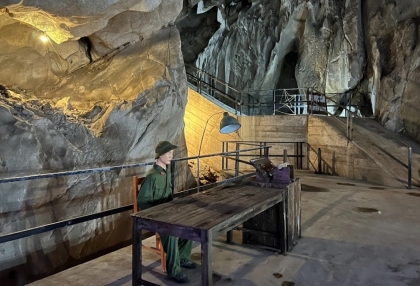
Discover Hang Quan Y (Military Hospital Cave) on Cat Ba Island. Learn about its wartime history, the 3-level concrete bunker, entrance fees, and how to get there.
 Cat Ba - Lan Ha Bay
Cannon Fort on Cat Ba Island is currently closed to visitors, with no official ticket sold. History, location, and what to see instead in 2026.
 Cat Ba - Lan Ha Bay
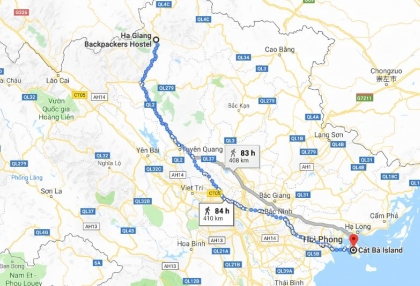
There is no direct bus from Ha Giang to Cat Ba Island. See the Palace Cabin bus via Hanoi, journey time, prices and pickup points for 2026.
 Cat Ba - Lan Ha Bay
There is no direct bus from Sapa to Cat Ba Island. Compare the overnight sleeper and daytime bus routes via Hanoi, with 2026 prices and timing.
