




 Ha Long
Halong Bay Airport: Which One Should You Fly Into?
There is no airport in Halong City. Travelers fly into Van Don, Cat Bi or Noi Bai and continue by road, about 35 minutes to 3 hours.
Planning a trip from Hanoi to Halong Bay is relatively easy, with several transport options available for different budgets and travel styles. Most visitors travel by road, using a shuttle bus, limousine van or private car, while motorbikes offer a more adventurous alternative.
The sections below cover the Hanoi to Halong Bay route in detail, including the distance, travel time, transport options, airport transfers, cruise ports and practical tips for choosing the best way to reach the bay.
The most convenient way to travel from Hanoi to Halong Bay is by road. The modern expressway has cut the journey time compared with older routes, so shared shuttles, limousine vans and private cars are the practical choices for most travelers. Public buses are cheaper, but they may stop at a bus station rather than at the pier.
For cruise passengers, a transfer arranged by the cruise is the simplest option. These services collect passengers from hotels in central Hanoi and take them directly to the correct port. A private car gives independent travelers the most flexibility. Travelers choose the departure time and ride from the hotel to the cruise terminal without changing vehicles.
The distance from Hanoi to Halong Bay is approximately 165 km by road from central Hanoi to Ha Long City. The actual distance varies depending on the starting point in Hanoi and the destination in Ha Long. By private car the drive generally takes 2.5 to 3 hours.
Most visitors should allow around 2.5 to 3.5 hours for a direct transfer. Local buses can take longer because they make more stops, while traffic, weather and the exact pickup location can also affect the journey.
The Hanoi to Halong Bay distance is short enough to make a Halong Bay day trip possible, but an overnight cruise is a better choice for travelers who want more time to explore the bay.
| Transport | Approx. travel time | Typical cost | Best for |
|---|---|---|---|
| Public bus | 4-5 hours | 120,000 to 250,000 VND | Budget travelers |
| Shuttle bus | 3-3.5 hours | 250,000 to 500,000 VND | Solo travelers and couples |
| Limousine van | About 2.5 to 3 hours | 350,000 to 700,000 VND | Comfort and convenience |
| Private car | 2.5 to 3 hours | 1,400,000 to 2,350,000 VND per car | Families and groups |
| Motorbike | 3-4 hours | Rental plus fuel | Experienced riders |
| Train | No direct practical service | Not available | Not recommended |
| Seaplane | No longer available from April 2026 | Not available | Previously available |
| Helicopter | Not available | Suspended since 2023 | Not available |
Prices vary according to vehicle type, season, pickup location and whether the transfer is booked separately or as part of a cruise package. Motorbike rental normally costs 235,000 to 470,000 VND per day, with fuel on top.
Road travel remains the main transport from Hanoi to Halong Bay. The Hanoi to Ha Long expressway makes the journey much easier than the older routes, and most cruise passengers now choose a direct transfer.
A bus from Hanoi to Halong Bay is the most affordable option for travelers who do not mind a less direct journey. Public buses run from the major Hanoi bus stations, including My Dinh and Gia Lam. The trip takes around four to five hours depending on the service, traffic and number of stops, and a one way fare is normally 120,000 to 250,000 VND.
The problem is the last part of the journey. Buses may stop at a bus station in Ha Long rather than at the cruise terminal, so a taxi is often needed to finish the trip. This works well for travelers staying in Ha Long City. For a cruise with a fixed check-in time, a direct transfer is safer.
A Hanoi to Halong Bay shuttle bus is a more convenient alternative to the public bus. Tourist shuttles and limousine vans collect passengers from hotels or set pickup points in Hanoi and go directly to the cruise port. The trip takes around three hours, depending on traffic and stops.
Limousine vans are the more comfortable version, with wider seats, air conditioning and fewer stops on some services. The price sits between the public bus and a private car, and the pickup is at the hotel door, which is why many international visitors choose one. It is especially convenient when the transfer is arranged together with an overnight cruise.
A Hanoi to Halong Bay taxi or private car is the most flexible way to travel. The car picks up at the hotel at the chosen time and goes straight to the cruise terminal. The fare is normally 1,400,000 to 2,350,000 VND one way, depending on the vehicle and the service, and it works out reasonable when divided between several passengers.
A Hanoi to Halong Bay private transfer suits families, groups and travelers with large luggage, and it removes the risk of ending up at the wrong bus station. Self driving is possible, but renting a car without a local driver is less common among international visitors, and traffic, road signs and port parking make it harder than expected.
A motorbike gives experienced riders more freedom to explore northern Vietnam along the way. The ride covers roughly 165 km and takes around three to four hours, although the exact time depends on the route and the road conditions.
Motorbikes cannot use expressways, so riders follow the older roads, which makes the trip longer and more tiring than going by car. Riding suits experienced motorbike travelers rather than visitors looking for the easiest way to reach a cruise. Avoid carrying large luggage and check the weather before leaving.
Travelers arriving at Noi Bai International Airport can go directly to Ha Long without entering central Hanoi first. A private car, taxi or pre-arranged cruise transfer takes travelers from the airport to the cruise ports. Noi Bai is roughly 190 km from Ha Long City by road, although the exact distance depends on the destination and route. Van Don International Airport is the nearest airport to Halong Bay, while Noi Bai is the main gateway for international flights.
Allow around three to three and a half hours, and more if traffic is heavy. A direct airport transfer is easier than going into Hanoi first and changing vehicles. When a flight lands on the same day as the cruise, a generous buffer between landing and the cruise check-in time is needed.
No train service currently runs on a schedule that suits a Ha Long cruise. Searches for Hanoi to Halong Bay by train may turn up older travel guides describing a direct railway journey, but that is not the practical choice for tourists today.
There is no convenient direct passenger train service that can compete with the current road journey in terms of travel time and convenience. For cruise passengers, a shuttle, limousine or private car is much easier to arrange.
For travelers going from Hanoi to Halong Bay by public transport, road travel is the option to consider first.

A seaplane was once one of the fastest ways to travel from Hanoi to Halong Bay. The direct flight took about 45 minutes and gave aerial views of the limestone islands before landing on the water.
The service is no longer available from April 1, 2026. Hai Au Aviation announced the suspension of its Halong Bay sightseeing seaplane after more than 12 years of operation, as reported by thanhnien.vn. Travelers searching for a flight from Hanoi to Halong Bay should not count on one when planning a trip in 2026, so road transport remains the practical choice.
Helicopter sightseeing flights over the bay were suspended after a crash in April 2023, as reported by tuoitre.vn. No regular helicopter service links Hanoi and Ha Long today.
For most travelers, a limousine or private car is a much simpler and more affordable way to reach Ha Long.
The pier depends on the cruise booked, so the exact departure port on the booking confirmation should be checked before arranging the Hanoi to Halong Bay transfer. Tuan Chau Port is a major departure point for sightseeing and overnight cruises, while Ha Long International Cruise Port is another passenger terminal in the city.
The two ports are separate locations, so telling a driver "Halong Bay port" may not be enough. The exact port name and the address supplied by the cruise operator prevent a wrong drop-off. This matters most for independent travelers and private transfers.
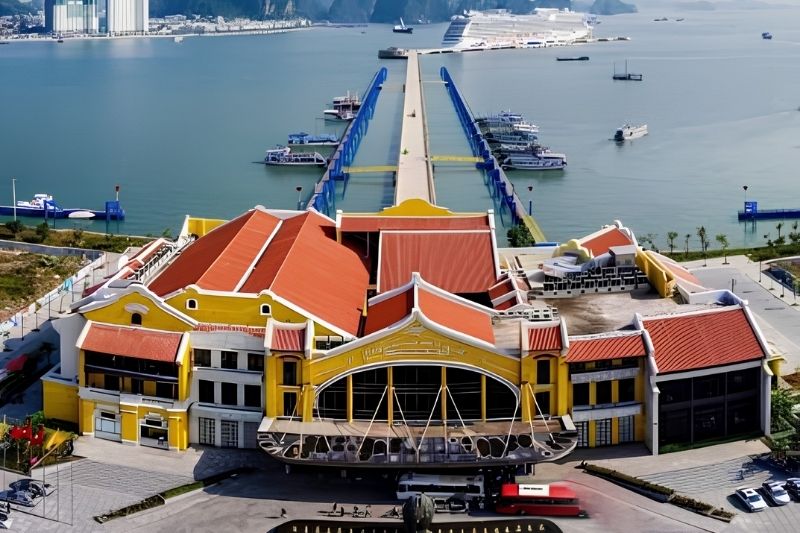
Cruise passengers should tell the difference between a port passenger ticket and the sightseeing fee for Ha Long Bay. From July 1, 2026, passengers using Ha Long International Passenger Port pay 80,000 VND per person for a return journey or 40,000 VND for one way. This is a port passenger fee rather than the sightseeing entrance fee for a particular bay route. The change was announced by Ha Long International Passenger Port, according to halongbay.com.vn.
Ha Long Bay sightseeing fees depend on the route. Published fees are 250,000 VND per person for VHL1 and VHL2, 200,000 VND for VHL3 and VHL4, 150,000 VND for VHL6 and 600,000 VND for VHL7. VHL8, the coastal route connecting Tuan Chau and Ha Long International Cruise Port, is listed at 70,000 VND.
Whether these fees are already included depends on the cruise or tour package, and the answer changes the total Halong Bay cost.
The drive from Hanoi is the same road whether the cruise sails in Ha Long Bay or in Lan Ha Bay. What changes is where passengers board and which water the boat sails in. Lan Ha Bay lies south of Ha Long Bay and east of Cat Ba Island, with the same limestone islands and far fewer boats around them.
Some Lan Ha Bay cruise departures leave from Tuan Chau, while others board from the Cat Ba side, reached on the Hanoi to Cat Ba Island route. In April 2026 a passenger service linking the two bays began operating, under a cooperation framework between Quang Ninh and Hai Phong, so more routes now cross between them. Check the cruise voucher for the exact port, the boarding time and whether the transfer is included.
The easiest way to organize your journey is to book the Hanoi transfer together with your cruise when the option is available. This allows the operator to match your pickup time to the cruise check-in schedule.
Weekends and public holidays cost more on almost every service. For the months that fill the vans first, see best time to visit Halong Bay.
If you prefer to book transport separately, consider these points:
A limousine or cruise operated shuttle sits between the public bus and a private car on both price and comfort, which is why most international visitors choose one of the two.
The easiest options are a shuttle bus, limousine van or private car. Most road journeys take around 2.5 to 3.5 hours depending on traffic and the exact departure point.
The road distance is approximately 165 km from central Hanoi to Ha Long City.
A private car or limousine generally takes around 2.5 to 3 hours, while public buses can take longer because of additional stops.
A local bus is generally the cheapest option, from 120,000 VND. However, you may need a taxi from the bus station to your hotel or cruise port.
Yes. Both local buses and tourist shuttle services operate on the route. Tourist shuttles are generally more convenient for cruise passengers because they can offer direct pickup and port drop off.
No. There is currently no direct passenger train option for travelers heading to a Ha Long cruise. Road transport is the practical choice.
No. There is no regular commercial flight between Hanoi and Ha Long. The former Halong Bay sightseeing seaplane service stopped operating from April 1, 2026.
Yes. A private taxi or pre-booked car can take you directly from Hanoi to Ha Long. This is particularly convenient for families and groups.
Most visitors choose a limousine or cruise shuttle, which sits between the public bus and a private car on price and comfort. A private car suits families or groups that want a flexible schedule.
Yes. The journey is short enough for a day trip, although the combined road travel and cruise schedule makes for a long day. A Halong Bay overnight cruise is a better option if you want more time on the bay.
Ha Long
There is no airport in Halong City. Travelers fly into Van Don, Cat Bi or Noi Bai and continue by road, about 35 minutes to 3 hours.
 Ha Long
Sapa to Halong Bay is about 475 km and 8 to 10 hours by road. Compare direct sleeper buses, trains via Hanoi and private cars, with times and fares.
 Ha Long
Ninh Binh to Halong Bay: distance, travel time and transport options by bus, train, private car and motorbike, with timing for cruise check in.
 Ha Long
Nine Halong Bay beaches compared: Ti Top, Bai Chay, Tuan Chau, Soi Sim and the outer islands, with where to swim, what it costs and when to go.
 Ha Long
Bai Tho Mountain in Ha Long: a 168 m peak with royal poems carved in 1468, closed to climbers since 2017, with a pagoda and temple at its base.
 Ha Long
Best time to visit Halong Bay: March to May and September to November. Weather by month, sea temperature, rainy days, storm season and busy periods.
 Ha Long
Dau Go Cave in Halong Bay: a three-chamber cave on Dau Go Island, entered on the route VHL1 ticket at 250,000 VND, with 90 steps and the wooden stakes legend.
 Ha Long
Halong Bay with kids: which ages suit a day tour or cruise, how child fares and the sightseeing ticket work, family cabins and safety checks.
 Ha Long
Halong Bay packing list: what to bring for a day trip or cruise, what to wear by season, luggage limits, plug type and the plastic ban.
 Ha Long
Discover how to practice responsible travel in Halong Bay, from the bay's single-use plastic ban to supporting local communities on a sustainable cruise.
