Dau Go Cave, also called Hang Dau Go or Driftwood Cave, is a limestone cave on Dau Go Island in the west of Halong Bay. Its mouth sits about 27 meters above sea level, at the top of roughly 90 stone steps. Inside are three linked chambers, and entry is covered by the route VHL1 sightseeing ticket together with nearby Thien Cung Cave.
Dau Go Cave quick facts
Quick fact
Details
Location
Dau Go Island, west of the Ha Long Bay heritage zone, Quang Ninh Province
Neighbor
Thien Cung Cave, a few minutes on foot on the same island
Size
About 5,000 square meters, in three chambers
Climb
About 90 stone steps, with handrails on the steeper sections
Ticket
Route VHL1, 250,000 VND per person for a day visit, covering both caves
Dau Go Cave sits on Dau Go Island, in the western part of the Ha Long Bay heritage zone. Thien Cung Cave is on the same island, a short walk from the Dau Go landing. Boats reach the island from Tuan Chau Harbor and from Ha Long International Cruise Port in Bai Chay. Published distances range from about 4 to 8 kilometers, depending on which pier is measured.
The cave covers about 5,000 square meters and is divided into three main chambers. In 2016, Ha Long City began repairs to the walkways and railings inside, after nearly 20 years of tourist use.
How to get to Dau Go Cave
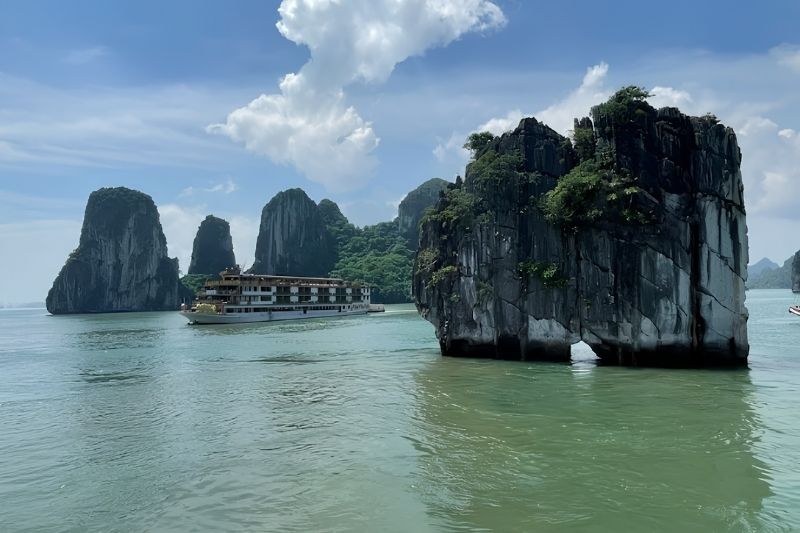
Boats to Dau Go Cave leave from Tuan Chau Harbor and from Ha Long International Cruise Port. The crossing takes about 30 to 45 minutes on a wooden tourist boat, past limestone islands. The cruise port is on the Bai Chay Ha Long side of the city, where most hotels are located.
The route VHL1 ticket is sold at the port on the day of travel, so it does not need to be booked ahead. Travelers on a package tour usually have the ticket included in the price.
What do Dau Go Cave tickets cost?
Dau Go Cave does not have a ticket of its own. Entry is part of sightseeing route VHL1, which costs 250,000 VND per person for a day visit and covers both Dau Go Cave and Thien Cung Cave, along with the islets on the route. The fee pays for sightseeing only, not for the boat.
Ticket
What it covers
Fee
VHL1, day route
Thien Cung Cave, Dau Go Cave and the route 1 islets
250,000 VND
VHL2, day route
Sung Sot Cave, Ti Top Island, Luon Cave and the route 2 stops
250,000 VND
VHL7
Routes 1 to 4 on exploration cruises
600,000 VND
Exemptions and reductions
Free for children under 1.2 meters tall or under 7 years old
20% reduction for children aged 7 to under 16
Fees are set by the Ha Long Bay Management Board and published on halongbay.com.vn. Prices in this table were checked in November 2026.
Most visitors see Dau Go Cave as part of a route VHL1 boat trip, and package prices vary by boat, group size and meals. The full Halong Bay cost, with transfers, boats and meals, is broken down item by item.
Where does the name Dau Go come from?
The name Dau Go is usually read as wooden stakes or driftwood. Two local explanations exist, and Vietnamese sources record both without settling on one.
The wooden stakes story
Local tradition says the forces of General Tran Hung Dao stored ironwood stakes in the cave during the wars against the Mongols in the 13th century. The stakes were later driven into the bed of the Bach Dang River to trap the enemy fleet at low tide, and leftover pieces of wood gave the cave its name.
Another reading treats the name as a worn form of Hang Giau Go, the hidden wood cave. The stakes story is tradition rather than record. No excavation has linked timber in the cave to the 1288 battle, and the Bach Dang battlefield lies well to the west.
What the French called it
French visitors in the colonial period called the cave Grotte des Merveilles, the cave of marvels. The name still appears in older French and English sources.
King Khai Dinh and the stone stele
King Khai Dinh visited Dau Go Cave in 1918 and wrote verses praising it. A stone stele carrying his poem in Han Nom script stands near the cave entrance. Some travel pages give 1917 or 1929 for the visit, but Vietnamese press reports use 1918.
Several English pages call Dau Go the largest cave in Ha Long Bay. Its quoted area of about 5,000 square meters is smaller than the figures usually given for Sung Sot Cave and Thien Cung Cave.
The three chambers inside Dau Go Cave
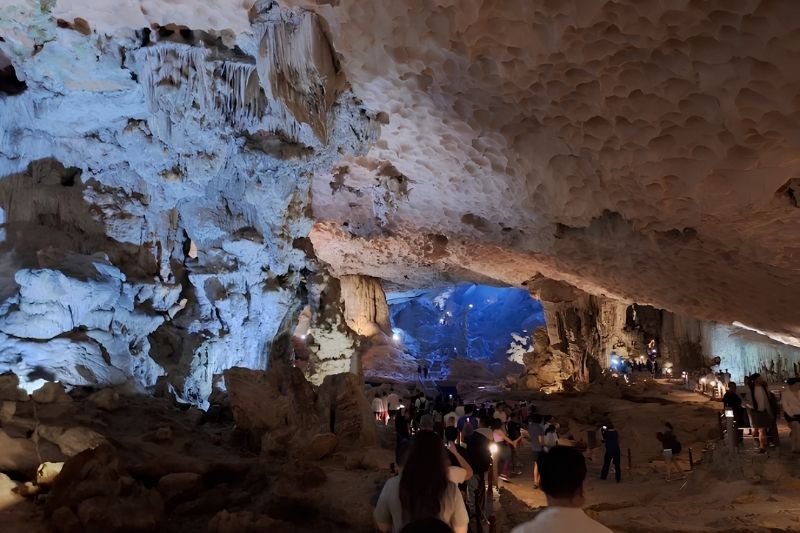
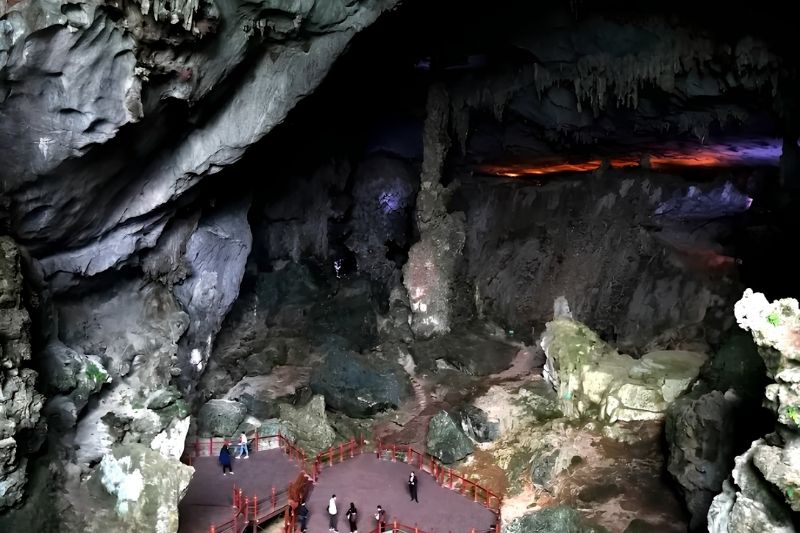
Swallows nest in the rock above the entrance. Inside, Dau Go Cave has three chambers, and the light drops from one chamber to the next.
The first chamber and its daylight
The first chamber is the largest, with a ceiling up to about 25 meters high. Daylight reaches it through the wide mouth. Guides point out stalactites and stalagmites shaped like lions, turtles and fighting cocks.
The second chamber and its narrow passage
A narrow passage about 1.4 meters wide leads into the second chamber. Daylight fades here, and the walkway relies on electric lighting. Stalactite curtains hang from the ceiling.
The third chamber and the freshwater well
The third chamber holds a small freshwater well that local guides say stays clear all year. The air in this chamber is cooler than outside.
Dau Go Cave compared with Thien Cung Cave
Thien Cung Cave is the brighter show, and Dau Go Cave is the more natural one. Thien Cung uses strong colored lighting on its formations. Dau Go takes daylight through its wide mouth and uses less artificial light deeper inside. Both caves are on the same route VHL1 ticket, so most boats stop at both.
Dau Go Cave
Thien Cung Cave
Island
Dau Go Island
Dau Go Island, a short walk away
Quoted size
About 5,000 square meters
Larger than Dau Go Cave
Lighting
Daylight in the first chamber, electric light further in
Strong colored lighting
Freshwater well
Yes, in the third chamber
No
Ticket
Route VHL1
Route VHL1
Guides often take groups to Thien Cung Cave first, and the order depends on the boat. Other Halong Bay caves on the main routes include Sung Sot Cave, Luon Cave and Me Cung Cave.
Does Beka Travel run tours to Dau Go Cave?
No. Beka Travel does not sell trips on route VHL1, so Dau Go Cave and Thien Cung Cave are not on its itineraries. Travelers who want to see this cave need a boat that runs route VHL1 from Tuan Chau Harbor or Bai Chay. Beka Travel sells trips on route VHL2 and in Lan Ha Bay to the south.
On route VHL2, the Halong Bay Day Tour from Hanoi costs $34 per adult and visits Sung Sot Cave, Luon Cave and Ti Top Island, with kayaking included.
For an overnight trip in Lan Ha Bay, Beka Travel also sells Heritage Cruises Binh Chuan, a partner cruise from $212 per person.
Travelers looking for a quieter bay can compare Halong Bay vs Lan Ha Bay. Lan Ha Bay has fewer boats on the water than the main Ha Long routes.
Travel tips for visiting Dau Go Cave
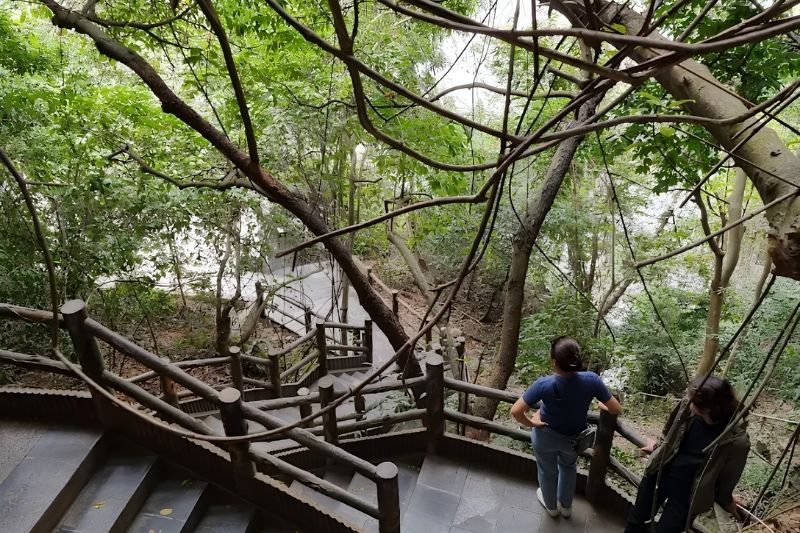
Effort: the cave entrance is about 90 stone steps above the boat landing. There are handrails, but the steps are steep, and the cave is not suitable for wheelchairs or strollers.
Time: allow 40 to 45 minutes for the three chambers, or about 90 minutes for both caves. Boats tend to arrive together in mid-morning.
What to wear: the steps are damp stone, so wear shoes with good grip and light clothing.
Best time: spring and autumn usually bring calmer seas and clearer views. Check the Halong Bay weather before choosing a date.
What to bring: a passport or ID for harbor check-in, sunscreen, insect repellent and a power bank.
Protection rules: do not touch or break the stalactites. Single-use plastic has been banned on tourist boats in the bay since 2019.
Since 2023, the UNESCO World Heritage listing has covered Ha Long Bay and the Cat Ba Archipelago as one site, as shown on whc.unesco.org.
Nearby attractions on the route
Dau Go Cave sits close to other well-known stops in Ha Long Bay.
Thien Cung Cave: on the same island, a few minutes on foot, known for large stone pillars and colored lighting.
Sung Sot Cave: on Bo Hon Island on route VHL2, one of the largest caves in the bay.
Me Cung Cave: on route VHL2, an archaeological site with traces of prehistoric settlement.
Frequently asked questions
Do you need separate tickets for Dau Go Cave and Thien Cung Cave?
No. Dau Go Cave and Thien Cung Cave are both covered by the route VHL1 ticket, which costs 250,000 VND per person for a day visit. Neither cave sells a ticket of its own, so there is nothing extra to pay at the second cave.
How many steps lead up to Dau Go Cave, and how hard is the climb?
About 90 stone steps lead from the boat landing to the cave mouth, with handrails on the steeper sections. The stone stays damp most of the year, and the way down is where people slip. Shoes with good grip matter more than fitness. Strollers and wheelchairs cannot make the climb.
How long does it take to visit Dau Go Cave?
About 40 to 45 minutes for the three chambers. A visit to Dau Go Cave and Thien Cung Cave together takes about 90 minutes ashore, including the steps up and down.
Is Dau Go Cave worth visiting if you have already seen Sung Sot Cave?
Yes, for a different experience. Sung Sot Cave is larger and sits on route VHL2, so the two caves rarely fit into one day. Dau Go Cave offers daylight in its first chamber, less artificial lighting and the wooden stakes legend.
Why is it called the wooden stakes cave?
Local tradition says the forces of General Tran Hung Dao stored ironwood stakes here before the Bach Dang River battle of 1288. A second reading treats the name as a worn form of Giau Go, meaning hidden wood. Vietnamese sources carry both versions.
Can you visit Dau Go Cave on a day trip from Hanoi?
Yes. The road from Hanoi to Ha Long takes about 2.5 to 3 hours, and a route VHL1 boat trip takes about 4 to 6 hours on the water. Many Hanoi day tours run route VHL2 instead, so check that the itinerary names Dau Go Cave before booking.
Planning the rest of a Halong Bay trip
Dau Go Cave combines a large daylit chamber with one of the best-known legends in Ha Long Bay. Most visitors see it together with Thien Cung Cave and the islets of route VHL1 in half a day on the water.
Day trips and cruises that Beka Travel sells on route VHL2 and in Lan Ha Bay are listed under Halong Bay boat tours.
There is no airport in Halong City. Travelers fly into Van Don, Cat Bi or Noi Bai International Airport and continue to the bay by road. Van Don is the closest at about 53 km, Cat Bi offers strong connections from Hai Phong, and Noi Bai has the widest range of international flights, with the road transfer taking 35 minutes to 3 hours depending on the airport.
Discover how to practice responsible travel in Halong Bay, from the bay's single-use plastic ban to supporting local communities on a sustainable cruise.



 Ha Long