



 Cat Ba - Lan Ha Bay
Monkey Island Cat Ba: What to Know Before You Go
Monkey Island Cat Ba in Lan Ha Bay: how to get there, what the monkeys are like, the viewpoint hike and which Beka tours stop there.
Trung Trang Cave is open again and receiving visitors as normal.
Last updated: 14 September 2026
Trung Trang Cave is an ancient underground cave and one of the largest and most well known caves in the Cat Ba archipelago. It is a major draw for visitors, welcoming tens of thousands of local and international travelers every year. Read on for everything you need to know about Trung Trang Cave before you visit.
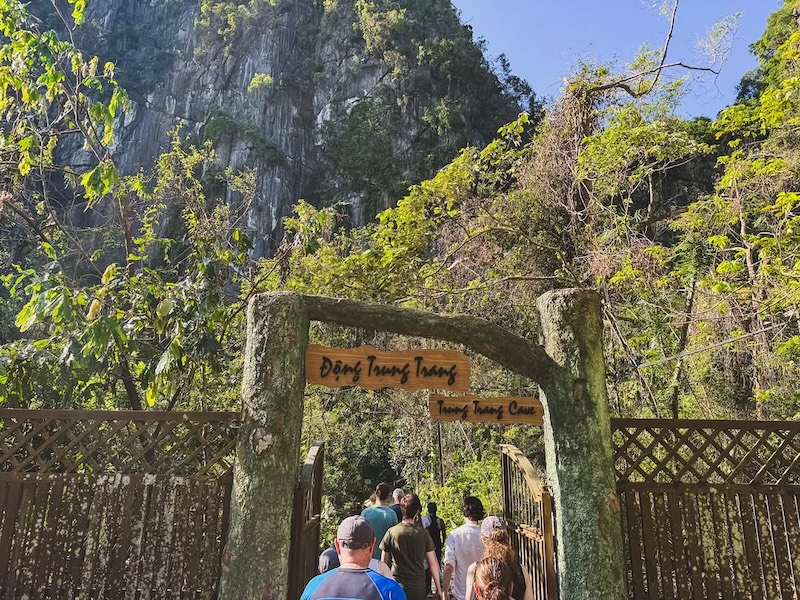
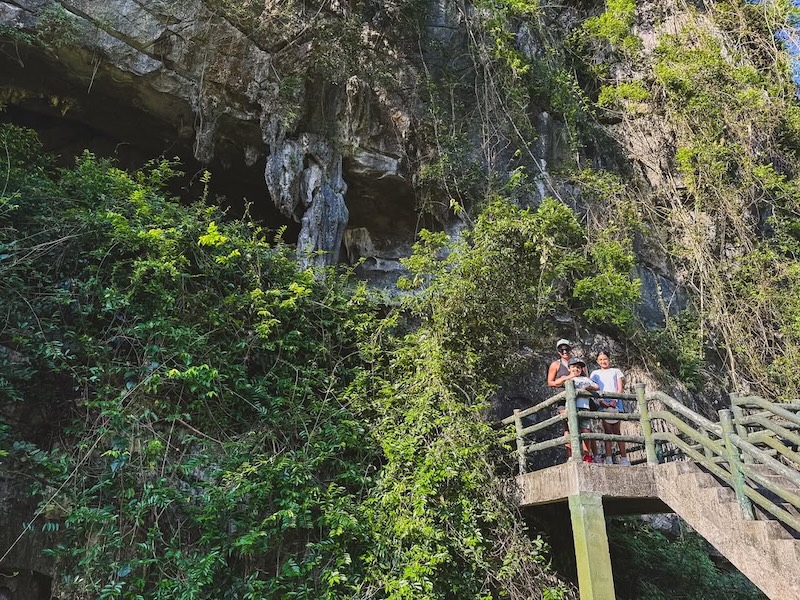
The cave is located about 12 km from the Cat Ba tourist center, and about 1 km south of the Cat Ba National Park headquarters, right beside the road that leads into Cat Ba town. From the park headquarters, it is only about a 10 minute walk. You will see other numbers online, some say 15 km from town, which likely comes from measuring a different starting point. If you are planning your visit around the national park, the distance from the park headquarters is the one to trust.
Most visitors rent a motorbike in Cat Ba town and ride there themselves, since the road is flat and easy to follow the whole way. If you would rather not drive, a taxi from town costs about 350,000 to 400,000 VND one way and takes around 30 minutes.
There is a small parking area at the cave. Parking costs 5,000 VND for a motorbike and 10,000 VND for a car, so keep a little small cash on hand.
Entry to Trung Trang Cave is included in the Cat Ba National Park ticket, which costs about 160,000 VND per adult. The cave is normally open daily from 8:00 in the morning to 5:00 in the afternoon, and most visitors spend between 30 minutes and an hour walking through, depending on how many stops they make to look at the formations.
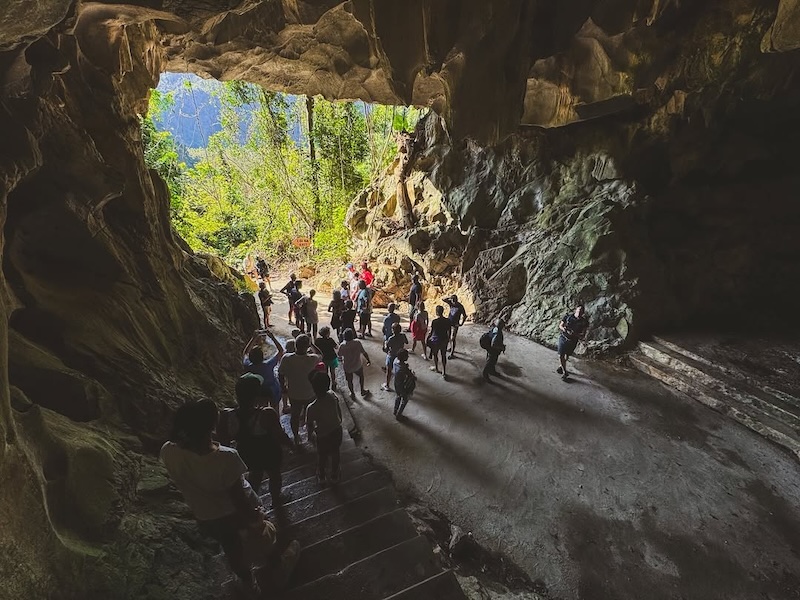
Stepping through the entrance, visitors are struck not only by the beauty of the cave and the strange, wonderful way nature has shaped it, but also by a legend tied to both the cave and the island of Cat Ba itself.
The story goes that Cat Ba was once a beautiful archipelago and a strategically important stronghold, which is why foreign invaders tried to seize it again and again. To defend the homeland and protect the people of the island, a lady known as Lady Trung Trang called on the young men of the island to take to the sea and drive the enemy away. After she had helped the islanders defeat their enemies, Lady Trung Trang came to settle in this very cave, where she meditated and continued to watch over and protect the island so its people could live in peace. From then on, the people of the island named the cave after her, and it has been known as Trung Trang Cave ever since.
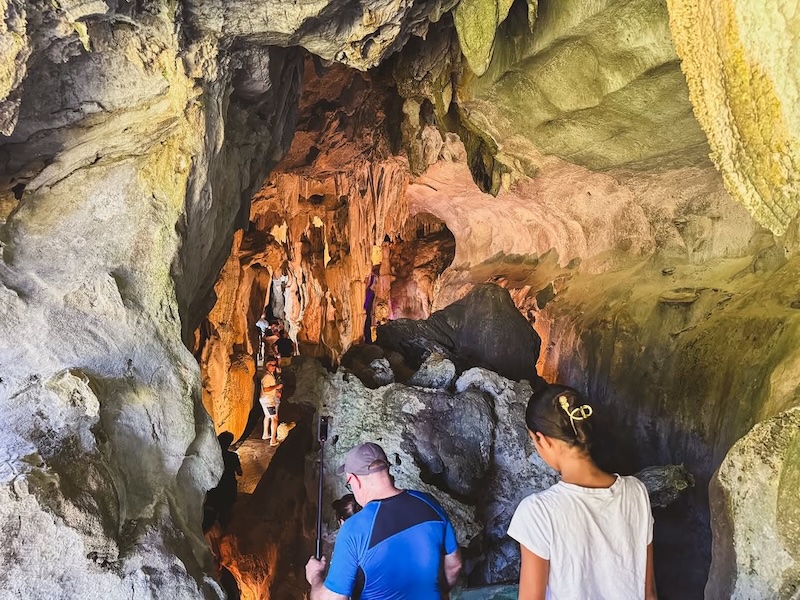
The walk through Trung Trang Cave feels like moving from one legend to the next, since almost every formation along the way has a story attached to it.
Right at the entrance, visitors come face to face with a rock formation shaped like a young woman leaning into the cave wall, and nearby is a formation shaped like a giant python. Legend says this is the sacred creature Lady Trung Trang placed here to guard the entrance.
A little further in, the cave opens into a chamber legend calls Lady Trung Trang's treasure room, with stalactites shaped like columns of gold and silver and a hoard of glittering diamonds. Look closely and you can pick out shapes said to resemble the eagle that stole the princess in the folk tale of Thach Sanh, the cranes engraved on the Dong Son bronze drum, and a black stone turtle known as Hac Quy, said to be one of the lady's soldiers. A golden furred lion formation nearby is said to be the guardian watching over the treasure.
Past the treasure chamber, the cave opens into vast domed ceilings woven together with narrower passages, so the walk starts to feel like moving through a maze. Toward the middle, keep an eye out for a formation said to trace the shape of Vietnam and the Cat Ba islands, followed by shapes that visitors compare to an ancient mummy and a pool with a crocodile in it. A cluster of rock formations nearby rings out gentle tones when tapped, much like a simple stone instrument. Two narrow passages here are known locally as the road to heaven and the road to the underworld, and one large chamber holds strange marks on the wall said to be handprints and footprints from where the lady once practiced her martial arts.
Near the end of the walk is a formation shaped like the Cat Ba langur, a creature found only on this island and nowhere else in the world. Beside it is what legend calls the lady's sacred sword, said to be passed down to protect Cat Ba for generations to come. Near the cave mouth stands a small shrine to the lady of the cave, with an elephant and a snake standing guard on either side.
Part of what makes the walk so memorable is the play of light inside. In places where narrow gaps reach up to the surface, natural light slips through and creates a striking pattern of light and shadow along the walls, and where a flashlight catches the stalactites directly, the mineral surfaces seem to sparkle.
The cave is also home to more than bats. Beetles and spiders have made a home in the cracks of the rock, and moss, lichen and several kinds of fungi thrive in the cool, damp air throughout the cave.
Trung Trang Cave carries more than one name, and each one comes from its own piece of history. Local people often call it Bat Cave, because thousands of bats, of several different species, live inside. During the resistance war against America, a communications unit from the naval command used the cave to house radio equipment and to station troops between 1964 and 1968, which is why it is also known as Navy Cave. Traces of that time remain inside today, including a water tank and a room once used for meetings and cultural gatherings for the soldiers stationed there.
Trung Trang Cave, together with a number of other caves in the area, has also yielded traces of ancient Vietnamese people who lived on the island more than 6,000 years ago, in places such as the Cai Beo site, Eo Bua cave and Tien Duc cave.
Trung Trang Cave took shape over tens of millions of years, as underground water moved through cracks in the limestone and slowly wore the rock away, leaving behind the stalactites and stalagmites you see today. It is a slow process, with stalactites usually growing about 0.13 mm a year, though in spots with more mineral rich water that can reach up to 3 mm a year. The Cat Ba National Park website notes that weathering from seawater played a part too, over that same span of millions of years.
Light inside the cave is limited, so bring a flashlight or a headlamp rather than relying on your phone. Wear hiking shoes with good grip, since the path can be slippery, and pack a light jacket, because the air inside stays noticeably cooler than outside even though it is humid. Carry drinking water and a small snack for the walk.
If you are not used to exploring caves, it is worth hiring a local guide, both for safety and to hear the stories behind each formation as you go. Please help protect the cave for the next visitor too, by taking your rubbish with you and not touching the stalactites and stalagmites, since they are fragile and take years to form.
Trung Trang Cave is located so close to the national park headquarters that it pairs naturally with a morning of hiking. Start early at the Cat Ba National Park entrance, walk the short trail to the cave first while the air is still cool, then continue on to one of the park's hiking routes such as the trail to Ngu Lam peak.
By early afternoon you can be back at the park entrance and ready to head to the coast, whether that means a swim at one of the Cat Ba beaches or a Cat Ba boat tour in Lan Ha Bay.
Yes. Trung Trang Cave reopened in September 2026 and is receiving visitors as normal. Opening hours are 8:00 to 17:00.
Most visitors rent a motorbike and ride there themselves. A taxi costs about 350,000 to 400,000 VND one way and takes around 30 minutes from Cat Ba town.
Entry is included in the Cat Ba National Park ticket, which costs about 160,000 VND per adult.
The cave normally opens daily from 8:00 in the morning to 5:00 in the afternoon.
Most visitors take 30 minutes to an hour, depending on how many stops they make along the way.
It is about 12 km from the Cat Ba tourist center, but only about 1 km, or a 10 minute walk, from the Cat Ba National Park headquarters.
Local legend says Lady Trung Trang led the island's people to fight off invaders, then came to rest and meditate inside this cave. The people of Cat Ba named the cave after her in gratitude.
You do not need one, since the path is paved and lit, but a local guide is worth hiring if you are new to caves or want to hear the stories behind the formations as you walk.
Ready to explore more of Cat Ba Island? Plan the rest of your trip with our other guides at Beka Travel.
Cat Ba - Lan Ha Bay
Monkey Island Cat Ba in Lan Ha Bay: how to get there, what the monkeys are like, the viewpoint hike and which Beka tours stop there.
 Cat Ba - Lan Ha Bay
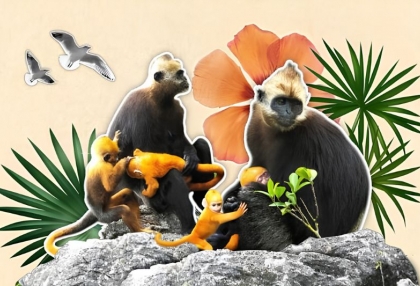
Around 90 Cat Ba langurs remain in the wild, all on one island. What they are, why sightings are rare, and how to visit responsibly.
 Cat Ba - Lan Ha Bay
The Cat Hai to Phu Long cable car crosses 3,955 meters of open water in 10 to 15 minutes, from about 08:30 to 15:45. Route, ticket prices and tips.
 Cat Ba - Lan Ha Bay
Beyond trekking and kayaking, Cat Ba Market is a must-visit destination to experience the authentic local lifestyle. It is the culinary heart of the island, where you can find the freshest seafood and traditional products of the Hai Phong port region.
 Cat Ba - Lan Ha Bay
How to get to Cat Ba Island from Hanoi, Hai Phong, Ha Long, Ninh Binh, Sapa and Ha Giang, comparing buses, ferries, the cable car and 2026 prices.
 Cat Ba - Lan Ha Bay
Complete 2026 guide to the Tuan Chau to Gia Luan ferry. Find updated schedules, ticket prices, transport from Gia Luan to Cat Ba Town, and expert travel tips.
 Cat Ba - Lan Ha Bay
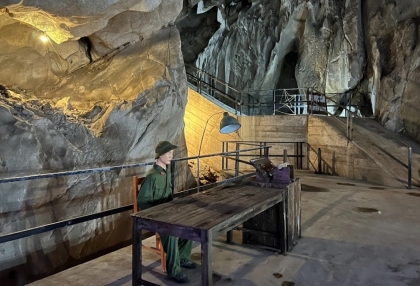
Discover Hang Quan Y (Military Hospital Cave) on Cat Ba Island. Learn about its wartime history, the 3-level concrete bunker, entrance fees, and how to get there.
 Cat Ba - Lan Ha Bay
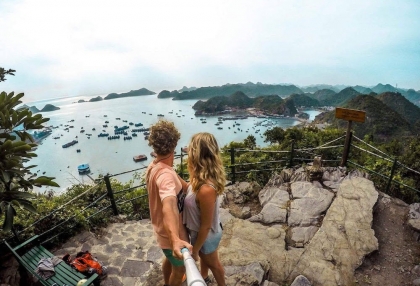
Cannon Fort on Cat Ba Island is currently closed to visitors, with no official ticket sold. History, location, and what to see instead in 2026.
 Cat Ba - Lan Ha Bay
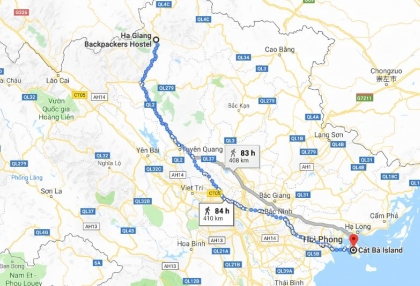
There is no direct bus from Ha Giang to Cat Ba Island. See the Palace Cabin bus via Hanoi, journey time, prices and pickup points for 2026.
 Cat Ba - Lan Ha Bay
There is no direct bus from Sapa to Cat Ba Island. Compare the overnight sleeper and daytime bus routes via Hanoi, with 2026 prices and timing.
