




 Cat Ba - Lan Ha Bay
Monkey Island Cat Ba: What to Know Before You Go
Monkey Island Cat Ba in Lan Ha Bay: how to get there, what the monkeys are like, the viewpoint hike and which Beka tours stop there.
Cannon Fort, also known as Entrenched Fortification 177, is one of Cat Ba Island's best-known historical landmarks. However, Cannon Fort is not open to visitors in 2026, because the hill it stands on is a military area, and there is no official ticket or confirmed reopening date. You can still learn about its wartime history, see the hill from the outside, and visit nearby viewpoints for similar panoramic views. The same limestone islands can also be seen from the water on a Cat Ba boat tour.
This Cannon Fort Cat Ba guide covers the closure and what it means for your plans, what remains inside the site, where to find the same view now, and how to build a day around the island's other historical places.

No. Cannon Fort is closed to visitors in 2026 because High Point 177 is a military area, and that is the reason no reopening date has been announced. Ticket sales have ended and the site no longer receives tourists, so there is currently no entrance fee to pay. The fort is still standing above Cat Ba Town, protected as a military relic under local heritage management, but the ground it covers is not open to the public.
Cannon Fort Cat Ba Island stands on High Point 177, a hill rising approximately 177 meters above sea level directly behind Cat Ba Town. The approach runs from the town area up Cai Beo Street, and the elevated position is what gave the fort its wide views over the town, the harbor, the Cat Co beaches and the limestone islands of Lan Ha Bay.
Before the closure, visitors reached the entrance on foot, by motorbike, by taxi or by xe om. Today the barriers mark the edge of a military area, so do not attempt to pass them or enter restricted ground, whatever anyone at the bottom of the path tells you.
Although you cannot currently enter the fort cannon Cat Ba complex, knowing what remains inside explains why the site matters. Cannon Fort was developed as a strategic coastal defense position during the 1940s and later played a role in the conflicts involving French and American forces, and it still preserves artillery positions, tunnels, bunkers and observation structures.
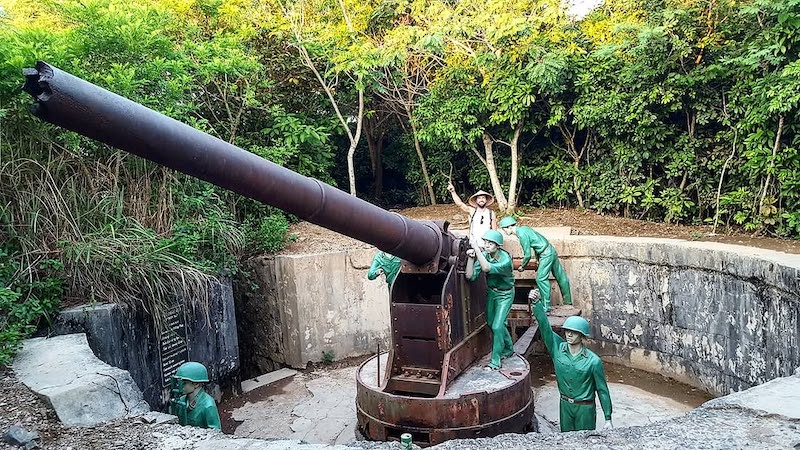
The two large coastal artillery guns are the most recognizable relics at Cannon Fort. Each is a substantial installation, positioned to control the sea approaches to the archipelago rather than to defend the town behind them.These guns became one of the defining images of Cat Ba Cannon Fort, together with the panorama from the hilltop, and both are still in place at the site.

The observatory was built at the highest point of the fort, giving soldiers a clear line of sight over the surrounding waters and the approaches to Cat Ba. When the site was open, this was also where most visitors stopped longest, looking out across the Cat Ba Archipelago and Lan Ha Bay.
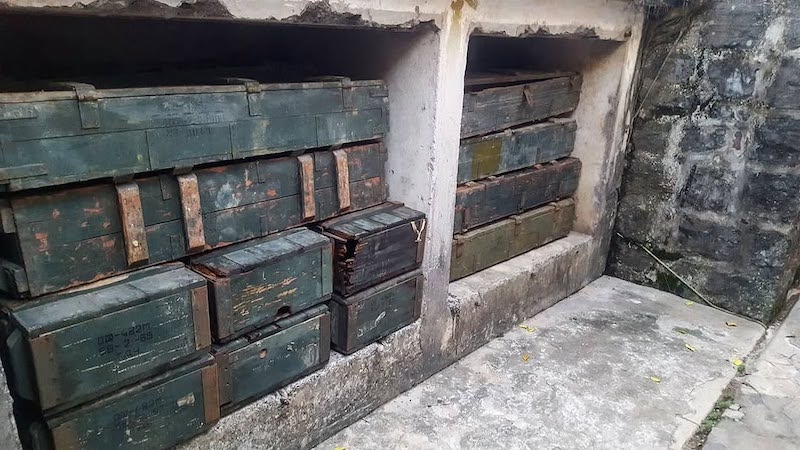
Concrete bunkers and underground structures formed the working core of the defensive network, providing protected shelter and command space during wartime. The blockhouses, battlefield bunkers and tunnels cut into the mountain have held up remarkably well after decades of sea air and monsoon rain.
The traditional room displayed historical objects connected with the island's wartime years, including military equipment, models, weapons and other memorabilia. It gave context to the concrete structures outside, which is harder to appreciate without knowing how the position actually operated.
The Love Room offered a more personal view of military life, associated with soldiers' reunions with the people waiting for them. It is a reminder that the fort was not only weapons and concrete, and it was often the part of the visit people remembered afterward.
The tunnel system is the most interesting feature of the Cannon Fort Cat Ba Island complex. Concrete passageways connect the different parts of the position and run deeper into the hill, linking the gun emplacements with the bunkers and the observation points above.
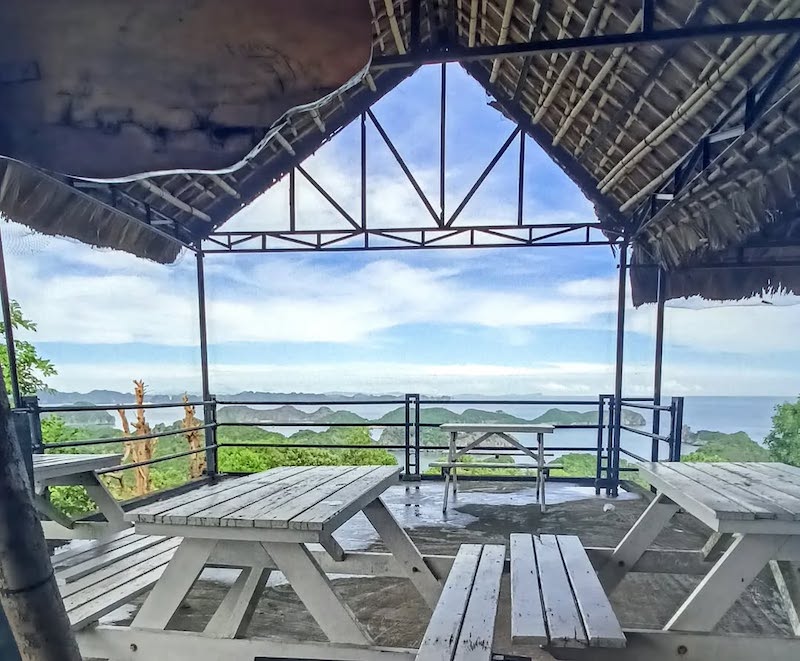
Fort Coffee was once a popular stop, because visitors could sit with a drink and the full panorama in front of them. Do not plan on a coffee there in 2026, since the cafe belongs to the period when the fort operated as an attraction and is not running while the site stays closed.
If your reason for going was the panorama rather than the military relics, the view has not gone anywhere. The closest replacement is a hilltop above the Ben Beo area that has no name and no sign, so you find it by asking people in the neighborhood rather than by looking it up. It is a proper climb and the view only opens up at the top, but from there you get the whole sweep of the town, the harbor and the bay.
Ngu Lam Peak in Cat Ba National Park is a different view rather than a substitute, because the bay is not visible from the summit at all. What opens up there is the park itself, an unbroken green canopy running over the limestone hills to the horizon, and it takes a real climb to reach. From the water, a Lan Ha Bay day tour by boat or kayak reverses the perspective completely, looking back toward the limestone hills instead of down over the rooftops.
If you want the bay and the national park in the same view, the climb to Navy Peak from Viet Hai village is the one to do. At 259 meters it looks out over Lan Ha Bay on one side and the forested interior of the park on the other, which no other viewpoint on the island manages at once.
The old radar station at the top was built in 1965 and moved in 1968. The walk starts from the village itself, so it works best as part of a day that already takes you to Viet Hai rather than as a trip on its own.

Late afternoon and the hour before sunset give the best light on Cat Ba's elevated viewpoints. The lower sun warms the color of the limestone and the water, and the town becomes more atmospheric as the light goes, which is exactly what Cannon Fort was famous for.
Do not arrive at a closed gate just before sunset expecting to get in. Check the access conditions first and head for an officially open viewpoint, because there is no second chance once the light has gone.
Two of the island's best-known historical sites are now closed, because Hospital Cave, the wartime medical facility built inside the mountain, is shut to visitors as well as Cannon Fort. Plan the day around what is still open instead, starting with Cat Ba National Park, where the natural landscape and the historical sites sit close together.
Cai Beo adds a much longer perspective, as one of the important archaeological sites tied to the island's history of human settlement, and it is still accessible from the harbor below Cannon Fort.
Few visitors know that Cat Ba has an older fortification than the one on High Point 177. Xuan Dam ancient fort, also called Thanh Don, was built in 1840 in the twentieth year of the Minh Mang reign as a military work protecting the Cat Ba waters, and it is recorded in the archives under the name Ninh Hai Bao.
The lower fort has a near-square plan of 80 by 75 meters with walls 3.35 meters thick, corner bastions projecting 14 meters, and limestone blocks fitted without any mortar that are still standing straight after nearly two centuries. Beneath it lies the Cat Don beach archaeological site, a settlement dating to the late Ha Long culture, roughly 3,500 to 4,000 years old, which Hai Phong ranked as an archaeological relic in January 2012.
No. Cannon Fort is closed to visitors in 2026 because the site is a military area, and there is no confirmed reopening date. Do not go beyond the barriers or into restricted ground.
There is no reliable evidence that the fort closed permanently in 2019. That date is repeated in older travel content, but the site continued to receive visitors after it, and the closure came later, toward the end of 2023.
There is no current entrance fee, because the site is closed. Older sources list 50,000 VND and 80,000 VND depending on the period, and neither figure is a 2026 ticket price.
Not for entry to a closed site. Since there is no official visitor ticket at present, ask your hotel or a recognized local operator to confirm whether any fee is legitimate before handing over money.
When it was open, the site included two large anti-sea cannons, observation posts, bunkers, trenches, underground tunnels and historical displays. Those relics are still what make Cannon Fort Cat Ba Island significant, but the complex cannot currently be entered.
The unnamed hilltop above Ben Beo is the closest replacement for the old Cannon Fort panorama, although it takes a climb and you will need to ask locally for the way up. Navy Peak above Viet Hai village is the only spot that shows the bay and the national park together, Ngu Lam Peak gives the forest but not the bay, and a sunset Cat Ba boat tour gives the same limestone landscape from sea level.
No. Do not count on Fort Coffee or any other service inside the fort while the site is closed. Eat or pick up a drink in Cat Ba Town before heading to an alternative viewpoint, and add one of the Cat Ba beaches to fill the rest of the day.
Cat Ba - Lan Ha Bay
Monkey Island Cat Ba in Lan Ha Bay: how to get there, what the monkeys are like, the viewpoint hike and which Beka tours stop there.
 Cat Ba - Lan Ha Bay
Around 90 Cat Ba langurs remain in the wild, all on one island. What they are, why sightings are rare, and how to visit responsibly.
 Cat Ba - Lan Ha Bay
The Cat Hai to Phu Long cable car crosses 3,955 meters of open water in 10 to 15 minutes, from about 08:30 to 15:45. Route, ticket prices and tips.
 Cat Ba - Lan Ha Bay
Beyond trekking and kayaking, Cat Ba Market is a must-visit destination to experience the authentic local lifestyle. It is the culinary heart of the island, where you can find the freshest seafood and traditional products of the Hai Phong port region.
 Cat Ba - Lan Ha Bay
How to get to Cat Ba Island from Hanoi, Hai Phong, Ha Long, Ninh Binh, Sapa and Ha Giang, comparing buses, ferries, the cable car and 2026 prices.
 Cat Ba - Lan Ha Bay
Complete 2026 guide to the Tuan Chau to Gia Luan ferry. Find updated schedules, ticket prices, transport from Gia Luan to Cat Ba Town, and expert travel tips.
 Cat Ba - Lan Ha Bay
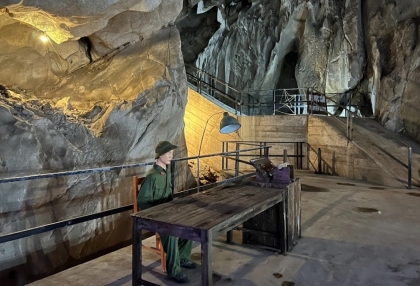
Discover Hang Quan Y (Military Hospital Cave) on Cat Ba Island. Learn about its wartime history, the 3-level concrete bunker, entrance fees, and how to get there.
 Cat Ba - Lan Ha Bay
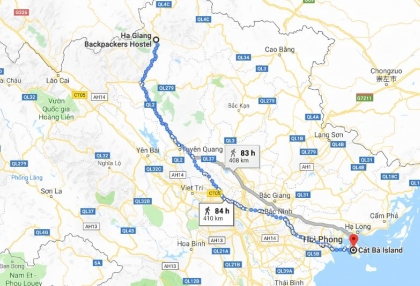
There is no direct bus from Ha Giang to Cat Ba Island. See the Palace Cabin bus via Hanoi, journey time, prices and pickup points for 2026.
 Cat Ba - Lan Ha Bay
There is no direct bus from Sapa to Cat Ba Island. Compare the overnight sleeper and daytime bus routes via Hanoi, with 2026 prices and timing.
 Cat Ba - Lan Ha Bay
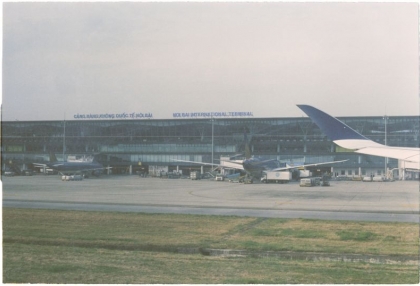
There is no direct bus from Noi Bai Airport to Cat Ba Island. Compare the private car and Hanoi bus-transfer routes, prices and 2026 timing.
