
The Cat Ba cable car is the fastest way to cross from Cat Hai to Cat Ba Island, and the only one that shows the sea, the limestone islands and the Phu Long mangroves from above. The Cat Hai to Phu Long line runs 3,955 meters and connects Dong Bai commune on Cat Hai with Phu Long commune on Cat Ba.
One change matters for trip planning. Since 1 September 2026 the cable car sells single tickets only, and the old cable car plus bus combination is no longer available, so the transfer from Phu Long into town has to be arranged separately. The sections below cover the route, the fare, the operating hours, what changed this year and the onward connection for a Lan Ha Bay cruise from Cat Ba.
Quick answer: a one-way ticket costs around 70,000 VND, the cabins run from approximately 08:30 to 15:45, and the crossing takes 10 to 15 minutes. Since 1 September 2026 tickets are sold on their own, so the transfer from Phu Long into Cat Ba Town has to be arranged separately.
Where does the Cat Ba cable car go?
The line runs between Cat Hai Station, on the mainland side close to Dong Bai and the ferry terminal, and Phu Long Station on the western side of Cat Ba Island. It is a three-rope sea-crossing system, which is what allows a span of this length over open water.
The point most travelers miss is that a cable car to Cat Ba does not reach Cat Ba Town. Phu Long is the arrival point, and a road transfer of around 30 to 40 minutes still follows, through the mangrove country the cabins pass over on the way in.
How much does a ticket cost?
A one-way ticket costs around 70,000 VND, with the same basic fare for adults and children, although prices change with the season and with promotions. Children under 1 meter have traveled free under previous policies, which is worth confirming at the counter rather than assuming.
What are the operating hours?
The published hours run from approximately 08:30 to 15:45, which is considerably shorter than the ferry timetable and often surprises travelers arriving late in the day. Times change with maintenance, weather and operating conditions.
Service can also stop temporarily when the weather turns, so a tight connection between the last cabin and a boat, a bus or a hotel check-in is risky. The operating status is worth checking before travel, particularly in the rainy season or when a storm is affecting northern Vietnam.
What changed for the cable car in 2026?
Two things changed this year, and both affect trip planning. Since 1 September 2026 the cable car is sold as a standalone ticket, so older information quoting a cable car plus bus package is out of date. The road transfer from Phu Long to Cat Ba Town is now a separate cost.
The second change works in the cable car's favor. Under Notice No. 292/TB-SXD, passenger cars and trucks were suspended on the Dong Bai ferry toward Cat Ba between 09:00 and 13:00 on weekends until 30 September 2026. The cable car was one of the alternatives the notice directed travelers to.
How long does the crossing take?
The design specification puts the crossing at 9 minutes, against roughly 20 minutes on the ferry, and that figure is what the line was built to achieve. In normal operation the ride takes closer to 10 to 15 minutes depending on conditions and the service running that day.

For planning purposes, allow around 15 minutes for the ride itself and add time for parking, tickets, boarding and sorting out onward transport at Phu Long. The theoretical journey time is the least useful number in the whole trip.
How to get to the cable car station
Coming by road on the Hanoi to Cat Ba route or from Hai Phong, travelers head for Cat Hai and Dong Bai. The road crosses the Tan Vu to Lach Huyen bridge, the main road link from the city to Cat Hai. The station is located close to the ferry terminal, so the two crossings share the same approach.
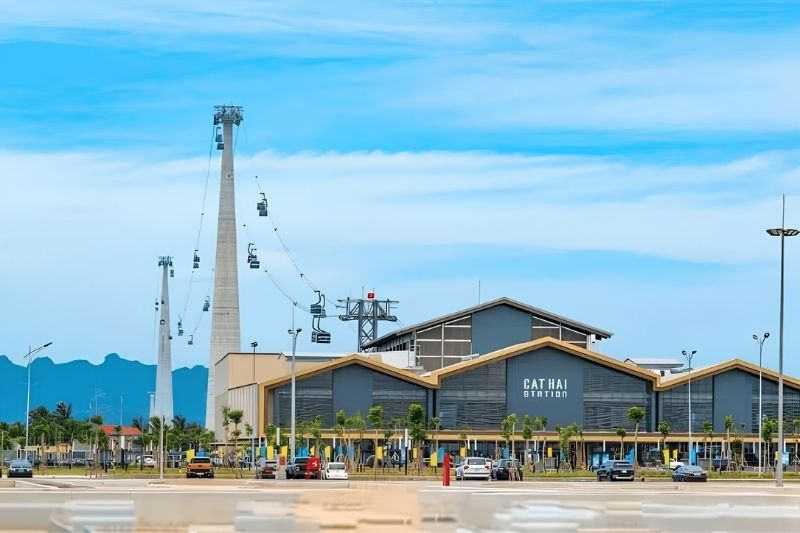
The sequence for an independent traveler is simple: drive or take a bus to Cat Hai station, cross by cable car to Phu Long, then continue by road to Cat Ba Town. Parking is available at the Cat Hai station for travelers leaving a vehicle on the mainland. Speedboat and ferry options are compared separately for the Hai Phong to Cat Ba route.
What should you know before boarding?
- Buy the right ticket: since 1 September 2026 the cable car ticket is sold on its own, so do not assume a bus transfer into town is included.
- Allow extra time: the ride is short but parking, ticketing, boarding and arranging transport at Phu Long are not.
- Check the weather: strong wind, storms or heavy rain can suspend the service for safety, and suspensions also happen for maintenance.
- Travel light where you can: normal luggage goes in the cabin, but oversized or heavy items may be handled separately or charged, so confirm the current policy first.
- Do not confuse Phu Long with Cat Ba Town: Phu Long is where you land, not where you are going.
Why take the Cat Ba island cable car instead of the ferry?
The first reason to choose the cable car over the ferry is the queue. The line was built partly to take pressure off the crossing at peak times, when vehicle lines at the ferry terminal back up along the approach road, and it bypasses that entirely.

The second is the view. From the cabin, passengers look down on the sea, the limestone islands, the fishing and aquaculture areas and the mangrove forest around Phu Long, a view the ferry does not offer. The third is comfort for anyone traveling without a vehicle, since the car can stay on the Cat Hai side while its passengers cross.
Is the cable car better than the ferry?
The cable car to Cat Ba Island wins for a quick, comfortable crossing with a view, particularly for passengers traveling without a vehicle and on a busy weekend when the ferry queue is long.
The ferry wins the moment a car or motorbike is involved, because the cable car carries people rather than road vehicles, and it wins again on operating hours, running early and late in a way the cable car does not. The cable car suits speed and the view, while the ferry suits vehicles and flexibility. Cable car hours are worth checking against the arrival time before choosing.
When did the Cat Ba cable car open, and who built it?
The cable car to Cat Ba Island opened on 6 June 2020, developed by Cat Ba Sun Company under Sun Group and built by the Austrian ropeway specialist Doppelmayr Garaventa. The Cat Hai to Phu Long section has 60 cabins carrying up to 30 passengers each, runs at a maximum speed of 8 meters per second, and moves around 4,500 passengers an hour.

It is one part of a larger Cat Ba cable car system planned to total 19.5 km. The engineering feature it is known for is the 214.8-meter pylon, recognized by Guinness World Records as the tallest cable car tower in the world.
Frequently asked questions
Does the Cat Ba cable car run every day?
It is scheduled to run daily while the system is open, but service can be suspended temporarily for maintenance or bad weather. Check the current operating status before setting off for the station.
How long is the Cat Ba cable car?
The Cat Hai to Phu Long route is 3,955 meters long, with 60 cabins carrying up to 30 passengers each and a capacity of around 4,500 passengers an hour. It forms part of a wider system planned to total 19.5 km.
Can you bring luggage on the cable car?
Normal luggage travels with you in the cabin. Large or heavy items may be subject to separate handling rules or an additional charge, so confirm the current policy before boarding if you are carrying oversized bags.
What happens if the weather is bad?
The cable car stops when conditions could affect safety, with strong wind, heavy rain and storms the usual reasons. Check the service status before leaving for the station rather than relying on the published timetable, and keep the ferry in mind as the fallback.
How much is a Cat Ba cable car ticket?
A one-way ticket costs around 70,000 VND, with the same basic fare for adults and children. Since 1 September 2026 it is a standalone ticket, so the road transfer from Phu Long to Cat Ba Town is a separate cost.
Is the cable car plus bus combo still available?
No. Since 1 September 2026 the cable car is sold as a standalone ticket, and the combined cable car and bus product is no longer offered. Budget for the transfer from Phu Long into Cat Ba Town separately.
Does the Cat Ba cable car hold a world record?
Yes. The Cat Hai to Phu Long line carries a 214.8-meter pylon recognized by Guinness World Records as the tallest cable car tower in the world. Once on the island, Cat Ba island tours depart from Ben Beo harbor near Cat Ba Town.