




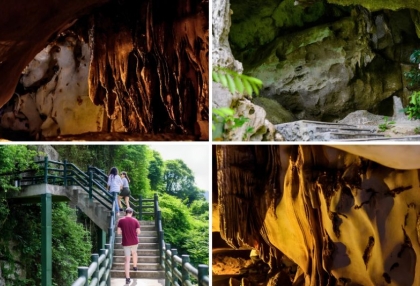
 Cat Ba
Caves and Nature in Cat Ba Island — The Complete 2026 Guide
Trung Trang Cave, Hospital Cave, Cannon Fort, Thien Long Cave and Cat Ba National Park — entrance fees, opening hours, and which one to pick if you are short on time.
Written by the Beka Travel guide team on Cat Ba Island. We walk the trans-park route to Viet Hai most weeks, so the ticket lines, the gate hours and the state of the limestone underfoot come from working days rather than from other travel blogs.
Last updated: 1 August 2026
Quick Summary: Cat Ba National Park covers 17,362 hectares of limestone forest, wetland and sea at the centre of Cat Ba Island. Gates open daily 07:00 to 17:00 and tickets run from 80,000 to 160,000 VND for adults depending on which route you walk. It is the only place on earth where the Cat Ba langur lives, and the population has climbed from about 40 in 2003 to around 90 as of October 2024.
Yes, the park is worth visiting. It covers 17,362 hectares of limestone forest, wetland and coastal water, and it sits at the core of a UNESCO Biosphere Reserve recognised on 2 December 2004. It protects the critically endangered Cat Ba langur, a primate found nowhere else. Trails range from short, easy walks to a full-day jungle trek.
Stepping inland from the island's emerald bays reveals a completely different world: a dense, ancient limestone jungle protecting rare wildlife and plant life found almost nowhere else.
Unmatched biodiversity: the park blends coastal wetlands, mangrove forests, and rugged mountain terrain into one ecosystem, home to hundreds of animal and plant species.
The Cat Ba langur: this golden-headed primate is one of the rarest animals on Earth, and the park was heavily protected specifically to save it from extinction.
The endemic Kim Giao forest: ancient groves of Kim Giao trees, a wood historically used to craft chopsticks believed to detect poisoned food for Vietnamese royalty.
The park was established on 31 March 1986 and turned 40 this year. It started at 15,200 hectares and has since grown to 17,362 hectares, of which roughly 10,912 hectares are forest and 6,450 hectares are sea surface.
The park headquarters and main gates are open daily from 07:00 to 17:00. Every visitor needs an entrance ticket, and the price depends on which route you are walking rather than on how long you stay. Buy at the gate before you start, in cash, and keep the stub with you.
| Ticket | Adult | Child |
|---|---|---|
| General park admission | 160,000 VND | 80,000 VND |
| Park centre – Kim Giao peak – Ngu Lam peak – Trung Trang cave | 120,000 VND | 60,000 VND |
| Dong Ninh Tiep – Tien Duc cave | 80,000 VND | 40,000 VND |
| Phu Long – mangrove forest – Thien Long cave | 80,000 VND | 40,000 VND |
| Motorbike parking | 10,000 VND | — |
Children under six years old, or under 1.2 metres tall, enter free. Visitors aged 60 and over, people with severe disabilities and students travelling in a school group pay half. Keep your ticket on hand if you're visiting Trung Trang cave the same day, since you may need to show it again.
These are statutory prices, not operator prices. They are set by Resolution 47/2025/NQ-HĐND of the Hai Phong People's Council, issued 10 December 2025 and in force from 1 January 2026, replacing Resolution 06/2024. Anyone quoting you a different figure at the gate is quoting the wrong document.
Two things worth budgeting for. The park ticket does not cover the bays: a day trip on the water carries its own 120,000 VND adult fee under the same resolution. And the ticket price doubled on 1 August 2024, from 80,000 VND to 160,000 VND, so older guides still quote half of what you will actually pay.
The park is open year-round, but the season changes the experience significantly. Dry months give you grip underfoot and clear views from the peaks. Wet months give you slippery limestone, leeches and a real chance of the long routes being closed for the day.
Dry season (October to April): the best window for trekking, with cool, dry, comfortable weather. November and March are especially good for long hikes, with clear skies and low humidity.
Wet season (May to September): heavy rain and humidity make the limestone paths slippery. If you hike during these months, come prepared for mosquitoes and jungle leeches.
Storm season in the Gulf of Tonkin runs June through September, and a storm closes trails as well as boat routes. Our best time to visit Cat Ba guide has the month-by-month rainfall figures if you are still choosing dates.
Whether you have two hours or a full day, the park has routes for most fitness levels. The important thing to understand is that the marked routes are not interchangeable: each one has its own gate, its own ticket price and its own terrain, so pick the route first and buy the matching ticket second.

The most popular hike in the park: a steep climb up rugged limestone steps to a 225-metre summit, rewarded with a 360-degree view over the surrounding mountains and valleys. It is the shortest way to earn a view on Cat Ba.
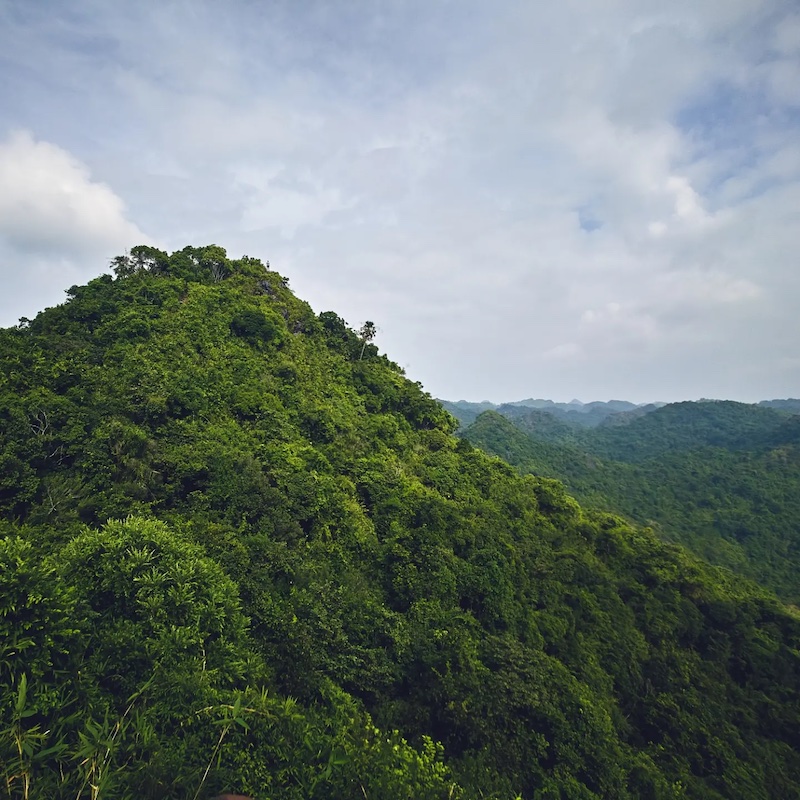
A gentle, shaded trail through the Kim Giao trees, with no strenuous elevation gain, a good fit for families or anyone wanting a peaceful walk rather than a climb. It shares a ticket with Ngu Lam Peak and Trung Trang cave.
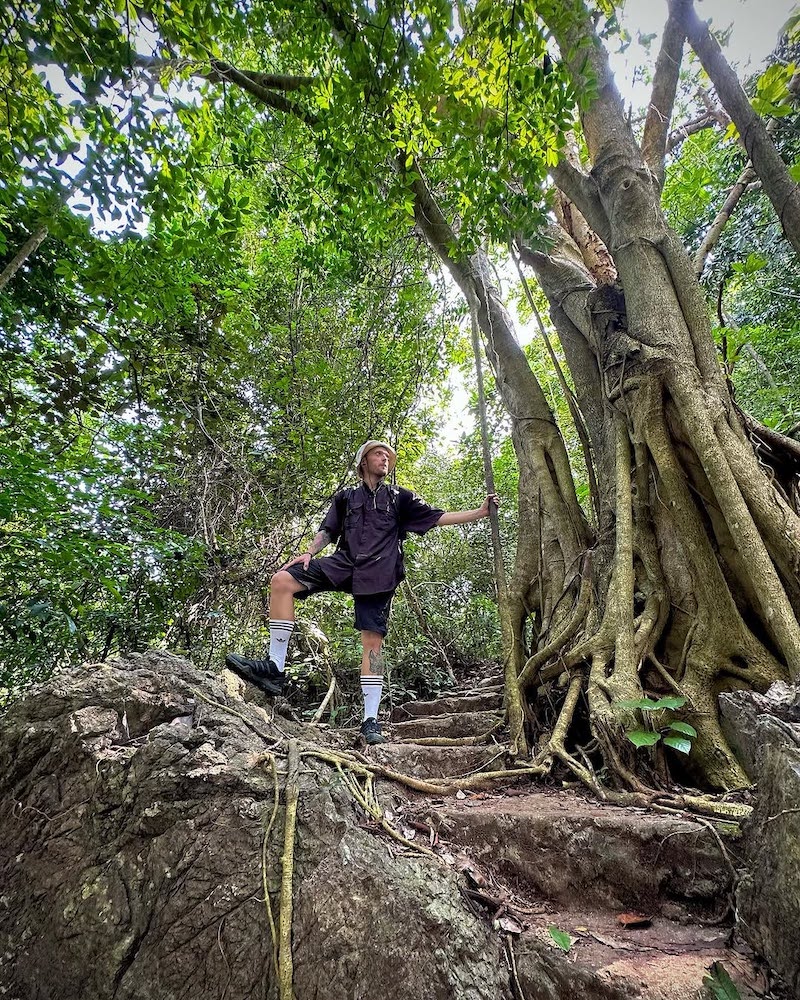
A challenging 14-kilometre, one-way route straight through the jungle core, past frog lakes and large root systems, ending at the remote Viet Hai settlement. This is the route our guided trek walks, and the boat picks you up at the village rather than making you walk back.
A short walk from the main gate leads into a 300-metre cave with visible stalactites, a natural add-on to the Ngu Lam Peak hike. For the rest of the island's sights, see our Cat Ba Island Travel Guide.
The quietest of the ticketed routes, entered from the Dong Ninh Tiep trailhead on level ground. It is the route we swap to when rain closes the crossing to Viet Hai, because the walking is flat and the cave itself is unaffected by weather. The cave floor can be wet, so bring grip.
The park's coastal edge rather than its jungle core, reached from Phu Long at the north-west end of the island. Expect flat ground, mangrove channels and part of the route on water. It is the only ticketed route where you see the wetland side of the reserve.
| Trail | Difficulty | Est. time | Distance | Ticket needed |
|---|---|---|---|---|
| Kim Giao walk | Easy | 45 mins | 1.5 km | 120,000 / 60,000 VND route ticket |
| Trung Trang cave | Easy | 1 hour | 1.0 km | 120,000 / 60,000 VND route ticket |
| Ngu Lam Peak | Moderate to hard | 1.5–2 hours | 3.0 km (round trip) | 120,000 / 60,000 VND route ticket |
| Tien Duc cave | Easy | not published | not published | 80,000 / 40,000 VND route ticket |
| Phu Long mangrove and Thien Long cave | Easy | not published | not published | 80,000 / 40,000 VND route ticket |
| Viet Hai core trek | Hard | 4–6 hours | 14.0 km (one way) | 160,000 / 80,000 VND general admission |
The park publishes no official walking time for the Tien Duc or Phu Long routes, so we have left those cells blank rather than guess at them.
The park records around 4,120 plant and animal species, including 1,595 higher plants, 209 birds and 177 corals, and 156 of those species are listed as threatened under Vietnamese or international law. The wider Cat Ba Archipelago Biosphere Reserve, which is a larger area than the park itself, records 4,151 species across 26,241 hectares.
Mammals and primates: keep an eye out for macaques, civets, and giant black squirrels. Spotting the Cat Ba langur itself is rare, and the section below explains why.
Birdlife: the park is a good spot for birdwatching, hosting species like the Oriental Pied Hornbill alongside various local eagles.
Flora: alongside the Kim Giao trees, expect ancient cycads, wild orchids, and strangler figs wrapping around the limestone cliffs.
Almost certainly not, and no honest guide will tell you otherwise. Around 90 langurs remained as of October 2024, up from roughly 40 in 2003, and they live in two subpopulations on sea cliffs well away from the walking routes. Most visitors finish the park without seeing one.
That is worth saying plainly, because the recovery is the better story anyway. The population more than doubled in two decades under a conservation project running since 2000, and 15 infants were recorded in 2024 alone. What you actually see on the trail is the forest that keeps the population alive.
Two separate designations get mixed up here, so it is worth separating them. The Cat Ba Archipelago has been a UNESCO Biosphere Reserve since 2 December 2004, covering 26,241 hectares. That is the older and wider of the two, and the national park sits inside it as the core zone.
The World Heritage listing came much later. On 16 September 2023, decision 45 COM 8B.3 extended the existing Ha Long Bay property to take in the Cat Ba Archipelago and renamed the site "Ha Long Bay – Cat Ba Archipelago, Viet Nam". So the park is part of a World Heritage site, but the park is not itself the World Heritage site.
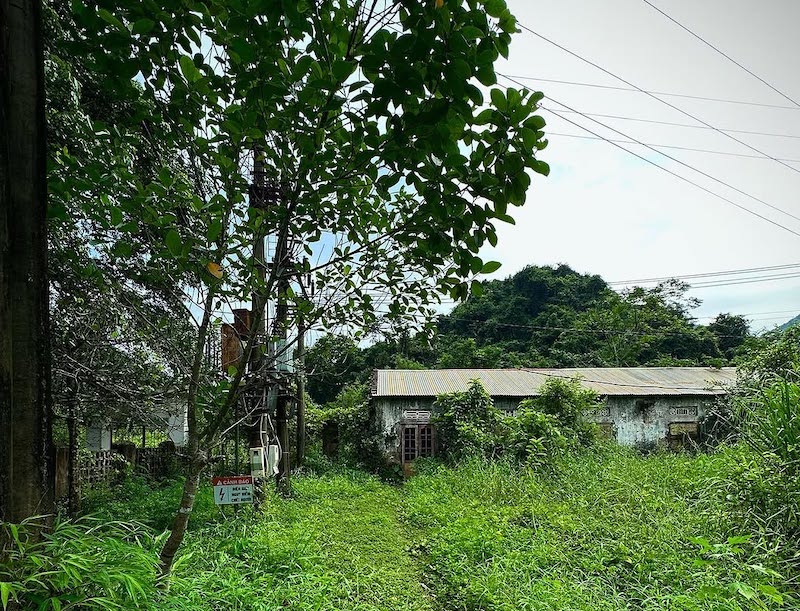
The main entrance sits inland, roughly in the centre of the island, and there is only one road worth using. Allow half an hour from town, and set off early if you want the long route, because the gate stops selling tickets well before it closes at 17:00.
From Cat Ba town: the entrance is about 14 kilometres away. A scooter, local taxi, or electric tourist bus all work, and the drive takes roughly 30 minutes. The route runs from the town centre along Tung Thu Road toward Ang Soi junction, then follows Ha Sen Road onto the island crossing road.
From Hanoi: the trip runs by road to the coast, then a ferry crossing to the island before driving to the park, taking about 3.5 to 4 hours in total. See our Hanoi to Cat Ba Island transport guide for route options and current ferry schedules, or the full transport comparison if you are coming from somewhere else.
The park management board answers on 0225.3888.741 and at vuonqgcatba@haiphong.gov.vn if you want to check trail conditions before you set off. That is worth doing in the wet season, when the long routes close without much notice.
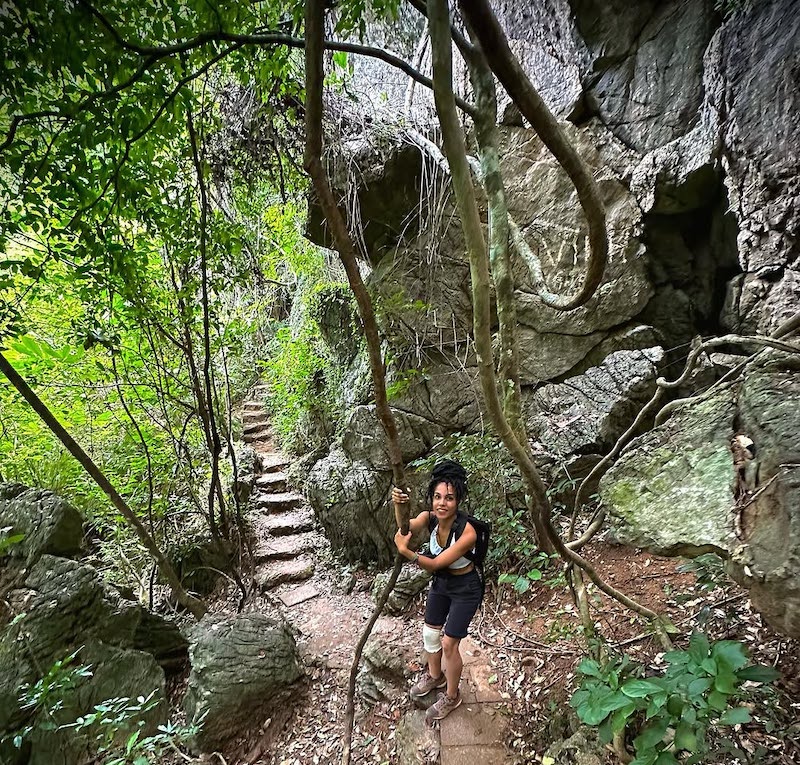
Three things catch people out. The gate takes cash in Vietnamese dong only, the trails have no shops or water points once you pass the entrance, and the limestone underfoot is sharper and more slippery than it looks in photographs. Sort your footwear, your water and your cash before you leave town.
Footwear: sturdy, closed-toe trekking shoes with good grip, because the limestone rocks are sharp and slippery.
Hydration: at least 1.5 litres of water per person; there are no shops on the trails.
Protection: insect repellent (leeches are common in the wet season), sunscreen, and lightweight, breathable clothing.
Cash: the ticket windows take Vietnamese dong in cash only, and there is no ATM at the gate.
For Ngu Lam Peak or the Kim Giao forest walk, you don't need a guide, since the paths are clear and well-marked. For the 14-kilometre Viet Hai village trek, a professional local guide is strongly recommended, because the deep jungle trails can be confusing to navigate alone and there is no phone signal for much of the crossing.
Beka Insight: our trekking guides average four years of experience leading routes through Cat Ba National Park.
Both work, and the honest answer depends on which route you want. The short routes near the gate are easy to do alone for the price of a ticket. The 14-kilometre crossing to Viet Hai is a different proposition, because it ends on the far side of the island with no road back.
| On your own | On the Beka Travel trek | |
|---|---|---|
| Best for | Ngu Lam Peak, Kim Giao, Trung Trang cave | The full crossing to Viet Hai village |
| Ticket | You buy at the gate, 80,000–160,000 VND | Included in the tour price |
| Getting there | Scooter or taxi, 30 minutes from town | Hotel pickup from Hanoi or Cat Ba town |
| Getting back | Return the way you came | Boat from Viet Hai harbour across Lan Ha Bay |
| Navigation | Fine on marked routes near the gate | Guided, which matters on the jungle core |
| Typical cost | Ticket plus transport | From 45 USD including lunch and boat |
If the crossing is what you came for, our Cat Ba National Park trekking and cycling day tour walks the same route, covers the entrance tickets and picks you up by boat at the village. If you would rather spend the day on the water instead, the Lan Ha Bay day tour runs from Ben Beo harbour.
The main Cat Ba National Park hike follows marked Cat Ba hiking trails up to Ngu Lam peak; most walkers reach the Cat Ba National Park viewpoint in about an hour.
Cat Ba National Park animals include the endangered Cat Ba langur, macaques and hornbills, and the trails pass a Cat Ba National Park cave carved into the limestone.
The Cat Ba National Park entrance fee starts at 160,000 VND for the main route, paid in cash at the gate.
Unlike the beaches and bay cruises Cat Ba is known for, the national park is a dense limestone jungle protecting rare wildlife like the Cat Ba langur, a wilder side of the island reached by trekking rather than boat. It is also the only part of the island where you pay a statutory entrance fee to walk.
For most travellers with average fitness, the round trip from the entrance gate to the summit and back takes about 1.5 to 2 hours. The climb is short but steep, on rough limestone steps rather than a graded path, so allow longer in wet weather and start before mid-afternoon.
Not for short trails like Ngu Lam Peak or Trung Trang cave. For the challenging cross-island trek to Viet Hai village, a local guide is strongly advised for navigation and safety, since the route runs 14 kilometres through the jungle core and ends at a village with no road connection back to town.
It depends on your route, not your age or your stay. The 120,000 VND ticket covers Kim Giao, Ngu Lam Peak and Trung Trang cave. The Tien Duc and Phu Long routes are 80,000 VND each. The full crossing to Viet Hai needs general admission at 160,000 VND.
Yes, but it is a long day. Road and ferry take 3.5 to 4 hours each way, so a day trip means leaving Hanoi before dawn and getting back after dark. Guided day trips do exactly that. If you would rather not, stay a night on the island.
Ready to step into the jungle? Beka Travel's local guides know these trails well and handle the transportation, entrance tickets, and pacing, so you can focus on the trek itself.
Beka Travel holds 4.9 out of 5 from 1,140 reviews on TripAdvisor and won a Travelers' Choice award in 2026. Explore more guides and tours at Beka Travel.
Check Availability
Beyond Ngu Lam peak Cat Ba, keen hikers tackle Navy Peak Cat Ba and the exposed rock trail Cat Ba; the most ambitious link them on the full Cat Ba loop through the park interior.
Cat Ba
Trung Trang Cave, Hospital Cave, Cannon Fort, Thien Long Cave and Cat Ba National Park — entrance fees, opening hours, and which one to pick if you are short on time.
 Cat Ba
Typhoon season runs June to October in northern Vietnam. Here is who decides, what you get back, and how to plan a bay trip around it.
 Cat Ba
A practical guide to Monkey Island in Lan Ha Bay: how to get there, what the monkeys are like, the viewpoint hike, and which Beka tours stop there.
 Cat Ba
Around 90 Cat Ba langurs are left in the wild, all on one island. What they are, why you probably won't see one, and how to visit responsibly.
 Cat Ba
The Cat Hai–Phu Long cable car crosses 3,955 metres of open water in 10–15 minutes, running 09:00–16:00 daily except Tuesdays. Route, hours, ticket prices and how it compares to the ferry.
 Cat Ba
Beyond trekking and kayaking, Cat Ba Market is a must-visit destination to experience the authentic local lifestyle. It is the culinary heart of the island, where you can find the freshest seafood and traditional products of the Hai Phong port region.
 Cat Ba
Complete 2026 guide to reaching Cat Ba Island: compare buses, ferries, cable cars and transfers from Hanoi, Hai Phong, Ha Long and Ninh Binh.
 Cat Ba
Complete 2026 guide to the Tuan Chau to Gia Luan ferry. Find updated schedules, ticket prices, transport from Gia Luan to Cat Ba Town, and expert travel tips.
 Cat Ba
Discover Hang Quan Y (Military Hospital Cave) on Cat Ba Island. Learn about its wartime history, the 3-level concrete bunker, entrance fees, and how to get there.
 Cat Ba
Cannon Fort on Cat Ba Island is currently closed to visitors, with no official ticket sold. History, location, and what to see instead in 2026.