




 Ha Long
Best Time to Visit Halong Bay, Month Guide
Planning your Halong Bay trip? Compare spring, summer, autumn, and winter weather, crowd levels, and booking tips to find your ideal travel month.
Last updated: July 2026
Most visitors eat two or three meals in Halong Bay and spend at least one of them on a cruise, where the menu is set and the seafood arrives without much explanation. That leaves very little room to eat badly, and not much room to eat well either.
This guide covers what to eat in Halong Bay when you do have a choice: the dishes the region is genuinely known for, what each one actually tastes like, and the one question to ask before you order anything from a tank.
The short version is that Halong food is coastal Vietnamese cooking with an unusual emphasis on shellfish and on a single squid dish that locals will insist you cannot get properly anywhere else.
Start with cha muc, the hand-pounded grilled squid patty that Halong is nationally known for, and eat it with xoi or in a bowl of banh cuon. After that, work through the shellfish: ngan clams, be be mantis shrimp, and sam if you find a restaurant that prepares it properly. Sa sung sea worms are the local luxury item and worth trying once.
Nothing on that list is difficult to find. The difficulty is the price, and knowing what you are actually being served.
The cooking is less herb-driven and far more shellfish-heavy than what you will have eaten in Hanoi. The bay produces a distinctive set of molluscs and crustaceans that barely appear on menus inland, and local kitchens tend to cook them simply, with steam, grill and a dipping sauce rather than heavy seasoning.
The other difference is squid. Halong squid is hand-pounded rather than machine-blended, which produces a springy texture that people from this region argue is impossible to replicate elsewhere. Whether or not that is strictly true, the local version is noticeably different from what you will be served in Hanoi.
Expect fewer noodle soups and more things that arrive in a shell.
Four dishes carry the region's culinary reputation, and they are very different from each other in price and approachability. Cha muc is the one to eat first and the easiest to enjoy. Ngan and be be are straightforward shellfish. Sa sung and sam are the specialist choices, one expensive and one requiring more care about where you order it.
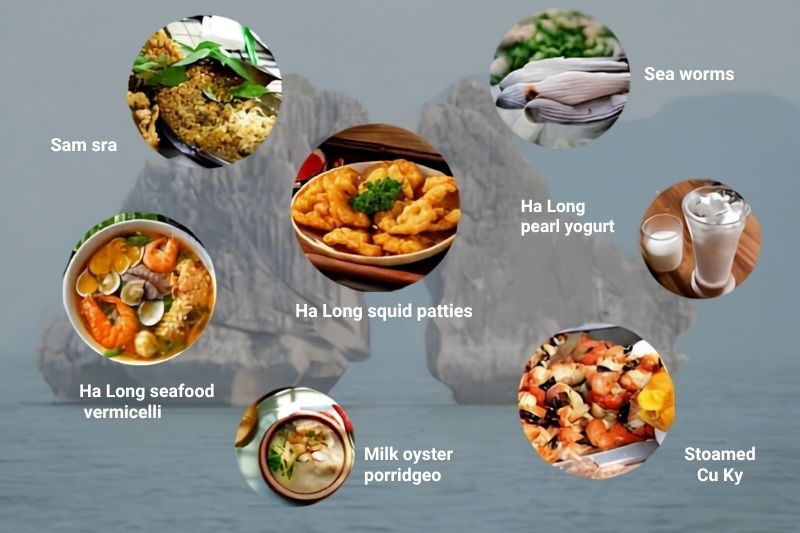
Cha muc is fresh reef squid pounded by hand in a stone mortar into a paste, seasoned, formed into small patties and deep-fried until golden. The hand-pounding is the point, since it leaves the texture springy and slightly coarse rather than smooth.
Eat it with xoi, the sticky rice pairing that locals consider correct, or in a bowl of banh cuon for breakfast. It also appears in bun cha muc, a noodle soup that is easier to find here than anywhere else in Vietnam.
If you eat one thing in Halong, make it this. It is also the most reliably good dish in cheap restaurants, since the recipe does not depend on anything being unusually fresh.
Sa sung, the peanut worm Sipunculus nudus, is one of the most expensive marine ingredients in Vietnam by weight. It is gathered by hand from sandy tidal flats, mainly around Van Don and Quan Lan, then dried and used sparingly as a flavour base rather than eaten in quantity.
Fried, it tastes nutty and slightly sweet, with a texture closer to a crisp than to seafood. Dried sa sung is considered earth-gold, and a small handful roasted and dropped into a boiling broth builds the deep, sweet umami behind northern Vietnam's traditional pho.
Be prepared for the price. Sa sung costs several times what you would expect for something served in small quantities, and this catches people out when the bill arrives.
Ngan, Austriella corrugata, looks like an oversized hard clam but lives deep in coastal mangrove mudflats. The meat is rich and earthy. It comes charcoal-grilled in tinfoil, steamed with lemongrass, or made into chao ngan, a rice porridge.
The local version most worth trying is ruou ngan, where the clam's liquor is drawn from the live mollusc and mixed into rice wine. It is an acquired taste, and locals will enjoy watching you form an opinion about it.
Sam is a horseshoe crab, prepared as a set-piece meal rather than a single dish: savoury blood jelly, a sweet and sour chilli stir-fry, batter-fried legs and grilled roe in the overturned shell. It is the most traditional dish on this list, and the one to be careful about.
Order sam, never so. Two horseshoe crab species live in these waters and only one is food.
The same caution covers raw dishes. Raw sam salad, live ngan with lime and raw oysters are all local favourites, and all three are hard on an unaccustomed stomach. Take the cooked version on the first night.
Beyond the headline four, the everyday eating here is coastal and straightforward, and much of it is better value than the specialist dishes.
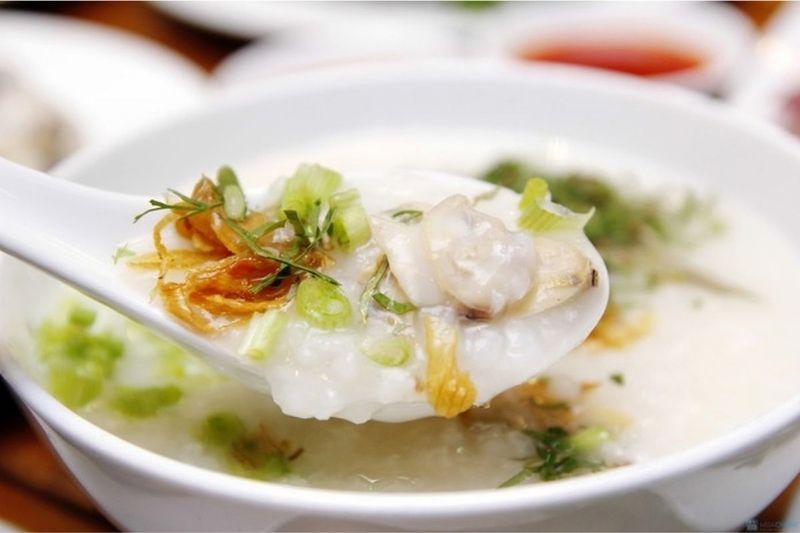
Breakfast is where Halong eats best, and it happens early. The good stalls open soon after dawn and many sell out before lunch.
By live weight, per kilogram, straight from the tank in front of you. Ask the price per kilo before you point at anything, watch the scale, and check whether cooking is billed separately.
| Cha muc grade | Retail price band |
|---|---|
| Hand-pounded, top grade | 500,000d to 650,000d per kg |
| Hand-pounded, grade 1 | 400,000d to 480,000d per kg |
| Blended with prawn | 380,000d to 420,000d per kg |
| Blended with mackerel | 280,000d to 320,000d per kg |
Retail prices surveyed July 2026 from Quang Ninh cha muc producers. Restaurant portions cost more.
| Dried sa sung grade | Retail price band |
|---|---|
| Top grade | 6,000,000d to 8,000,000d per kg |
| Grade 1 | 4,000,000d to 6,000,000d per kg |
| Grade 2 | 3,200,000d to 4,000,000d per kg |
| Pho-stock grade | 1,900,000d to 2,400,000d per kg |
Retail bands surveyed July 2026 from Quang Ninh sa sung sellers. 10 to 12 kilos of fresh sa sung dry down to a single kilo, which is why the price sits so far above everything else on this list.
Buy 100 grams of dried sa sung rather than a kilo. That is enough to flavour stock for months, and it keeps the souvenir budget sane. Vacuum-sealed cha muc and sa sung both travel well, and vacuum packing is what makes cha muc practical to carry home. Our where to eat in Halong Bay guide covers the market where you can buy both.
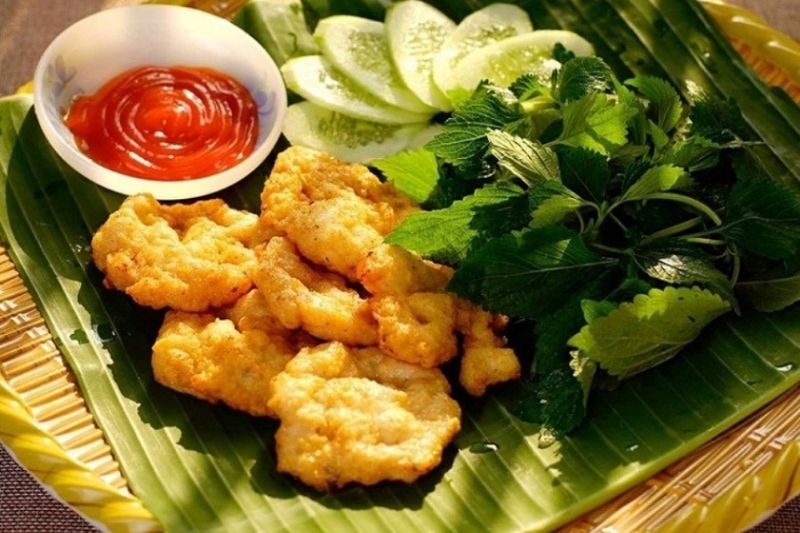
For a sit-down seafood dinner, budget roughly 800,000d to 1,000,000d for two people. That figure swings hard with what you point at, because a crab or a lobster taken from the tank moves the bill well past it. For how food fits the wider trip, our complete Halong Bay trip cost breakdown covers transfers and tickets as well.
April to June. That window brings good coastal weather and the peak harvesting season for local crabs and bivalves, so tanks are full and prices steady. Typhoon season runs from late May to early November and peaks between July and October. Rough water thins supply and cancels boats, so winter suits cha muc and porridge better than fresh shellfish.
Cha muc, a hand-pounded grilled squid patty, is the dish Halong is known for across Vietnam. It is eaten with sticky rice or in banh cuon, and the hand-pounding gives it a springy texture that machine-processed versions do not have. Ngan clams and sa sung sea worms are the other regional specialities.
Yes, if it is sam and not so. Sam is a normal restaurant dish across Quang Ninh. So bien, a smaller lookalike, carries tetrodotoxin, and cooking does not destroy it. Sam are caught as a mated pair and have a spined, triangular tail. So travel alone with a smooth, round tail. Order sam only at established restaurants.
It varies widely, because seafood is priced by weight rather than by dish. A simple fish and rice meal is inexpensive, while a dinner featuring sa sung or a large sam costs several times more. Always confirm the price per kilogram before ordering rather than after the food arrives.
Yes. Cruise menus are diverse and offer poultry, beef and dedicated vegetarian dishes on request, and Bai Chay restaurants will build a meat-free table without fuss. Flag it at booking rather than on the day, since ships sail with limited kitchen supplies and a request made at the table is far harder to fill.
Yes. Vacuum-sealed cha muc and dried sa sung both travel well and are sold at the local market. Buy sa sung in small quantities, since a little goes a long way in stock, and check your airline's rules on food in cabin baggage before you fly.
Cha muc. It is the most approachable dish on this list, the easiest to find, and reliably good even in cheap restaurants, since the recipe does not depend on anything being unusually fresh. Everything else on this page can wait until you have tried that first.
The practical approach in Halong Bay is to treat your cruise meals as fixed and plan one proper meal ashore around them, built around cha muc, ngan and a table full of shellfish.
Meals are included on our Ha Long Bay Day Tour from $34, which leaves your evenings free for the mainland restaurants covered in our where to eat in Halong Bay guide.
For the wider trip, our Halong Bay travel guide covers the itinerary options, and our Halong Bay vs Lan Ha Bay comparison explains how the two bays differ.
Browse everything at bekatravel.com.
Ha Long
Planning your Halong Bay trip? Compare spring, summer, autumn, and winter weather, crowd levels, and booking tips to find your ideal travel month.
 Ha Long
Dau Go Cave is one of Ha Long Bay's largest historic caves, tied to a 13th-century Tran Hung Dao legend. Find the Route 1 ticket price, accessibility notes, and what to expect inside.
 Ha Long
Planning to cruise Halong Bay with kids? Compare family cabins, child pricing by age, kid-friendly itineraries, and safety tips for a stress-free trip.
 Ha Long
Wondering what to pack for Halong Bay? Check out our ultimate packing list, including travel essentials and seasonal tips for your cruise vacation.
 Ha Long
Discover how to practice responsible travel in Halong Bay, from the bay's single-use plastic ban to supporting local communities on a sustainable cruise.
 Ha Long
Looking to stay active in Halong Bay? Explore our top 5 experiences including kayaking, cave trekking, cycling, and more, plus what changed under the 2026 safety rules.
 Ha Long
Complete 2026 guide to traveling from Hanoi to Halong Bay: bus, minivan, private car, and helicopter options, distance, price, and which port to use.
 Ha Long
A practical guide to choosing a Halong Bay cruise: which bay to sail (Halong, Lan Ha, or Bai Tu Long), how many days, which comfort tier fits your budget, and when to go.
 Ha Long
Thien Canh Son Cave (Hang Co) sits on Hon Co Island in quiet Bai Tu Long Bay, reached by a jungle climb of about 100 stone steps. Find directions, prices, and how it compares to Ha Long Bay's main caves.
 Ha Long
If Ha Long Bay is a glamorous, globally acclaimed painting of limestone mountains and emerald water, Bai Tu Long Bay is its quiet, poetic sister. Remaining beautifully raw, serene, and deeply enchanting, it is a hidden gem in Northeast Vietnam.