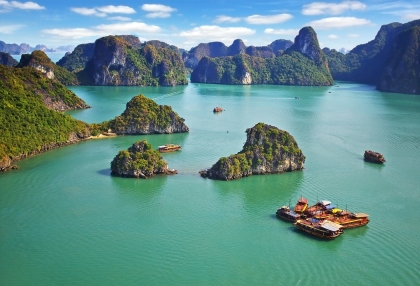
Dau Go Cave, also called Driftwood Cave, is one of the most historically profound and geologically remarkable destinations in Ha Long Bay. French travel researchers once honored it as the Grotte des Merveilles, the cave of wonders. It remains a top-rated experience for adventurers in Northeast Vietnam.
Quick summary: Dau Go Cave stands on Dau Go Island in the southwest of the bay. Thien Cung Cave sits about 300 metres away on the same island. One route VHL1 ticket at 250,000d covers both. Ninety stone steps lead to the mouth, and most groups spend 40 to 45 minutes inside. Beka Travel runs no route VHL1 product, and this guide says so plainly.
At a glance
Location
Dau Go Island, southwest Ha Long Bay, Quang Ninh
Distance
About 4km by boat from the tourist port at Tuan Chau
Neighbour
Thien Cung Cave, about 300m away on the same island
Sightseeing route
VHL1, at 250,000d, covering both caves
Climb
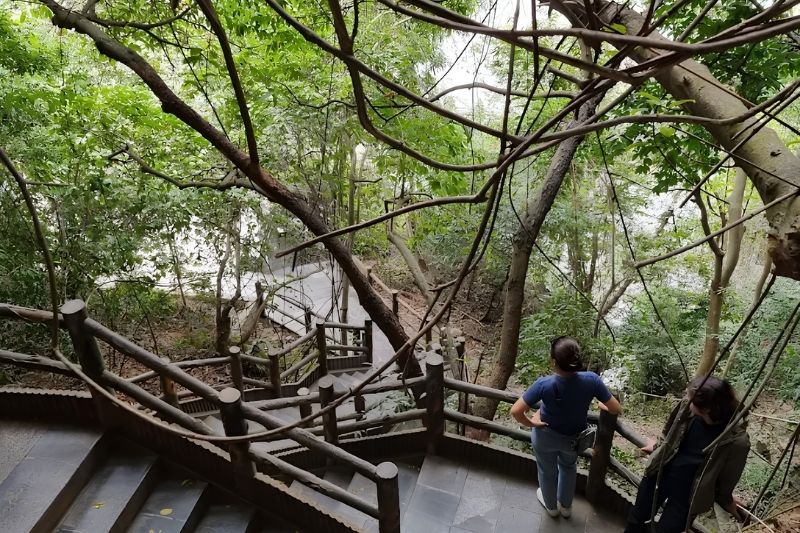
90 stone steps, handrails on the steeper sections
Beka Travel
Runs no VHL1 product. Closest option is the Ha Long Bay Day Tour: Sung Sot Cave, Luon Cave & Titop Island at $34 per adult, on route VHL2
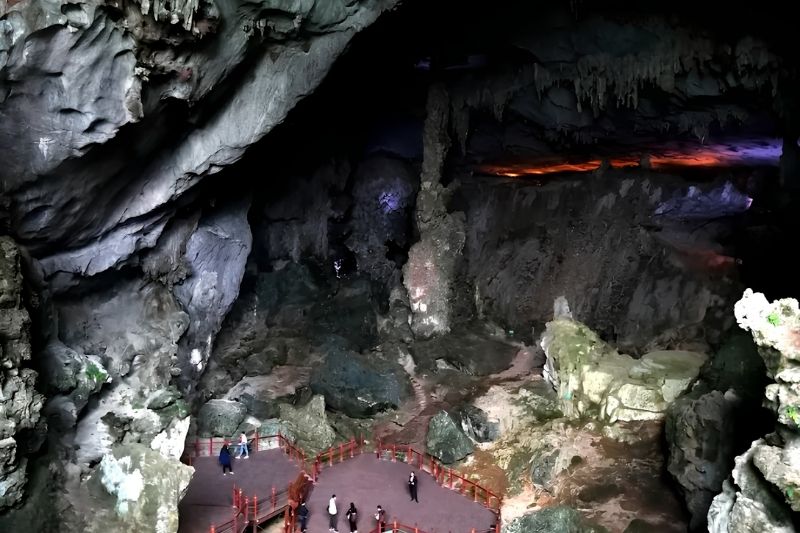
Dau Go Cave, or Hang Dau Go, is a limestone cave on Dau Go Island in the southwest of Ha Long Bay. The landing lies roughly 4 kilometres by boat from the tourist port at Tuan Chau. Ninety stone steps climb to the entrance. Inside are three linked chambers, running from a daylit outer vault to an inner one with a freshwater well. It shares route VHL1 with Thien Cung Cave, and one ticket covers both.
Where is Dau Go Cave located?
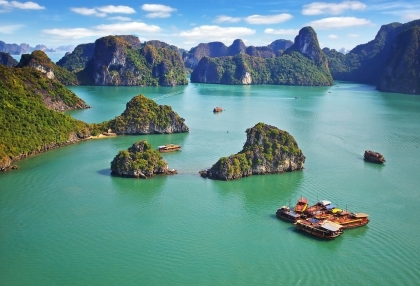
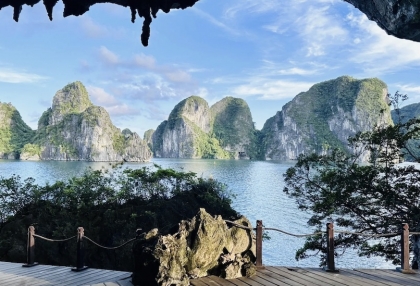
The cave sits on Dau Go Island in the southwestern pocket of Ha Long Bay's core heritage zone. The island lies roughly 4 kilometers from Tuan Chau International Marina and 6 kilometers from the tourist centre of Bai Chay. Boats reach it within half an hour.
Tuan Chau Marina → 4km boat ride → Dau Go Island → heritage cave trek
The cavern spans about 5,000 square meters, with an entrance 17 meters wide and 12 meters high. It behaves like an ancient, hand-carved stone fortress, and sits next to Thien Cung Cave. Having shared a geological evolution over two million years, the two form an inseparable twin-destination loop.
Vietnamese sources put the distance from Bai Chay at anywhere from 6 to 8 kilometres. The gap comes from measuring to different piers, not different caves.
How do you get to Dau Go Cave?
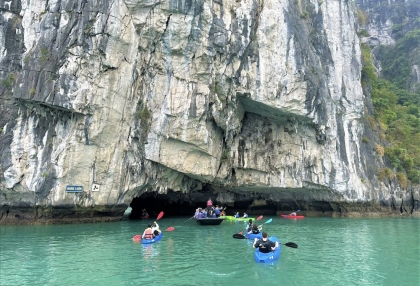
To begin your expedition, head to Tuan Chau International Marina or Halong International Cruise Port. From there you board a traditional wooden junk boat or a modern speed cruiser toward Dau Go Island. The crossing takes approximately 30 to 45 minutes, with views of the limestone karsts.
Tickets are sold at the port on the day, so nothing needs booking ahead. The Bai Chay area guide covers the shore side and where the boats leave from.
What do Dau Go Cave tickets cost, and what do they cover?
Dau Go Cave tickets are not sold on their own. You buy sightseeing route VHL1 at 250,000d per person. That single ticket covers Dau Go, Thien Cung, Hon Cho Da, Ba Hang and Dinh Huong. The fee pays for sightseeing, not for the boat.
Ticket
What it covers
Fee
VHL1, day route
Thien Cung, Dau Go, Hon Cho Da, Ba Hang, Dinh Huong
250,000d
VHL2, day route
Soi Sim, Ti Top, Sung Sot, Me Cung
250,000d
VHL7, day route
Routes 1, 2, 3 and 4 on one pass
600,000d
Exemptions and reductions
Free for children under 1.2m or under 7 years old
20% reduction for children aged 7 to under 16, assessed by age rather than height
50% reduction for visitors aged 60 and over, Vietnamese citizens only
Updated July 2026. Source: Ha Long Bay - Yen Tu World Heritage Management Board.
Dau Go Cave is a primary anchor stop on route VHL1, the four-hour half-day loop. Visitors buy the route ticket at harbor counters.
All-inclusive day tours: most international visitors take a route 1 package. Harbour quotes run from 700,000 to over 1,000,000 VND.
What is included: entry tickets, shared boat transport, an English-speaking guide and a seafood lunch onboard.
What is not: the boat, sold by the seat, and the small Tuan Chau port fee.
The name Dau Go, read as driftwood or wooden stakes, is deeply woven into the fabric of Vietnam's ancient military history. The most famous local chronicle dates back to the 13th-century Mongol invasions. A second reading points at timber storage. Vietnamese sources carry both without settling.
The wooden stakes story
According to historical lore, this cavern was a secret military depot for National Hero General Tran Hung Dao. Inside these dark chambers, Vietnamese soldiers hid thousands of heavy, iron-tipped ironwood stakes. Those stakes were later driven into the bed of the Bach Dang River to destroy the Mongol fleet.
Locals originally called it Hang Giau Go, the hidden wood cave, which slowly evolved into Hang Dau Go. Another coastal legend says the cave sheltered fishing vessels during typhoons, turning the island into a symbol of protection.
Treat the stakes version as tradition rather than record. No excavation has tied timber here to the 1288 battle, and the Bach Dang battlefield lies well west.
What the French called it
A 1938 French volume, Merveilles du Monde, named it Grotte des Merveilles, the cave of marvels. The label stuck hard enough that old charts and many English pages still use it. Electric lighting arrived here long before the caves further out.
Where the sources contradict each other
Three details are worth flagging, because most travel pages state them with more confidence than the sources allow.
The imperial visit. Vietnamese press puts Emperor Khai Dinh at the cave in spring 1918, touring the north with Governor-General Albert Sarraut. The same coverage dates the stele to 20 March 1927. Most tourism pages compress all of it into 1917, and one English cave database offers 1918 and 1929.
The size. Several English pages call this the largest cave in Ha Long Bay. Vietnamese sources give about 5,000 square meters, half of Thien Cung and well below Sung Sot. The superlative looks inherited.
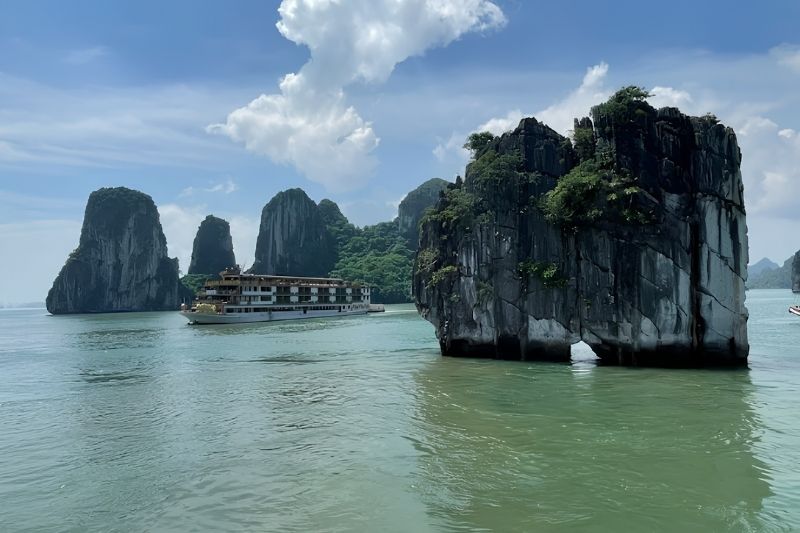
The entrance shape. Guides describe the mouth as a jellyfish seen from the water. Others call it a starfish. Nobody disputes that it is wide and green with plant growth.
The stele was re-cut in 2011 by the Han-Nom Research Institute and the National Museum of History.
Inside the cave: three chambers running from bright to dark
Rare sea swallows nest in the rocky crevices above the entrance. Past them the cave unfolds into a three-chambered marvel, and the light drops at every step.
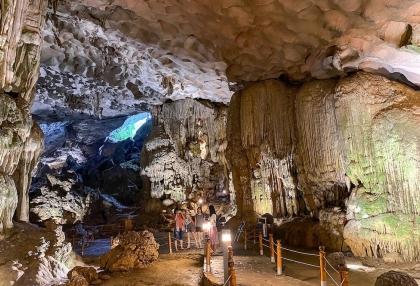
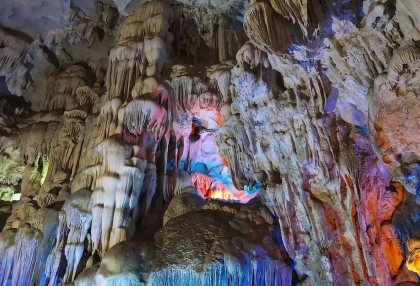
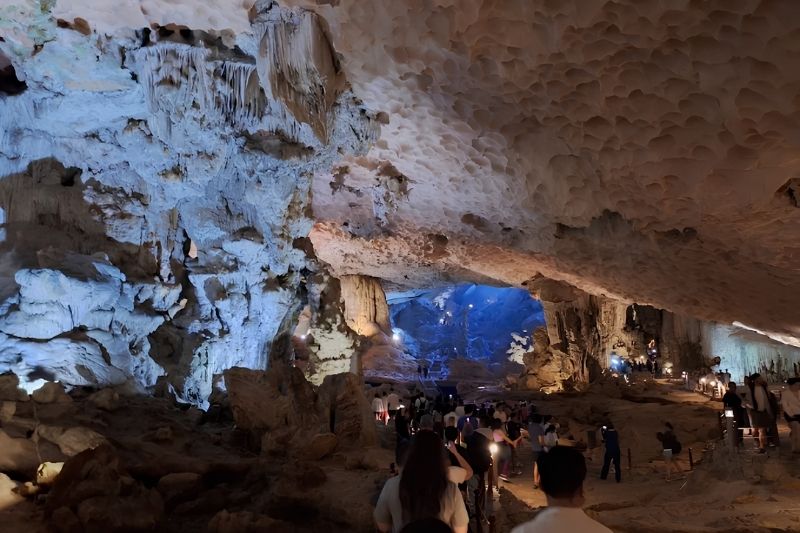
The massive first vault is lit by natural daylight pouring through the wide cave mouth. The ceiling features a high density of towering stalactites and stalagmites. Water has sculpted these formations into stone lions, sea turtles and fighting cocks.
Chamber 2: the ethereal gallery
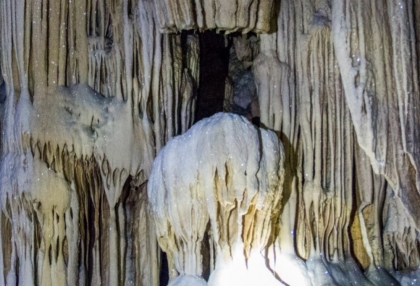
Moving deeper, the daylight fades into shadow and soft, eco-friendly lighting. This chamber holds a dreamlike atmosphere where vast stone blocks appear to float over petrified waves. Delicate stalactite curtains hang down like silk.
Chamber 3: the fairy well
The final chamber opens into a monumental, soaring stone vault. The crown jewel of this inner sanctuary is a natural freshwater well that stays clear through all four seasons. The stone pillars around it are intricately detailed. Air here stays cooler than the boat deck.
Dau Go or Thien Cung: which one deserves more of your time?
Thien Cung is the spectacle and Dau Go is the cave. Thien Cung carries roughly twice the quoted floor area and runs heavy coloured floodlighting that most groups enjoy. Dau Go takes daylight through a wide mouth and lights the rest sparingly. For raw rock, Dau Go wins.
Dau Go
Thien Cung
Island
Dau Go Island
Same island, about 300m away
Quoted floor area
Around 5,000 m²
Around 10,000 m²
Steps to entrance
90
Roughly 50
Lighting
Daylight plus sparse spotlights
Heavy coloured floodlighting
Crowd level
Lighter, many groups rush it
Heavier, the anchor stop of the route
Freshwater well
Yes, in the third chamber
No
Key insight: Thien Cung is heavily illuminated with vivid colors to highlight its rock formations. Dau Go offers a much more natural, earthy atmosphere with minimal lighting, leaning into its history.
Photographers prefer Dau Go for that reason. Guides almost always run Thien Cung first, because the queue builds early. Ask to reverse the order if the boat allows it. The Halong Bay caves guide ranks the rest.
Does Beka Travel run the route to Dau Go Cave?
No. Beka Travel operates nothing on route VHL1, so neither Dau Go nor Thien Cung appears on its itineraries. Beka works route VHL2 in the central bay and the water south of it around Lan Ha. To see this cave, book a route 1 day boat from Tuan Chau or Bai Chay.
If a cave without a queue is what pulled you here, read the Halong Bay vs Lan Ha Bay comparison next. Lan Ha has far fewer boats in the frame.
Essential travel tips for international visitors
Accessibility and effort: reaching the mouth means climbing roughly 90 steep stone steps. There are handrails, but the climb is demanding, and the cave is not wheelchair or stroller accessible.
Time commitment: a full walk-through of the three chambers takes 40 to 45 minutes. Both caves together take about 90 minutes ashore. Boats cluster between 09:00 and 11:00, so leave before 08:30 or after 14:00.
What to wear: the paths inside are wooden boardwalks, but the entrance trail means damp stone steps. Wear breathable clothing and sturdy shoes with grip.
The ideal window: the golden months are April to June, with bright sunshine and clear skies for open-deck cruising. One number cuts against it. June averages 300mm of rain against 90mm in April, and November only 35mm.
Smart packing checklist: keep your passport or ID on hand for harbor check-in. Bring sunscreen, bug spray and a power bank for photos.
Preservation ethics: Dau Go is a highly protected natural monument. Do not touch or snap off any stalactites. Single-use plastic has been banned bay-wide since 2019.
Two rules changed recently. Tourist boats now carry mandatory GPS, AIS and VHF radio, with 332 vessels inspected in March 2026. The official UNESCO name has been Ha Long Bay - Cat Ba Archipelago since 2023.
Nearby attractions on the route
A route VHL1 or VHL2 ticket lets you combine this visit with other legendary highlights.
Thien Cung Cave: a 5-minute walk away on the same island. It is famous for massive central pillars and skylights that bounce light off minerals.
Sung Sot Cave: on Bo Hon Island, route VHL2. It is the largest dry cavern in the bay, with chambers like a grand opera house.
Me Cung Cave: an archaeological site with prehistoric fossils and a circular marine lake.
Frequently asked questions
Do you need separate tickets for Dau Go Cave and Thien Cung Cave?
No. Both caves are covered by the single route VHL1 ticket at 250,000d per person. Neither issues a ticket of its own. The fee also covers Hon Cho Da, Ba Hang and Dinh Huong islet. Some visitors pay twice out of confusion. There is nothing to buy at the second cave.
How many steps lead up to the cave, and how hard is the climb?
Ninety stone steps rise from the boat landing to the cave mouth. Most people take five minutes at a steady pace, with handrails on the steeper sections. The stone stays damp year round, and the descent is where people slip. Shoes with grip matter more than fitness. Strollers and wheelchairs cannot make the climb.
Is it worth visiting if you have already seen Sung Sot?
Probably yes, for different reasons. Sung Sot is larger and more theatrical, and it sits on route VHL2, so the two rarely combine in one day. Dau Go offers daylight, a quieter floor and an older story. Travellers who found Sung Sot too crowded rate this one higher than the guidebooks do.
Why is it called the wooden stakes cave?
Local tradition says Tran Hung Dao's forces shaped ironwood stakes here before the Bach Dang River battle of 1288. That is the wooden stakes cave version of the name. A competing reading treats it as a worn form of Giau Go, meaning hidden wood, which points at timber storage. Vietnamese sources carry both.
Can you visit Dau Go Cave on a day trip from Hanoi?
Yes, and it is among the easiest caves in the bay to reach that way. Hanoi to Halong is roughly 150 to 160 kilometres, two and a half to three hours by road. Route 1 boats then need four to six hours on the water. Most Hanoi day tours run route 2, so check the itinerary names this cave.
Planning the rest of your trip
Dau Go Cave is a remarkable testament to the raw power of nature and the long history of Vietnam. The contrast between its stone architecture and its wartime past makes it an essential stop for any cultural traveler.
For ports, seasons and how the sightseeing routes carve up the water, start with the Halong Bay travel guide.
Thien Cung Cave has its own guide covering the neighbour on the same island. Beka Travel lists the day tours and cruises running route VHL2 and the Lan Ha water.
Nếu Vịnh Hạ Long là một bức tranh sơn thủy lộng lẫy và nổi tiếng toàn cầu, thì Vịnh Bái Tử Long lại tựa như một "nàng thơ" ẩn mình, giữ trọn vẻ đẹp tĩnh lặng, nguyên sơ và đầy quyến rũ. Đối với những tín đồ du lịch đang tìm kiếm một không gian thực sự tách biệt để hòa mình vào thiên nhiên, Bái Tử Long chính là thiên đường mà bạn nhất định phải đặt chân đến một lần trong đời.
Vịnh Hạ Long từ lâu đã là "tọa độ" vàng trong bản đồ du lịch Việt Nam, thu hút hàng triệu lượt khách mỗi năm. Tuy nhiên, trước mỗi chuyến đi, nỗi băn khoăn lớn nhất của du khách vẫn luôn là chi phí du lịch Vịnh Hạ Long bao nhiêu là đủ và làm thế nào để tránh được các khoản phát sinh không đáng có.
Vịnh Hạ Long từ lâu đã trở thành biểu tượng du lịch của Việt Nam trên bản đồ quốc tế. Không chỉ là một địa danh, đây còn là nơi hội tụ của vẻ đẹp thiên nhiên kỳ vĩ, giá trị lịch sử lâu đời và hệ sinh thái độc bản. Dưới đây là thông tin chi tiết nhất để bạn chuẩn bị cho hành trình tham quan vịnh hạ long đầy cảm hứng.
Hệ thống hang động tại Vịnh Hạ Long nổi tiếng thế giới nhờ vẻ đẹp kỳ vĩ của những dải thạch nhũ triệu năm tuổi. Trong số hàng nghìn hang động, Hang Sửng Sốt luôn là cái tên hàng đầu mà mọi du khách phải ghé thăm. Đúng như tên gọi, địa danh này mang vẻ đẹp choáng ngợp, khiến bất cứ ai đặt chân tới cũng phải kinh ngạc trước tài nghệ của tạo hóa.
Discover Luon Cave (Tunnel Cave), a magnificent natural tidal arch cutting through Bo Hon Island along Ha Long Bay's iconic Sightseeing Route 2. This complete travel guide covers updated ticket prices, essential kayaking and bamboo boat tips, wildlife encounters with wild golden monkeys, and the best cruise itineraries.
Cẩm nang khám phá các hang động ở Vịnh Hạ Long tráng lệ và huyền bí nhất. Bài viết tổng hợp danh sách các hang động Hạ Long nổi tiếng theo từng tuyến tham quan, bảng giá vé chi tiết và các gợi ý tour du lịch tối ưu giúp bạn dễ dàng lên lịch trình hoàn hảo.
Khám phá Động Thiên Cung Hạ Long, "cung điện trên trời" nguy nga tráng lệ bậc nhất vịnh di sản với hệ thống thạch nhũ đá kỳ vĩ. Bài viết cung cấp cẩm nang chi tiết từ giá vé mới nhất, cách di chuyển đến lộ trình các tour tham quan Tuyến 1 tối ưu nhất.
Ha Long Bay is internationally celebrated as a natural world wonder, but for discerning travelers, it is also an incredible maritime culinary paradise. Beyond the towering limestone karsts lies a vibrant, fresh-off-the-boat food culture shaped by the Gulf of Tonkin.
Cùng Beka Travel thực hiện chuyến du lịch Hạ Long, khám phá 1 trong 7 kỳ quan thiên nhiên thế giới, đồng thời là Di sản Thiên nhiên Thế giới UNESCO. Nhờ vẻ đẹp hoang sơ, hùng vĩ của núi non và biển trời, vịnh Hạ Long trở thành sự lựa chọn hàng đầu, thu hút hàng triệu lượt khách ghé thăm mỗi năm.



 Ha Long