




 Cat Ba
Caves and Nature in Cat Ba Island — The Complete 2026 Guide
Trung Trang Cave, Hospital Cave, Cannon Fort, Thien Long Cave and Cat Ba National Park — entrance fees, opening hours, and which one to pick if you are short on time.
Last updated: 1 August 2026
Quick Summary: Cat Ba Island has no bridge and no airport of its own, so every route combines a road transfer with a sea crossing by ferry, speedboat or cable car. Journey times run from 1.5 hours out of Hai Phong to around 11 hours on an overnight sleeper from Ha Giang. This page compares the routes; the linked guides handle each one in detail.
Cat Ba Island has no bridge and no airport of its own. Every route, no matter where you start, combines a road transfer with a sea crossing by ferry, speedboat or cable car. Six mainland cities have a working route, and the right one for you is usually decided by where you are standing rather than by budget.
This is the overview page. Each route has its own guide with fares, timetables and pickup points, and they are linked from the table below. Read the full Cat Ba Island travel guide for what to do once you arrive.

Cat Ba sits in the Gulf of Tonkin at the edge of Lan Ha Bay, separated from the mainland by open water on one side and the narrow Cat Hai channel on the other. No bridge connects it to Hai Phong or the rest of northern Vietnam, and the island has no commercial airport.
Because of this, every route into Cat Ba follows the same three-step logistics chain: a land transfer to the coast, a sea crossing, and a final island transfer to Cat Ba town. The only thing that changes between routes is how long the land transfer takes and which sea crossing you use.
The Tan Vu to Lach Huyen bridge, opened in September 2017, carries you by road as far as Cat Hai island. Guidebooks that describe a ferry out to Cat Hai are describing a journey that no longer exists. The crossing you actually make is the shorter one beyond it.
Six mainland starting points have a working route to Cat Ba, and the table below sets each one out. What changes between them is only the length of the land transfer and which crossing you end up using. The final sea leg is short from everywhere.
| Starting point | Distance and time | Usual vehicle | Route guide |
|---|---|---|---|
| Hai Phong and Cat Bi Airport | About 28 km to the coast, 1.5–2 hours total | Direct bus, or taxi plus speedboat | Hai Phong to Cat Ba guide |
| Hanoi Old Quarter | About 150 km, 3.5–4.5 hours | All-in-one tourist combo bus | Hanoi to Cat Ba guide |
| Noi Bai Airport | About 175 km, 4–4.5 hours | Private car, or airport bus then combo bus | Noi Bai Airport guide |
| Ninh Binh, Tam Coc and Trang An | About 140 km, 4.5–5 hours | Direct through-bus | Ninh Binh to Cat Ba guide |
| Ha Long City and Tuan Chau Marina | About 7.8 km by sea, roughly 50 minutes afloat | Tuan Chau to Gia Luan car ferry | Ha Long to Cat Ba guide |
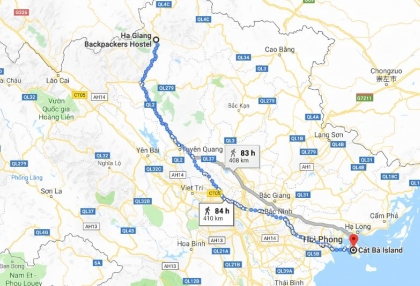
| Sapa and Ha Giang | Sapa 9–10 hours, Ha Giang 10–11.5 hours | Overnight sleeper bus | Sapa guide · Ha Giang guide |
One route needs a warning the others do not. The Tuan Chau ferry from Ha Long only sails once at least 30 passengers have boarded, and on a quiet winter afternoon a sailing can be dropped altogether. Leave a buffer if you have a flight or a cruise to connect with.

Four modes cover almost every trip: the all-in-one tourist combo bus, a private limousine or van, the train to Hai Phong paired with a boat, and a self-drive motorbike. Which one suits you depends less on your budget than on how much luggage you are carrying.
There is a fifth option worth knowing about even though it is not a mode of its own. Cars and trucks heading out to the island are turned away from the Dong Bai crossing between 09:00 and 13:00 at weekends, through to 30 September 2026, which changes the maths for anyone driving. Our Hai Phong route guide, linked in the table above, explains the restriction and the three ways around it.
Every route ends the same way, crossing open water to reach Cat Ba. Three crossings exist, and your starting point usually decides which one. From Hai Phong or Hanoi you take the Dong Bai crossing or the cable car. From Ha Long you take the Tuan Chau ferry.
Dong Bai to Cai Vieng. The main public crossing, carrying cars and motorbikes as well as foot passengers, with a long daily operating window and departures every half hour or so. This is the crossing behind almost every combo bus ticket sold in Hanoi and Hai Phong. Sailing times and the fare table by vehicle class are in our Dong Bai to Cai Vieng ferry guide.
Dong Bai passenger speedboat. The fastest way across, at 8 to 10 minutes, leaving from alongside the ferry terminal. It carries foot passengers only, which is precisely why it is useful: you skip the vehicle queue that builds on summer weekends.
Tuan Chau to Gia Luan. The car ferry from Ha Long, sailing through the karsts on a two-season timetable and landing on the northern tip of the island. Fares, sailing times and the minimum-passenger rule are in our Tuan Chau to Gia Luan ferry guide.
Cat Hai to Phu Long cable car. Not a boat at all, which is the point. It crosses the same water in the air, suits anyone who gets seasick, and is the one option the weekend car restriction does not touch. It runs a short daily window and closes one day a week, so check before you build a day around it. Full details are in the Cat Ba cable car guide.
Dong Bai wins on frequency and reliability, Tuan Chau wins on scenery. Dong Bai sails all day, every day, from the Hai Phong side. Tuan Chau sails three to five times a day from Ha Long and only once it has 30 passengers aboard. Pick by where you start, not by the view.
| Dong Bai to Cai Vieng | Tuan Chau to Gia Luan | |
|---|---|---|
| Comes from | Hai Phong, Hanoi, Ninh Binh | Ha Long City |
| Sailings per day | All day, roughly every half hour | Five in summer, three in winter |
| Minimum passengers | None | 30, or the sailing may be dropped |
| Time afloat | Under half an hour | About 50 minutes |
| Scenery | A working port and a narrow channel | Open water between the karsts |
| Lands at | Cai Vieng, about 25 km from Cat Ba town | Gia Luan, on the northern tip of the island |
In practice almost nobody chooses between these two. If you are coming from Hanoi, Hai Phong or Ninh Binh, the road leads to Dong Bai and there is no sensible reason to drive an extra two hours to Ha Long for a prettier boat. If you are already in Ha Long, the reverse is true.
The one case where the choice is real is a northern Vietnam loop that takes in both Ha Long and Cat Ba. There, crossing from Tuan Chau on the way out and returning through Dong Bai saves you doubling back, and you see the karsts from the water without paying for a separate bay cruise. The trade-off is the 30-passenger rule, which is a genuine risk on a winter weekday.

Whichever crossing you take, you land at Cai Vieng Pier, the Phu Long cable car station, or Gia Luan in the north. All three sit about 25 km from Cat Ba town, roughly 35 to 40 minutes by road, and all three have transport waiting.
If you booked a combo bus ticket, the same coach usually continues on to drop you in town. Travellers crossing independently can catch the local public bus, a shared shuttle, or a taxi or xe dien, the electric cars that work as local taxis. All are readily available for this last stretch.
The one time this leg goes wrong is late in the evening, when the last boats have landed and the shuttles have stopped running. A taxi is always findable, but the price is whatever the driver says it is. If you are arriving after dark, agree the fare before you get in.
Budget from about $7 if you are coming from Hai Phong on a local bus, and around $12 to $17 from Hanoi on a combo bus or limousine. A private car from Hanoi runs $85 to $130 for the whole vehicle. Sleeper buses from Sapa cost more.
Three things sit outside those fares and catch people out:
Book three to five days ahead on weekdays and at least two weeks over public holidays. The three things that derail this journey are unofficial ticket sellers, oversized luggage on the cable car, and storms suspending the crossings. All three are avoidable if you plan for them.
Fake ticket agents. Hanoi's Old Quarter has unofficial ticket sellers offering suspiciously cheap combo tickets. Book directly through your hotel, online, or with a verified agency such as Beka Travel to avoid being sold an invalid or non-existent seat.
Luggage constraints. The cable car cabins are compact, and hauling a large suitcase in and out at both ends can be genuinely inconvenient. If you are travelling with big luggage, the ferry or a direct bus is the more practical choice.
Storm season disruptions. In the Gulf of Tonkin the storm season runs June through September, earlier than the September to November window most Vietnam guides quote. Those later storms mostly land on the central coast. Northern Vietnam sees one to two landfalling storms in an average year, and each one closes the ferry and cable car routes for one to three days. Build a buffer day into your itinerary if you are travelling in that window, and check conditions before heading to the pier.
Your travel dates change more than the weather. The months that fill the boats are the same months that fill the hotels, so booking early helps twice over.
Yes. Cat Ba has no bridge to the mainland, so every route, whether you start in Hanoi, Hai Phong, Ha Long or elsewhere, includes a ferry, speedboat or cable car crossing at some point. The cable car is the only one that makes the crossing in the air rather than on the water.
For most first-time visitors the all-in-one tourist bus is the easiest option, because one ticket covers the entire journey with no separate transfers to arrange. It runs from Hanoi, Hai Phong and Ninh Binh. Independent routing saves money but costs you a morning of queuing and connections.
No. Cat Ba has no commercial airport. The closest is Cat Bi International Airport in Hai Phong, about 28 km from the ferry crossing point, and Noi Bai in Hanoi is the next nearest. Flying into Cat Bi cuts several hours off the journey if the fare works out.
Between 1.5 and 11.5 hours, depending entirely on where you start. Hai Phong is the shortest at 1.5 to 2 hours. Hanoi takes 3.5 to 4.5 hours, Ninh Binh 4.5 to 5, and the overnight sleepers from Sapa and Ha Giang run 9 to 11.5 hours.
On a combo bus, yes. Seats sell out three to five days ahead in summer and two weeks ahead over public holidays. Foot passengers buying ferry or speedboat tickets at the pier do not need to book, but drivers bringing a car should check the weekend restrictions first.
Cai Vieng if you take the Dong Bai crossing, Phu Long if you take the cable car, and Gia Luan if you come by ferry from Ha Long. All three sit on the northern half of the island, and all three need a further road leg into Cat Ba town.
However you arrive on the island, your journey into Lan Ha Bay starts here. Beka Travel runs daily cruises and multi-day tours departing from Beo Pier in Cat Ba town, taking you into quiet lagoons, secluded beaches and some of the best kayaking water in northern Vietnam.
Beka Travel holds 4.9 out of 5 from 1,140 reviews on TripAdvisor and won a Travelers' Choice award in 2026. Browse the Lan Ha Bay day tour to see what the bay looks like once the transfer is behind you.
Leaving the island? The return trip from Cat Ba to Hanoi runs the same combo route in reverse, and there are onward links from Cat Ba to Ninh Binh and from Cat Ba to Halong Bay via the Tuan Chau ferry. Arriving from elsewhere, see our route guides for Sapa to Cat Ba, Ha Giang to Cat Ba, Hai Phong to Cat Ba and Ninh Binh to Cat Ba. And if you are only wondering how to get to Lan Ha Bay, it is the same journey — every Lan Ha boat leaves from Cat Ba.
Cat Ba
Trung Trang Cave, Hospital Cave, Cannon Fort, Thien Long Cave and Cat Ba National Park — entrance fees, opening hours, and which one to pick if you are short on time.
 Cat Ba
Typhoon season runs June to October in northern Vietnam. Here is who decides, what you get back, and how to plan a bay trip around it.
 Cat Ba
A practical guide to Monkey Island in Lan Ha Bay: how to get there, what the monkeys are like, the viewpoint hike, and which Beka tours stop there.
 Cat Ba
Around 90 Cat Ba langurs are left in the wild, all on one island. What they are, why you probably won't see one, and how to visit responsibly.
 Cat Ba
The Cat Hai–Phu Long cable car crosses 3,955 metres of open water in 10–15 minutes, running 09:00–16:00 daily except Tuesdays. Route, hours, ticket prices and how it compares to the ferry.
 Cat Ba
Beyond trekking and kayaking, Cat Ba Market is a must-visit destination to experience the authentic local lifestyle. It is the culinary heart of the island, where you can find the freshest seafood and traditional products of the Hai Phong port region.
 Cat Ba
Complete 2026 guide to the Tuan Chau to Gia Luan ferry. Find updated schedules, ticket prices, transport from Gia Luan to Cat Ba Town, and expert travel tips.
 Cat Ba
Discover Hang Quan Y (Military Hospital Cave) on Cat Ba Island. Learn about its wartime history, the 3-level concrete bunker, entrance fees, and how to get there.
 Cat Ba
Cannon Fort on Cat Ba Island is currently closed to visitors, with no official ticket sold. History, location, and what to see instead in 2026.
 Cat Ba
There is no direct bus from Ha Giang to Cat Ba Island. See the Palace Cabin bus via Hanoi, journey time, prices and pickup points for 2026.