Choosing when to visit Halong Bay is one of the most important decisions in planning a Vietnam trip. Most travellers are not looking for generic high season versus low season advice. They want a month-by-month breakdown that matches their own priorities, whether that is warm water for swimming or misty landscapes for photography. This guide sets out the best time to visit Halong Bay by month, with rainfall, sea temperature and the cancellation risk almost nobody publishes.
Quick summary: planning a trip to Halong Bay means balancing weather, crowd levels, and activity preferences. This guide breaks down spring, summer, autumn, and winter conditions, a month-by-month reference table, and booking tips to help you choose your ideal cruise dates. October and November are the strongest months overall. August is the wettest at 445mm and carries the highest chance of a cancelled departure.
At a glance
Strongest months
October and November, then March and April
Warmest sea
July and August, around 30°C
Wettest month
August, 445mm. Driest, December, 20mm
Sea range
21°C in February to 30°C in July
Typhoon season
Late May to early November, peak July to October
Fog season
February to early April
Vietnamese peak
June to August, Tet, 30 April holiday
International peak
October to November, then March to April
From Hanoi
About 150 to 160km, 2.5 to 3 hours
Sample day trip
Beka Travel, Ha Long Bay Day Tour: Sung Sot Cave, Luon Cave & Titop Island, $34 adult, $25 child
Sample overnight
Beka Travel, Orchid Classic Cruise, $170 adult, $128 child, 2 days 1 night on Lan Ha Bay
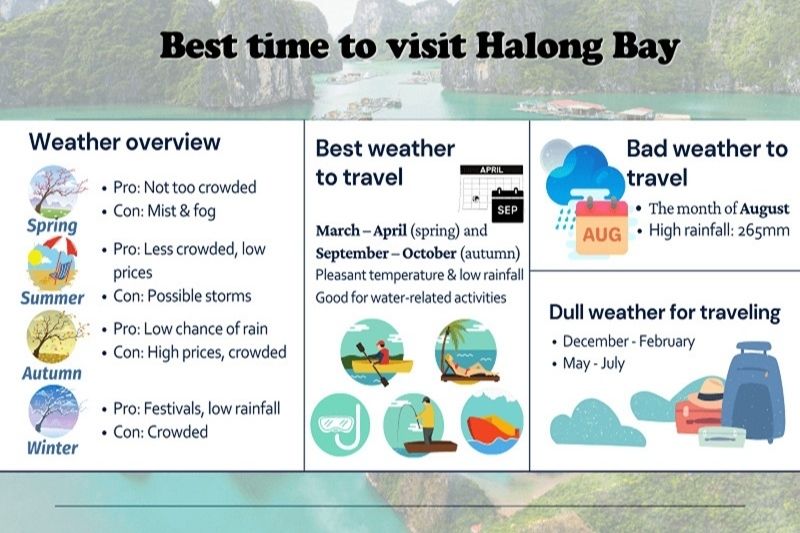
Halong Bay has a humid subtropical climate with a cool dry winter and a hot wet summer. With its emerald waters and thousands of limestone karsts, the bay is photogenic nearly year-round. Regional weather patterns still decide the quality of a cruise. October and November bring the clearest air and sea temperatures around 25 to 28°C. February and March stay mild yet often lose their views to sea fog. The best time to visit Halong Bay therefore depends on whether you value visibility, warm water, an empty boat or a low price.
What is the best time to visit Halong Bay?
October and November. Rainfall drops to 160mm and then 35mm, typhoon season has ended, and the sea still holds 25 to 28°C. The summer humidity clears, so the limestone reads sharp from the deck rather than grey. March and April form the second window, warmer than winter but often hazy.
Those two months carry a cost. They are also when international demand peaks, so cabins on the smaller boats sell out weeks ahead. Anyone asking about the best time to visit Halong Bay for one fixed week should default to them, then book early.
The rest of the year is not wasted. Deciding when to visit Halong Bay is really two decisions: which month, and how much slack you leave in it.
The four seasons on the bay, and who each one suits
Each season delivers a different bay rather than a better one. Spring and autumn sell on visibility, summer on water temperature, winter on price.
Spring: the golden shoulder season, March to May
Spring is widely regarded as one of the best overall periods to explore the bay.
Weather: temperatures range comfortably between 20°C and 28°C in March and April, with low humidity and light rainfall of 40mm and 90mm. May breaks the pattern at 170mm.
Ideal for: sightseeing, photography, cave exploration, and kayaking without the intense heat of summer. April consistently ranks as a top month for weather stability and visibility.
The catch: March is the haziest month, with sea fog and crachin drizzle over the water for days.
Crowds and booking: because conditions are near-perfect, international demand spikes. Booking 2 to 3 months in advance is recommended.
Summer: the best season for water lovers, June to August
For travelers whose priority is swimming, snorkeling, and water sports, summer delivers the warmest sea.
Weather: temperatures regularly reach 31°C with high humidity, and the sea reaches 30°C in July and August. This period overlaps with the regional rainy season.
Weather risks: brief afternoon downpours are common. Tropical storms or typhoons can occur from late May to early November, peaking July to October, occasionally prompting port authorities to temporarily suspend sailings.
Smart travel tip: secure travel insurance that covers weather disruptions, and keep flexible contingency days in your broader Vietnam itinerary.
Autumn: crisp air and clear skies, September to November
Many seasoned travelers and photographers consider autumn the peak window for northern Vietnam.
Weather: temperatures settle into the mid-20s°C, humidity drops, and rainfall falls from 280mm in September to 160mm in October and 35mm in November. October and November bring crisp air and strong visibility from viewpoints like Ti Top Island.
Ideal for: first-time visitors, couples, and panoramic landscape photography.
Booking insight: demand rises noticeably in late November as holiday and festive cruise packages come online.
Winter: the quiet, atmospheric season, December to February
Winter brings a moody, cinematic look to the limestone karsts that appeals to slow travelers and photographers.
Weather: temperatures range between 14°C and 22°C, dropping lowest in January. Mornings often bring atmospheric mist drifting across the water.
Ideal for: travelers seeking quiet, lower crowds, and better value. Open-water swimming is too cold at 21 to 23°C. Select cruises with a heated indoor pool or a jacuzzi still offer a warm-water option on board.
Packing advice: bring warm layers, a jacket, and long pants for chilly evening deck sessions.
Halong Bay weather by month, including sea temperature
Here is the full picture of Halong Bay weather by month. The sea temperature column decides whether you swim or stay on deck, and almost no competing guide publishes it.
Month
Low / high air (°C)
Rain (mm)
Sea (°C)
What that means on the water
January
14 / 19.3
25
21.5
Too cold to swim, good for caves
February
15.2 / 19.7
25
21
Coldest sea, fog starts
March
17.8 / 22
40
22
Mild air, haziest month
April
21.5 / 26.1
90
24
Fog easing, first swimmable water
May
24.6 / 30.1
170
27.5
Good swimming, storm risk late
June
26 / 31.5
300
29.5
Warm sea, afternoon thunderstorms
July
26.2 / 31.7
325
30
Warmest sea, typhoons, crowded
August
25.4 / 31.3
445
30
Wettest month, highest cancellation risk
September
24.4 / 30.7
280
29.5
Storms frequent, late month turns good
October
22.2 / 28.8
160
28
Clear air, warm sea, calm mornings
November
18.7 / 25.5
35
25.5
Clearest sailing, still swimmable
December
15.3 / 21.7
20
23
Dry, wind shortens deck time
Averages are long-run monthly means for the Halong and Gulf of Tonkin coastal area. Treat them as planning figures, not a forecast for your dates.
Two numbers do more work than the rest. August at 445mm gets more than twice the rain of May, and sea temperature above 27°C from May to October is why summer keeps selling. One gap catches people out: April air feels warm at 26°C, but the sea is still 24°C.
How likely is your cruise to be cancelled, month by month?
Cancellations cluster in two seasons for two reasons. Between July and October, typhoons and tropical depressions close the bay to departures. Between December and March, cold northeast monsoon surges bring strong wind. From February to April, sea fog stops boats on visibility grounds. This table decides how much slack you build into an itinerary.
Month
Cancellation risk
Main cause
What to do about it
January
Low to moderate
Monsoon wind surges
Ask if the boat sails in wind warnings
February
Moderate
Sea fog and drizzle
Pick a cave-heavy route
March
Moderate
Peak fog season
Distrust any forecast beyond three days
April
Low
First thunderstorms late
Book normally
May
Low, rising late
First tropical storms
Watch the final week
June
Moderate
Storm season active, 300mm
Keep one flexible day
July
High
Typhoon peak begins, 325mm
Book refundable, not before a flight
August
Highest of the year
445mm of rain, frequent typhoons
Allow two spare days
September
High
Storms still frequent, 280mm
Prefer the last ten days
October
Low to moderate
Late typhoons, first half
Second half is safer
November
Lowest of the year
Storm season over
No contingency needed
December
Low to moderate
Cold monsoon surges
Pack layers, wind stops boats
Risk levels are an estimate inferred from published rainfall averages and typhoon-track patterns for the Gulf of Tonkin. They are a seasonal planning guide, not an operator's cancellation record.
What actually stops a boat from sailing
The decision is not the operator's alone. The port authority suspends departures when wind or wave forecasts cross a threshold, and every boat stays put. A sunny morning can still come with a closed bay. Fog works differently, because visibility rules hold boats at the pier even in calm water. A third cause is undersold: the Tuan Chau to Gia Luan ferry needs roughly 30 passengers to run.
What to ask an operator before you pay
Ask what happens if the port authority closes the bay, and whether that means a refund or a reschedule. Ask how late the decision is normally made, and get it in writing. Ask what the alternative programme is, because some operators cancel and some run a land itinerary. Then put Halong in the middle of your Vietnam route, not at the end. If July to September is your only window, the Ninh Binh and Halong Bay comparison covers an inland backup.
Which months should you not visit Halong Bay?
August is the month to avoid outright. It brings 445mm of rain, the peak of the typhoon season, and the highest chance that your departure never leaves the pier. March runs a close second for anyone travelling to see the bay, because fog holds visibility low for days.
An honest seasonal guide names the losers as well as the winners.
July and August. Storm peak, heaviest rain of the year, and the most crowded decks because Vietnamese school holidays land in the same weeks.
February and March. Cheap and mild, but the karst views disappear behind sea fog. Caves are unaffected, so this only matters if the deck view is the point.
Tet and the 30 April holiday. Both push domestic rates to their annual highs.
None is unusable. Each simply costs you the view, the schedule or the price.
Halong Bay typhoon season and how to plan around it
The Halong Bay typhoon season runs from late May to early November, peaking between July and October. Storms track across the Gulf of Tonkin and rarely give more than four days of warning. When one approaches, the bay closes and every departure stops, usually for one to three days. This is why the best time to visit Halong Bay sits outside the storm months.
Build in slack. Two spare days in August, one in July or September, none in November.
Book refundable. The price difference is smaller than the cost of a lost cabin.
Do not schedule the bay against a flight. Put a Hanoi night between the cruise and the airport.
Safety rules tightened in 2026. Tourist boats now carry mandatory GPS, AIS and VHF radio equipment, and 332 vessels were inspected in March 2026. The Halong Bay cruise guide covers the requirements.
What the Halong Bay rainy season actually looks like
The Halong Bay rainy season runs June to September, with August the heaviest month at 445mm. Most of it arrives as short violent afternoon thunderstorms rather than all-day drizzle, so mornings are frequently usable. Humidity is the underrated part. At 26 to 32°C with saturated air, clothes do not dry overnight. The Halong Bay packing list covers what earns its space.
When to visit Halong Bay for what you actually came to do
Choosing by month alone is the mistake. Four travellers can share a boat and want four different things from it. There is no single best time to visit Halong Bay once you split them by purpose.
What you came for
Best months
Avoid
Photography and karst views
November, then late October
February, March
Swimming and kayaking
June to early September
December to March
Warm sea, no storm risk
Late September to mid October
July, August
The quietest boat
May and September
June to August
The lowest prices
May, June, September
Tet, 30 April
A first trip with children
Late October to November
July to September
If you came to photograph the bay
November is the month. The air dries out after the summer, haze drops, and the karsts separate into layers instead of one grey wall. Morning light between 6am and 9am is the strongest. One old tip no longer works: aerial views by seaplane are no longer available as of April 2026.
If you came to swim
Sea temperature is the only number that matters, and it lags the air by about a month. From June to August the water sits at 29.5 to 30°C, warm enough for children to stay in for an hour. By November it is 25.5°C, still comfortable for most adults. December to March rules out real swimming at 21 to 22°C. Of roughly 200 beaches, only Ti Top is licensed for guests to swim from.
If you came to avoid crowds or to save money
May and September are the two quiet months, for opposite reasons. May sits between the 30 April holiday and the Vietnamese summer rush. September falls after schools go back and before the international season. Both carry rain, which is why cabins are cheap.
Why the Vietnamese peak season and the international peak season fall in different months
This is the piece most English-language guides miss. Halong Bay has two peak seasons that barely overlap. Which one you walk into changes the best time to visit Halong Bay more than the weather does.
Period
Who fills the bay
What it changes for you
Tet, late Jan to mid Feb
Vietnamese families
Highest domestic rates, book ahead
Late March to April
International, building
Moderate crowding, good midweek
30 April to 3 May
Vietnamese holiday
Day boats full, ports congested
June to August
Vietnamese summer
Busiest decks, family-heavy
September
Thinnest month overall
Best chance of a half-empty boat
October to November
International peak
Cabins sell out early, best weather
December to January
Few of either kind
Quietest sailing, lowest rates
The bay recorded roughly 3.4 million visits in 2025, of which 2.2 million were international. Arrivals from abroad concentrate in the dry months, so October feels crowded in a different way from July. If you dislike crowds but want warm water, September beats July on everything but rain.
The right month for Lan Ha Bay is not the right month for Halong Bay
The two bays share a weather system, so the table above applies to both. What differs is crowding and what the water is used for.
Halong peaks on visibility. The karst view from the deck is the selling point, so October and November win and February to March lose.
Lan Ha peaks on water use. Swimming off the boat is the selling point, so the warm months hold their value.
The crowd gap flips the summer. Central Halong routes carry most of the June to August traffic, while the southern water stays empty.
That makes late September the best compromise date for a Lan Ha trip. The sea is still 29.5°C and international arrivals have not begun. The Halong Bay and Lan Ha Bay comparison shows how different the two feel on one July morning. Lan Ha Bay covers the southern routes.
Events on the bay, and why you should not build a trip around them
Quang Ninh province runs a heavy events calendar, and it changes yearly. The largest recent addition was Song hoi anh sang, a light procession of 76 steel-hulled tourist boats. They sailed lit routes along the waterfront from 28 April to 2 May 2026.
It was staged for the first time in 2026 and has not been made a recurring fixture. Treat it as a bonus if your dates match, not as a reason to choose them.
The same calendar shows why. A light and music show set for 2 May 2026 at the city square was cancelled before it ran. Ha Long Carnival, 25 April to 3 May 2026, has a longer record but is a city event.
What you pay to be on the water, whatever month you pick
Sightseeing fees do not move with the season. They are fixed by route number, so a November ticket costs what an August one does.
Route
What it covers
Fee
VHL1
Thien Cung, Dau Go, Hon Cho Da, Ba Hang, Dinh Huong
250,000d
VHL2
Soi Sim, Ti Top, Sung Sot, Me Cung
250,000d
VHL3
Cua Van, Tien Ong, Ba Ham Lake
200,000d
VHL4
Hang Co (Thien Canh Son), Hang Thay, Cap La, Vung Vieng
200,000d
VHL5
Thien Cung to Gia Luan pier
250,000d
VHL6
Hon Chan Voi, Vung Ba Cua, Tung Lam
150,000d per day
VHL7
Routes 1, 2, 3 and 4
600,000d
VHL8
Coastal water
70,000d
Overnight rates already include sightseeing: 550,000d for one night on route 2, 750,000d for two, 500,000d and 650,000d on routes 3 and 4. Children under 1.2m or under 7 enter free. Those aged 7 to under 16 pay 20% less by age, and Vietnamese citizens aged 60 and over pay half.
Updated July 2026. Source: Ha Long Bay - Yen Tu World Heritage Management Board.
Route VHL5 does not cover the public Tuan Chau to Gia Luan ferry, which counts as transport rather than sightseeing.
Frequently asked questions
When is the absolute best month to visit Halong Bay?
April and October consistently offer the most dependable weather, combining comfortable temperatures, stable sea conditions, and lower rainfall. November is the quiet third answer and arguably the strongest, with 35mm of rain and the clearest air of the year. April suits anyone wanting warmth without heat, October anyone wanting a 28°C sea.
Can I travel to Halong Bay during the rainy summer months?
Yes, cruises operate year-round. Travelers should monitor forecasts closely and keep flexible schedules in case tropical weather causes temporary port closures, particularly from July to October. Summer rain mostly arrives as short afternoon storms, so morning caves and kayaking usually go ahead. The real risk is a closure of one to three days.
Is winter too cold to enjoy a cruise?
Not at all. Open-water swimming is discouraged at 21 to 23°C, but winter suits travellers who enjoy atmospheric mist, peaceful landscapes, and fewer crowds. Select cruises offer heated pools for those who still want a swim. Rainfall drops to 20 to 25mm and cabin rates sit at their annual low.
Does the bay close during storms?
Yes. When wind or wave forecasts cross the safety threshold, the port authority suspends all departures. No operator sails, whatever the sky looks like from shore. Closures usually last one to three days. They cluster between July and October and occasionally follow cold surges in December and January. A closure suspends sailing rather than the season.
Is February a bad month because of the fog?
It is the hardest month to photograph and one of the cheapest to book. Air sits at 15 to 20°C and rainfall is only 25mm, but sea fog can hold visibility low for days. Caves are unaffected, and Sung Sot Cave looks the same in fog as in sun. If deck views are the point, pick another month.
Which month has the warmest water for swimming?
July and August, both around 30°C. June and September sit just behind at 29.5°C, and October still holds 28°C. For most travellers the practical answer is late September to mid October, when water stays above 28°C and the storm peak has passed. Winter runs 21 to 23°C, which is cold enough that most guests get knee deep and change their minds.
Ready to plan your Halong Bay journey?
Still deciding on the best month or itinerary for your trip? If you would rather skip the crowds of classic Halong Bay altogether, consider the quieter neighbouring bay with the same limestone scenery. Beka Travel's local team can match your seasonal preferences, budget, and travel style to the right cruise.
Match the boat to the month rather than the other way round. For warm-water months, the Orchid Trendy Cruise carries 20 balcony cabins and 50 guests. For shoulder months, the Orchid Premium Cruise runs 5 suites and 15 guests.
Once you have settled on the best time to visit Halong Bay, the rest follows quickly. Start with the Halong Bay travel guide for ports and routes, and the Halong Bay activities guide for what holds up in which months.
Nếu Vịnh Hạ Long là một bức tranh sơn thủy lộng lẫy và nổi tiếng toàn cầu, thì Vịnh Bái Tử Long lại tựa như một "nàng thơ" ẩn mình, giữ trọn vẻ đẹp tĩnh lặng, nguyên sơ và đầy quyến rũ. Đối với những tín đồ du lịch đang tìm kiếm một không gian thực sự tách biệt để hòa mình vào thiên nhiên, Bái Tử Long chính là thiên đường mà bạn nhất định phải đặt chân đến một lần trong đời.
Vịnh Hạ Long từ lâu đã là "tọa độ" vàng trong bản đồ du lịch Việt Nam, thu hút hàng triệu lượt khách mỗi năm. Tuy nhiên, trước mỗi chuyến đi, nỗi băn khoăn lớn nhất của du khách vẫn luôn là chi phí du lịch Vịnh Hạ Long bao nhiêu là đủ và làm thế nào để tránh được các khoản phát sinh không đáng có.
Vịnh Hạ Long từ lâu đã trở thành biểu tượng du lịch của Việt Nam trên bản đồ quốc tế. Không chỉ là một địa danh, đây còn là nơi hội tụ của vẻ đẹp thiên nhiên kỳ vĩ, giá trị lịch sử lâu đời và hệ sinh thái độc bản. Dưới đây là thông tin chi tiết nhất để bạn chuẩn bị cho hành trình tham quan vịnh hạ long đầy cảm hứng.
Hệ thống hang động tại Vịnh Hạ Long nổi tiếng thế giới nhờ vẻ đẹp kỳ vĩ của những dải thạch nhũ triệu năm tuổi. Trong số hàng nghìn hang động, Hang Sửng Sốt luôn là cái tên hàng đầu mà mọi du khách phải ghé thăm. Đúng như tên gọi, địa danh này mang vẻ đẹp choáng ngợp, khiến bất cứ ai đặt chân tới cũng phải kinh ngạc trước tài nghệ của tạo hóa.
Discover Luon Cave (Tunnel Cave), a magnificent natural tidal arch cutting through Bo Hon Island along Ha Long Bay's iconic Sightseeing Route 2. This complete travel guide covers updated ticket prices, essential kayaking and bamboo boat tips, wildlife encounters with wild golden monkeys, and the best cruise itineraries.
Cẩm nang khám phá các hang động ở Vịnh Hạ Long tráng lệ và huyền bí nhất. Bài viết tổng hợp danh sách các hang động Hạ Long nổi tiếng theo từng tuyến tham quan, bảng giá vé chi tiết và các gợi ý tour du lịch tối ưu giúp bạn dễ dàng lên lịch trình hoàn hảo.
Khám phá Động Thiên Cung Hạ Long, "cung điện trên trời" nguy nga tráng lệ bậc nhất vịnh di sản với hệ thống thạch nhũ đá kỳ vĩ. Bài viết cung cấp cẩm nang chi tiết từ giá vé mới nhất, cách di chuyển đến lộ trình các tour tham quan Tuyến 1 tối ưu nhất.
Ha Long Bay is internationally celebrated as a natural world wonder, but for discerning travelers, it is also an incredible maritime culinary paradise. Beyond the towering limestone karsts lies a vibrant, fresh-off-the-boat food culture shaped by the Gulf of Tonkin.
Cùng Beka Travel thực hiện chuyến du lịch Hạ Long, khám phá 1 trong 7 kỳ quan thiên nhiên thế giới, đồng thời là Di sản Thiên nhiên Thế giới UNESCO. Nhờ vẻ đẹp hoang sơ, hùng vĩ của núi non và biển trời, vịnh Hạ Long trở thành sự lựa chọn hàng đầu, thu hút hàng triệu lượt khách ghé thăm mỗi năm.






 Ha Long