



 Cat Ba
Caves and Nature in Cat Ba Island — The Complete 2026 Guide
Trung Trang Cave, Hospital Cave, Cannon Fort, Thien Long Cave and Cat Ba National Park — entrance fees, opening hours, and which one to pick if you are short on time.
Here is the thing almost no one will tell you . The three bays are located on the same sea area, on the same drowned limestone islands and islets, and they look the same. If we showed you three photos with the labels removed, you could not tell which bay is which, and neither could we. So the real question is not which bay is prettier. In this Halong Bay vs Lan Ha Bay and Bai Tu Long comparison, Beka Travel shares what actually changes your day on the water, based on the trips we run out of Cat Ba every week.
The short version is this. All three bays share one continuous karst landscape. Halong Bay has the huge walk-in caves and the heaviest boat traffic. Lan Ha Bay has the same scenery with far fewer boats, cleaner swimming water and freedom to anchor and jump in. Bai Tu Long is quiet and needs no ferry, but it has the fewest boats to choose from and it sits outside the official World Heritage boundary. For most travellers in 2026, Lan Ha Bay is the better booking.
Geologists do not draw a line between these bays, because there is nothing to draw a line around. The whole area is one karst system that formed over roughly 20 million years, then flooded when the sea rose after the last ice age. What you see today are the tops of old limestone hills poking out of the water.
UNESCO describes the area as "the most extensive and best-known example of marine-invaded tower karst" in the world, made up of fengcong cone clusters and fenglin isolated towers (UNESCO World Heritage Centre, whc.unesco.org/en/list/672, accessed August 2026). That description covers every one of these bays. The rock is the same rock. The water is the same water.
So when a guide tells you that one bay has "more dramatic scenery" than another, treat it as marketing. What genuinely differs is how many other boats share the view with you, whether you are allowed to swim, and how far you have to travel to get there.
Ecologically, yes. Administratively, no. Halong Bay belongs to Quang Ninh province, while Lan Ha Bay belongs to Hai Phong city and wraps around the south and east of Cat Ba Island. There is no wall in the water, just an invisible line on a management map.
That line matters more than it should, because each side sells its own sightseeing tickets and licenses its own boats. Boats leaving from Halong Bay can cross over and anchor in Lan Ha Bay on a registered route. Boats leaving from Cat Ba cannot do the same in reverse, which is why a Cat Ba cruise will not take you to Sung Sot Cave.
For you, the practical result is simple. One trip, one bay, unless you buy a specific cross-bay tour that includes both regional tickets. Our guide to the Ha Long Bay to Lan Ha Bay crossing explains how that transfer works in practice.
This is the strongest evidence that the bays are one landscape, and it is worth two minutes of your time. On 16 September 2023, at the 45th session of the World Heritage Committee in Riyadh, Saudi Arabia, UNESCO expanded the existing Ha Long Bay listing to include the Cat Ba Archipelago. The site is now officially called Ha Long Bay – Cat Ba Archipelago (Vietnam Ministry of Culture, Sports and Tourism,(Source:https://bvhttdl.gov.vn, https://whc.unesco.org/en/list/672/)).
The listed property covers 1,133 limestone islands, of which 775 are in Ha Long Bay and 358 are in the Cat Ba Archipelago, together with more than 17,000 hectares of mangrove forest and seven distinct tropical marine habitats. It was Vietnam's first World Heritage site to span two provinces, and it is now jointly managed by Quang Ninh Province and Hai Phong City. UNESCO lists it under criteria (vii) for outstanding natural beauty and (viii) for its geological record, with a core zone of 65,650 hectares and a buffer zone of 34,140 hectares.
One detail often gets lost. Those 1,133 islands are the ones inside the inscribed boundary, not the total. Ha Long Bay as a whole contains around 1,969 islands and the Cat Ba Archipelago around 389, so a large part of both areas sits inside the same limestone system but outside the World Heritage line. Beautiful either way, but useful to know when a brochure quotes island counts at you.
Bai Tu Long Bay lies northeast of Halong Bay, in the same province and the same geological formation, and it is genuinely lovely. It is not, however, inside the inscribed World Heritage property. The core zone runs from Dau Go Island in the west to Cong Tay Island in the east, and Bai Tu Long begins beyond that eastern edge.
This is not a quality judgement. Bai Tu Long has its own protection as a national park and it is arguably less touched than either neighbour. But if you are booking partly so you can say you slept in a UNESCO World Heritage Site, Bai Tu Long will not tick that box, while both Halong Bay and Lan Ha Bay will.
It is also worth knowing that the heritage listing is a management framework, not a guarantee of a quiet trip. The same UNESCO documentation notes that the critically endangered Cat Ba Langur remains under pressure from tourism disturbance, which is exactly why Lan Ha Bay operators are asked to spread out rather than pile into the same three stops.
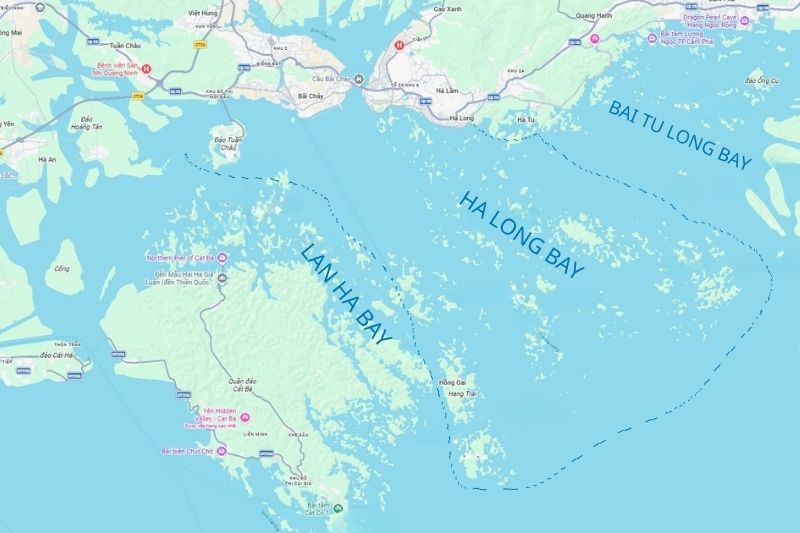
Understanding the core differences between the three bays helps you align your expectations with reality.
| Feature | Halong Bay | Lan Ha Bay | Bai Tu Long Bay |
|---|---|---|---|
| Province | Quang Ninh | Hai Phong (Cat Ba) | Quang Ninh |
| Inside UNESCO listing | Yes, 775 islands | Yes, 358 islands | No, outside the boundary |
| Islands in the wider area | ~1,969 | ~389 | ~600 |
| Overall feel | Grand, open, busy | quiet, lest touristy, active | Quiet, slow, empty |
| Boat traffic | High | Low | Very low |
| Main highlights | Sung Sot Cave, Thien Cung | Hidden lagoons, untouched beaches | Thien Canh Son Cave, Vung Vieng |
| Anchoring rules | Fixed stops only | Free anchoring on registered routes | Fixed stops only |
| Swimming | Artificial beaches | Open water and natural beaches | Designated spots only |
| Kayaking | Short, supervised | Long, open exploration | Short, supervised |
| Viewpoint hike | Ti Top Island | Monkey Island, Navy peak | None |
| Cruise fleet | Old refits plus new mega-ships | Newer boutique boats and classic cruises | Few options |
| Cabins per boat | 20–60 | 10–22 | 12–30 |
| Ferry needed | No | Yes (If you depart from Cat Ba island), but you can also depart from Ha Long bay | No |
| Time from Hanoi | 2.5–3 hours | 3.5–4.5 hours | 3–3.5 hours |
| Day tour cost | $30–$70 | $40–$100 | Almost none available |
| Overnight from | ~$99 | ~$99 | ~$130 |
| Best for | Relaxing, Luxury cruises | Swimmers, couples, repeat visitors and adventurous people | Silence seekers |
The sheer scale of the landscape here is unmatched anywhere else in Vietnam. With nearly 2,000 limestone towers rising from the Gulf of Tonkin, the visual depth is staggering. As your boat navigates the main channels, the karst formations continuously rearrange themselves, creating a seemingly endless, open seascape that defines the classic Vietnamese postcard.
The defining feature of this specific bay is its massive, walkable cave system. Gargantuan caverns like Sung Sot feature three massive chambers where stalactites have formed over millions of years. You can hike up Thien Cung cave for intricate rock formations or climb the 400 steps of Ti Top Island to capture the iconic panoramic shot of the cruise fleet below. Neither Lan Ha nor Bai Tu Long offers dry caves of this magnitude.
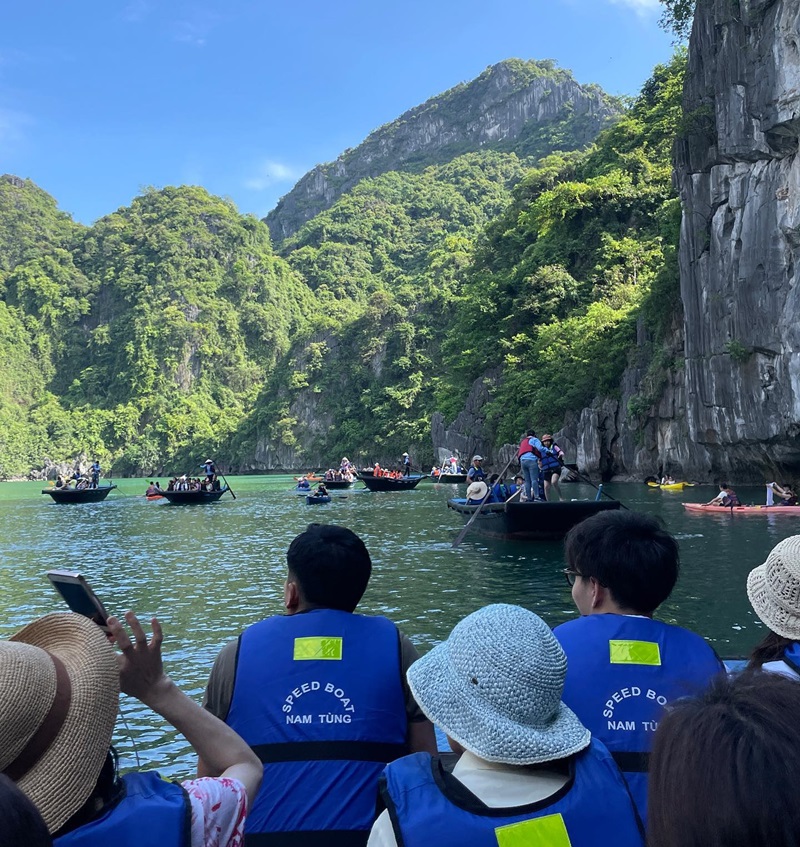
Normally, day tours run Route 2 from 11:30 AM to 5:30 PM, which is why the number of tourists is very high, significantly reducing the natural tranquility. Tourists do not complain about the wonderful natural scenery, but what leaves them less than fully satisfied is the uncontrollable crowding.
For a trip that truly meets your expectations, you should not overlook overnight cruises, which will bring you the most relaxing and peaceful feeling on the water.
Lan Ha Bay is famous as a place where you can freely splash around in the water instead of moving to fixed sightseeing spots like Halong Bay. Because it is shielded geographically by Cat Ba Island, the water here is noticeably cleaner and calmer, making swimming here a well-deserved reward.
The geographical scale feels much more intimate and compact. Instead of wide, open shipping lanes, your boat frequently threads through narrow limestone corridors. You can kayak directly under low-hanging rock ceilings into enclosed, silent water pockets like the Dark and Bright Cave. The floating fishing villages here are still active, breathing communities rather than staged cultural stops for tourists.
Basing your trip here also grants you immediate access to Cat Ba Island, effectively doubling the value of your itinerary. You can seamlessly combine your time on the water with jungle trekking through the national park, cycling to the isolated Viet Hai Village, or hunting for the magical bioluminescent plankton on a moonless night.
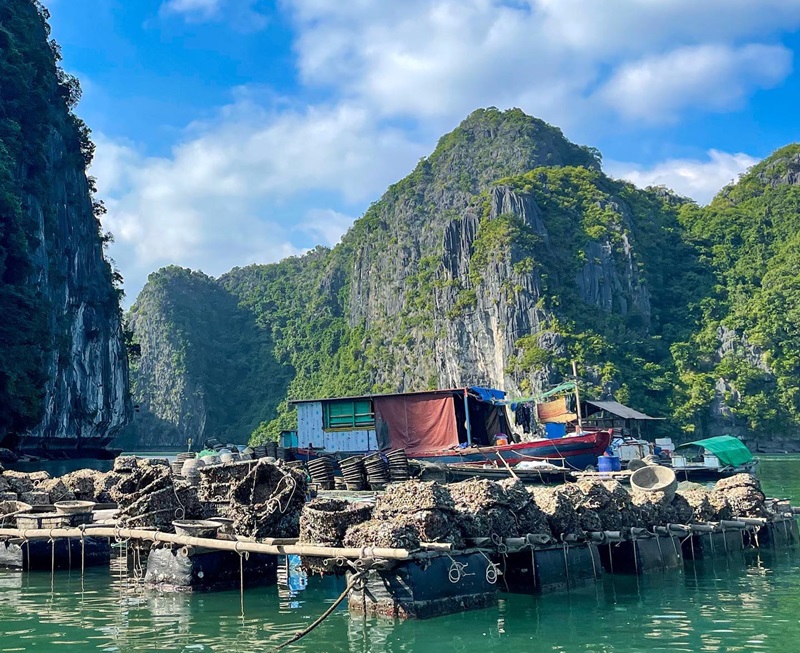
Most travel blogs state that Lan Ha Bay is quieter, but they do not explain the structural reason behind it. The major difference is the permitted sightseeing areas within the itinerary.
While Halong Bay rigidly fixes its visits to Sung Sot Cave, Ti Top Island, and Luon Cave, Lan Ha Bay is a bit more favored. Guests can move to various beach areas and kayak anywhere, as long as it is still within the sightseeing route, or visit floating farms and cycle in Viet Hai village. Because of this, Lan Ha Bay cruise ships can reasonably adjust their sightseeing routes to ensure the fewest tourists are gathered in one spot.
When travelers want to escape the massive crowds, the decision usually narrows down to these two specific alternatives. Both offer a beautifully quiet experience, but they achieve that silence in completely different ways.
|
Feature |
Lan Ha Bay |
Bai Tu Long Bay |
|
Transit to Boat |
Highway + Ferry to island |
Highway only, no ferry |
|
Swim / Kayak Stops |
Free anchorage, highly flexible |
Strictly designated stops |
|
Natural Beaches |
Abundant |
Very limited |
|
Cave Exploration |
Water caves via kayak |
Walkable Thien Canh Son Cave |
|
Cruise Fleet Variety |
High, many boutique options |
Low, very few operators |
|
Starting Price |
Budget-friendly options exist |
Generally premium pricing only |
If you prioritize jumping off the boat into the ocean, kayaking freely through quiet lagoons, and want access to dozens of hidden sandy beaches, head to Lan Ha Bay and Cat Ba Island. If you simply want absolute silence, travel with elderly parents who cannot endure a ferry transfer, and do not mind sticking to a fixed sightseeing schedule, Bai Tu Long is the perfect retreat.
Your daily activities change drastically depending on which body of water you choose to sail. Halong Bay focuses heavily on classic, structured sightseeing. You will hike through the massive Sung Sot and Thien Cung caves, climb Ti Top Island for panoramic photography, enjoy short supervised kayak sessions near Luon Cave, and try nighttime squid fishing from the main deck.
Lan Ha Bay caters to active, dynamic exploration. You will embark on long kayaking routes, swim freely multiple times a day right off the boat, and relax on pristine natural shores like Ba Trai Dao beach. You can also hike the rugged trails of Monkey Island for sweeping ocean views or trek deep into the island's national park, occasionally spotting the critically endangered Cat Ba Langur. Bai Tu Long sits in the middle, offering pristine scenery, the walkable Thien Canh Son cave, and authentic visits to the Vung Vieng fishing village, though it shares the same rigid stopping regulations as its famous neighbor.
|
Activity |
Halong Bay |
Lan Ha Bay |
Bai Tu Long Bay |
|
Walkable Caves |
Excellent (Massive) |
Limited |
Good (Thien Canh Son) |
|
Kayaking |
Basic / Short routes |
Excellent / Free exploration |
Basic / Short routes |
|
Free Swimming |
No |
Excellent |
No |
|
Natural Beaches |
Rare |
Abundant |
Rare |
|
Panoramic Peaks |
Ti Top Island |
Monkey Island |
None |
|
Jungle Trekking |
None |
Excellent (National Park) |
None |
|
Squid Fishing |
Standard on cruises |
Standard on cruises |
Standard on cruises |
|
Fishing Villages |
Mostly relocated |
Active communities |
Active communities |
When it comes to cruise quality, both regions deliver exceptional five-star experiences, but they interpret luxury quite differently.
Halong Bay boasts a massive, constantly upgraded fleet featuring 5-star and even ultra-premium 6-star mega-ships. Luxury here means immense scale and resort-style amenities—think presidential suites, fine-dining restaurants, and expansive spas.
Lan Ha Bay specializes in small to medium-sized boutique cruises. Their compact size allows them to navigate deep into hidden, pristine coves where larger 25+ cabin ships simply cannot enter. Luxury in Lan Ha translates to absolute privacy and highly personalized service. With typically only 10 to 15 cabins, and captains drop anchor in totally secluded spots where no other ships are visible from your private balcony.
The pricing between the two overlaps far more than most travelers expect, with a premium Lan Ha cabin generally running $145 to $200 per guest. Surprisingly, chartering an entire private boutique boat for a family in Lan Ha Bay is often more cost-effective than booking two high-end suites on a massive Halong Bay mega-ship. You can safely compare these modern, intimate options in our Lan Ha Bay cruises portfolio.
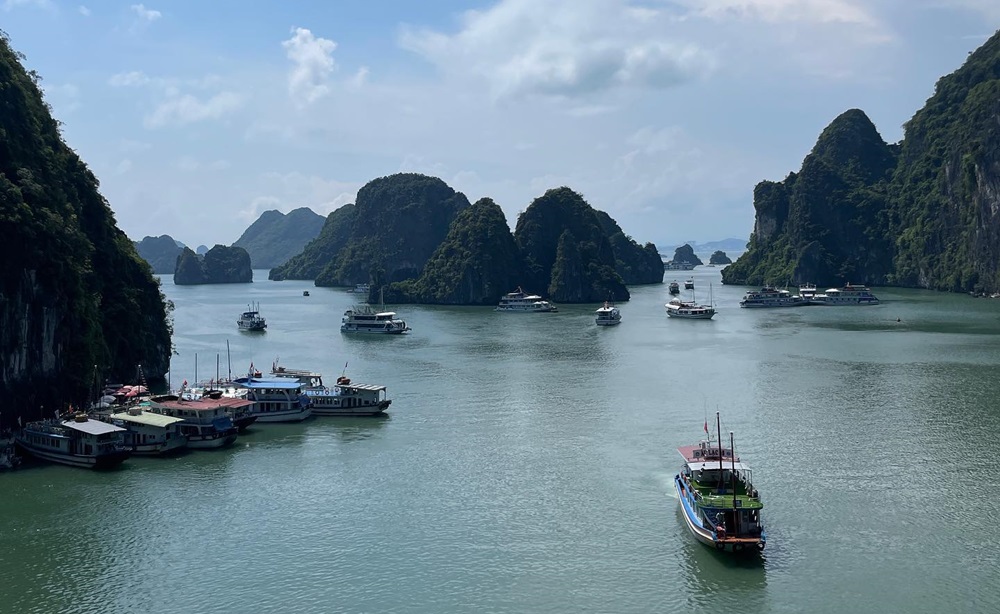
To help you budget accurately, the table below outlines the standard 2026 market rates across all three regions. These estimates represent the baseline cost in USD per passenger for reputable operators, allowing you to benchmark any quotes you receive.
|
Trip Style |
Halong Bay |
Lan Ha Bay |
Bai Tu Long Bay |
|
Half-day / sunset boat trip |
$35 – $50 |
$15 – $30 |
N/A |
|
Day tour (full day) |
$50 – $80 |
$30 – $50 |
$60 – $90 |
|
Cross-bay day trip |
$60 – $90 |
$60 – $90 |
N/A |
|
2D1N budget cruise |
$110 – $130 |
$99 – $120 |
$140 – $150 |
|
2D1N mid-range cruise |
$150 – $180 |
$130 – $170 |
$160 – $200 |
|
2D1N luxury cruise |
$190 – $350+ |
$180 – $300+ |
$220 – $400+ |
|
3D2N cruise |
$250 – $400 |
$230 – $380 |
$280 – $450 |
Traveling to the Halong Bay ports is incredibly easy. From Hanoi, you can easily book a bus or limousine departing at 8:00 AM, taking only 2.5 hours to Tuan Chau Marina. If you are visiting Bai Tu Long Bay, the bus can drop you off straight at the pier.
Traveling to Cat Ba Island for Lan Ha Bay is a bit further and requires changing multiple transport modes because there is no road connecting directly to the island. If you buy a full-package bus from Hanoi, it will already include the ferry, speedboat, or cable car in the ticket. The travel time is about 3.5 hours, departing from Hanoi one hour earlier than the buses heading to Tuan Chau Marina.
Long-term backpackers and repeat visitors on Reddit almost universally recommend Lan Ha Bay. Their reasoning is simple: you get the exact same breathtaking scenery with a fraction of the boat traffic. However, first-time visitors and families with young children frequently defend Halong Bay. The massive steel ships are much easier to navigate with strollers, and skipping iconic spots like Sung Sot Cave can lead to serious FOMO. Treat Reddit's consensus as an accurate gauge of crowd levels, not an absolute quality ranking. If seeing world-famous landmarks is your priority, Halong Bay remains a perfectly valid choice.
Matching your specific travel style to the correct body of water is the secret to a flawless trip.
If you only have one night and desperately want to see the colossal caves and iconic panoramic views you saw on Instagram, book the Halong Bay route. You will leave without the nagging feeling of missing out on a world wonder. If you happen to have a spare day, you can always add a day trip to Lan Ha Bay later.
This depends entirely on the age of your children. For toddlers under eight, the massive ships in Halong Bay are vastly superior, offering wide, shaded decks, stable cruising, and plenty of walking space. For energetic teenagers, the Lan Ha Bay route wins easily, as the freedom to jump off the boat and kayak independently keeps them highly engaged.
The Lan Ha Bay route is the undisputed winner for romantic getaways. The modern boutique cruises offer highly private balconies, intimate dining, and the ability to drop anchor completely alone in a silent lagoon. Your vacation photos will also look significantly better without dozens of other tourist boats crowding the background.
Base yourself on Cat Ba Island to access Lan Ha Bay. The island offers highly affordable accommodation, a vibrant evening nightlife, and excellent jungle trekking. You can book an independent boat trip for as little as $15. If you are returning to Vietnam for a second time, you should completely skip the central tourist routes.
Yes, and for many itineraries, this is the smartest possible strategy. The two main bodies of water are only separated by about an hour of sailing. You can easily book a cross-bay day trip starting around $50 that allows you to photograph the classic Halong Bay caves in the morning and swim in the clean Lan Ha Bay waters in the afternoon.
The second highly effective method is using Cat Ba Island as your mainland base. This gives you two or three days on the water, access to the dense national park, and vibrant island dining, all while avoiding the cost of paying for two separate luxury cruise transfers. Three days is the absolute sweet spot for this hybrid approach.
Geographically and ecologically, they are part of the exact same continuous limestone plateau. However, administratively, they are managed by two completely different local governments, requiring different tickets and separate boat licenses.
Halong Bay is better if you want to explore massive walkable caves and do not mind sharing the views with crowds. Lan Ha Bay is significantly better if you prefer quiet, unrestricted swimming, long kayaking routes, and newer boutique boats.
Yes, it is entirely worth visiting if you manage your expectations regarding crowds. To make the most of it, avoid cheap midday tours, book an overnight cruise to wake up on the water, or request a boat that sails the longer, less congested peripheral routes.
Choose Lan Ha Bay if you love jumping off the boat to swim and kayaking freely through hidden lagoons. Choose Bai Tu Long if you want absolute silence, do not care about swimming, and want to avoid taking a ferry transfer.
You can only swim at strictly designated, artificial beaches like Ti Top, which are often heavily crowded. You are strictly prohibited from jumping off your cruise boat into the open water due to local maritime regulations.
Absolutely. Lan Ha Bay offers a completely different, highly active experience focused on free swimming, deep kayaking, and exploring wild natural beaches that you could not access during your first trip.
The best weather occurs during the spring (March to May) and autumn (September to November), offering clear blue skies and calm waters. Try to avoid July and August when heavy tropical storms frequently cause port closures.
Yes. Because they belong to different provinces, your sightseeing ticket for one area is completely invalid in the other. If you book a cross-bay tour, your operator handles the purchase of both regional tickets for you.
So which bay should you book?
If this is your first time in Vietnam, you only have two days, and you genuinely want to see the famous caves and iconic landscapes everyone talks about, stick to the classic Halong Bay route. Just ensure you book a newer, well-reviewed boat that sails slightly off the main channel to mitigate the heavy midday crowds.
If your schedule allows it, do both. Sleep on Lan Ha Bay for a night, then take a day trip across the invisible border to photograph the legendary Halong Bay caves. Ready to start planning? Visit Beka Travel to explore our curated itineraries and let our local experts tailor the perfect voyage for your travel style.
Cat Ba
Trung Trang Cave, Hospital Cave, Cannon Fort, Thien Long Cave and Cat Ba National Park — entrance fees, opening hours, and which one to pick if you are short on time.
 Cat Ba
Typhoon season runs June to October in northern Vietnam. Here is who decides, what you get back, and how to plan a bay trip around it.
 Cat Ba
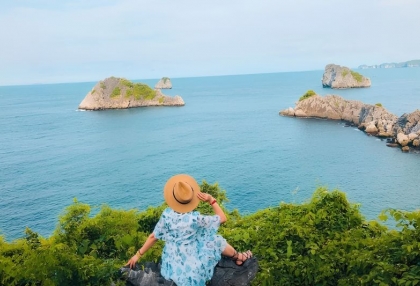
A practical guide to Monkey Island in Lan Ha Bay: how to get there, what the monkeys are like, the viewpoint hike, and which Beka tours stop there.
 Cat Ba
Around 90 Cat Ba langurs are left in the wild, all on one island. What they are, why you probably won't see one, and how to visit responsibly.
 Cat Ba
The Cat Hai–Phu Long cable car crosses 3,955 metres of open water in 10–15 minutes, running 09:00–16:00 daily except Tuesdays. Route, hours, ticket prices and how it compares to the ferry.
 Cat Ba
Beyond trekking and kayaking, Cat Ba Market is a must-visit destination to experience the authentic local lifestyle. It is the culinary heart of the island, where you can find the freshest seafood and traditional products of the Hai Phong port region.
 Cat Ba
Complete 2026 guide to reaching Cat Ba Island: compare buses, ferries, cable cars and transfers from Hanoi, Hai Phong, Ha Long and Ninh Binh.
 Cat Ba
Complete 2026 guide to the Tuan Chau to Gia Luan ferry. Find updated schedules, ticket prices, transport from Gia Luan to Cat Ba Town, and expert travel tips.
 Cat Ba
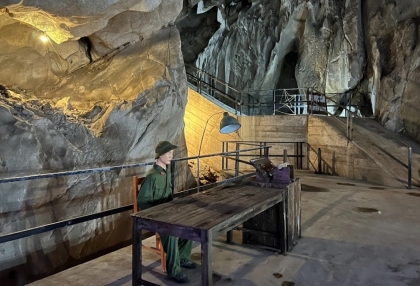
Discover Hang Quan Y (Military Hospital Cave) on Cat Ba Island. Learn about its wartime history, the 3-level concrete bunker, entrance fees, and how to get there.
 Cat Ba
Cannon Fort on Cat Ba Island is currently closed to visitors, with no official ticket sold. History, location, and what to see instead in 2026.