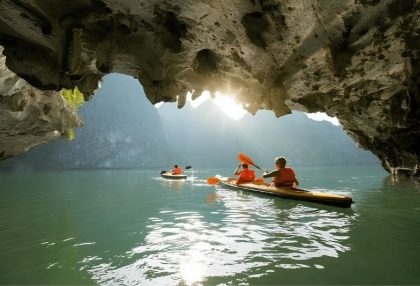

Drifting along the towering limestone cliffs of Lan Ha Bay, many travelers stare into the dense green foliage and ask if they will see a Cat Ba langur. The honest truth is that with around 90 individuals left on Earth, all confined to this single archipelago, your chances are incredibly slim. However, understanding this critically endangered primate makes every moment spent in these waters feel far more meaningful.
What the Cat Ba langur is?
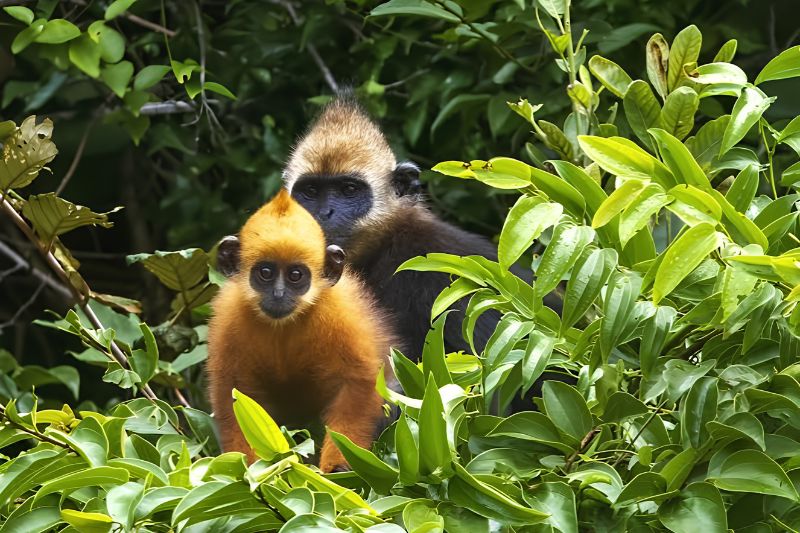
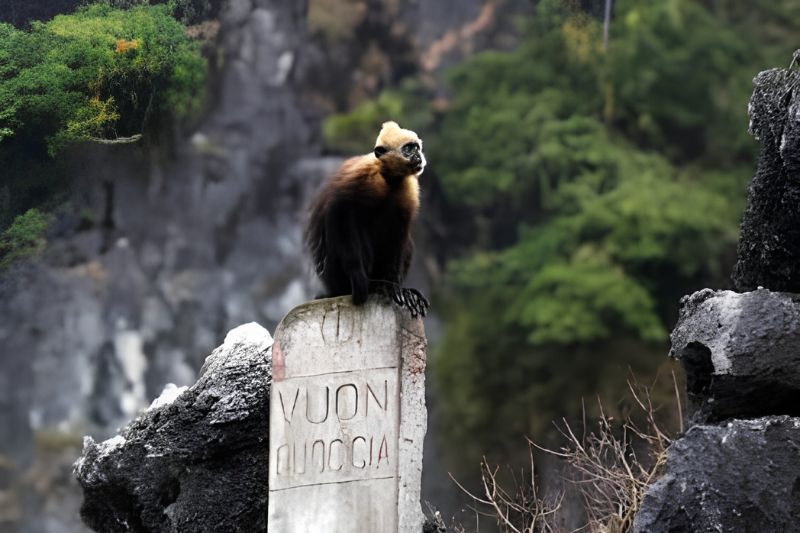
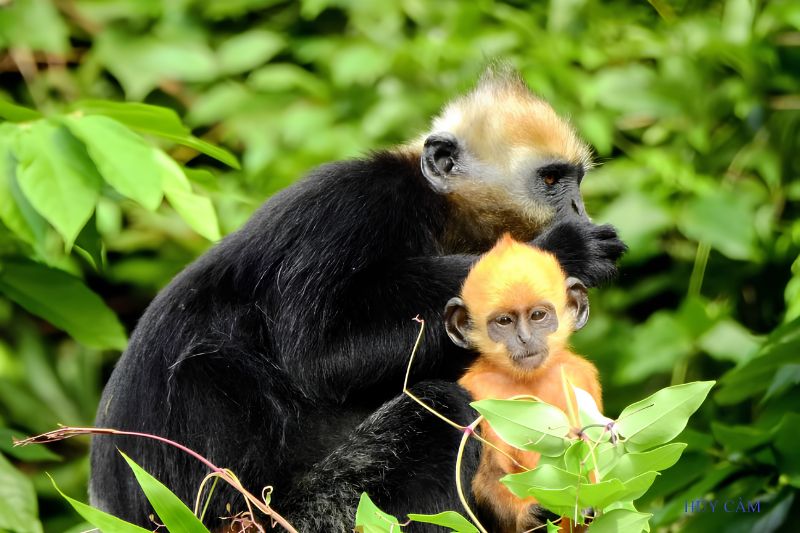
The golden-headed langur is a remarkably unique and agile primate native only to this specific region of Vietnam. They are easily identifiable by their dark brown to black bodies that contrast sharply with bright golden hair on their heads and shoulders. You can also spot a distinct grey V-shaped patch on their lower back if you ever catch a glimpse of them.
These slender monkeys typically measure between 49 and 59 centimeters in body length. Their most striking physical feature is their exceptionally long tail, stretching 70 to 90 centimeters, which is significantly longer than their entire body. Adult males weigh up to 9.5 kilograms, while the females are slightly smaller, usually weighing around 6.8 to 8 kilograms.
Why the babies are bright orange
Unlike the dark adults, newborn infants are completely covered in bright orange fur. This vibrant coloring begins to slowly change when they reach about four months of age. By the time they hit 18 months, their coats transition entirely to the adult black coloration.
How many Cat Ba langurs are left?
There are around 90 Cat Ba langurs left in the wild as of 2024, marking the highest population count in roughly a century. A peer-reviewed genomic study published in Nature Communications recorded 74 to 79 individuals in December 2023. Shortly after, the Cat Ba Langur Conservation Project reported the population passing the 90 mark during 2024.
This current number reflects decades of intense conservation efforts to save the species from the brink of extinction. The historic population decline was devastating, but the recent upward trend offers a genuine glimmer of hope. Here is a look at the historical population estimates for this rare primate.
| Time period | Population count | Source |
|---|---|---|
| Before exploitation | 2,400–2,700 | Nature Communications 2024 |
| 1960s | ~2,500 | Mongabay |
| 1970–1986 | 500–800 killed | Wikipedia |
| 1999 survey | 104–135 | Nature Communications 2024 |
| All-time low in 2003 | ~40 | Mongabay |
| December 2023 | 74–79 | Nature Communications 2024 |
| 2024 | ~90 | VnExpress, Thanh Nien |
That monkey on Monkey Island is not a langur
Many tourists cruise past Monkey Island, see primates running on the beach, and mistakenly believe they have spotted the elusive golden-headed langur. Those are actually macaques that have been released or reintroduced to the area for tourism purposes. They are highly accustomed to humans, frequently approach visitors for food, and are notorious for snatching belongings.
The golden-headed langur behaves in the exact opposite manner and almost never appears on crowded beaches. They strictly avoid human contact and isolate themselves on steep, inaccessible cliffs. Understanding this difference helps manage your expectations and prevents common misidentifications during your bay cruise.
| Feature | Monkey Island monkeys | Cat Ba langur |
|---|---|---|
| Species | Macaque | Golden-headed langur |
| Behaviour towards humans | Approaches, begs, snatches | Avoids completely |
| Coloration | Uniform grey-brown | Black body, bright golden head |
| Tail length | Short to medium | Longer than its entire body |
| Typical location | Beaches, walkways | Steep cliffs, strictly protected zones |
| Population | Abundant | ~90 globally |
Where Cat Ba langurs actually live
These rare primates are absolutely endemic to the Cat Ba Archipelago, meaning they do not exist anywhere else on Earth. Over 98 percent of the wild population is restricted to Cat Ba Island itself. Their actual living range is incredibly small, covering a fragmented habitat of only about 22 square kilometers.
A cliff animal, not a deep forest animal
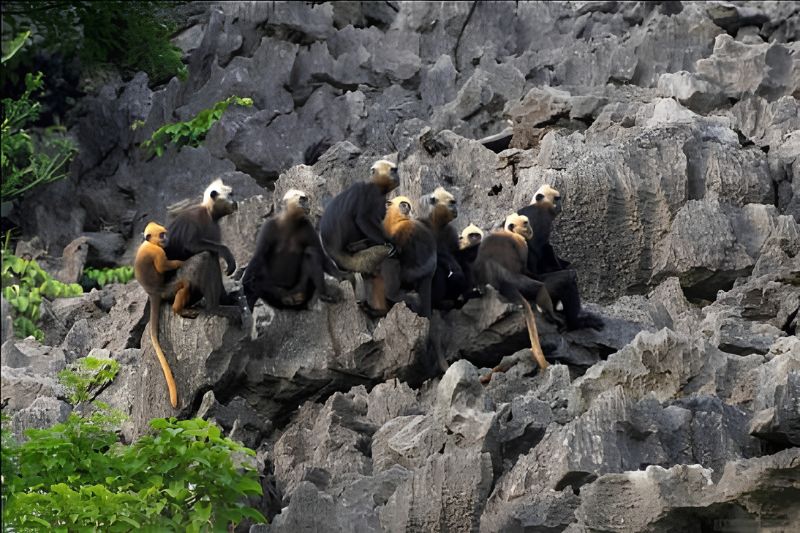
Many articles advise trekking deep into the jungle to find them, but they actually inhabit the coastal zone between 0 and 130 meters above sea level. They sleep in limestone caves and on rock ledges situated an average of 42 meters above the ground or water. These sleeping spots are virtually inaccessible by foot, and the monkeys predictably return to the same caves every night.
The langur that drinks seawater
A fascinating October 2024 study in Nature Communications revealed that this species possesses a specific genetic variation for metabolizing calcium and sodium. Because the porous limestone islands hold very little fresh water, the monkeys evolved to safely drink seawater. This extraordinary adaptation is almost entirely unique among all primate species worldwide.
Can you see a Cat Ba langur?
The honest answer is almost certainly no, and you should not book a trip expecting to encounter one. The tiny population of roughly 90 individuals is spread across 22 square kilometers of dense, rugged terrain. Furthermore, their core habitat is a strictly protected zone where human access is completely forbidden by law.
There is no legal tour designed specifically for public primate spotting on the island. Because they sleep on high cliffs without hiking trails, the rare sightings that do occur happen by pure chance from the water. You might catch a fleeting glimpse while taking standard Lan Ha Bay cruises and tours, but this is always a stroke of extraordinary luck rather than a guaranteed product.
What to do if you do see one
If you are incredibly fortunate enough to spot one from a boat, you must follow strict guidelines to ensure their safety.
- Maintain your distance and never ask the captain to approach closer.
- Stay completely quiet by avoiding calling out, whistling, or using loudspeakers.
- Never fly drones near the cliffs, as the noise causes extreme stress and can force them to abandon their caves.
- Never throw food to them, because human food transmits diseases and destroys their natural wariness of people.
- Do not disembark into the strictly protected zones.
- Never share the exact GPS coordinates of a sighting on social media.
- Report any signs of poaching or suspicious activity to your guide.
What you will see instead
While the golden-headed primate might remain hidden, the national park and surrounding waters are home to 282 recorded animal species. You have an excellent chance of spotting majestic sea eagles soaring above the karst formations or observing vibrant marine life. The ecosystem is rich with 32 mammal species, 78 bird species, and 177 different types of coral.
As you glide through the quiet waters, you will likely encounter dense mangrove forests and a stunning variety of over 1,500 plant species. Our local guides often point out beautiful reef fish and fascinating tidal creatures while you are kayaking in Lan Ha Bay. The sheer biodiversity of this archipelago ensures your nature expedition will be unforgettable regardless of which animals appear.
Beyond the headline numbers, the archipelago holds 20 reptile and amphibian species and close to 200 species of marine fish, many of which you can watch from a kayak in the shallower lagoons. Kingfishers work the mangrove edges in the early morning, and white-bellied sea eagles are a fairly reliable sight along the outer cliffs on clear days. None of these are rare enough to feel like a prize, which is exactly what makes them easy to actually enjoy.
What our guides point out first
Our guides tend to notice the small things before the big ones, because those are what people remember. Mudskippers in the tidal flats, the way the karst walls change colour through the afternoon, the sound a limestone cave makes when a kayak drifts inside it. You came for a landscape rather than a checklist, and the archipelago rewards that far more generously than any single animal sighting could.
Who is protecting the Cat Ba langur?
The Cat Ba Langur Conservation Project was established in 2000 by ZGAP and Allwetterzoo Münster. Since January 2019, Zoo Leipzig has taken over as the primary sponsor for these crucial preservation efforts. The project currently operates three community-based anti-poaching units alongside specialized Langur Guards who work closely with local forest rangers.
The project runs on a modest budget of roughly 80,000 to 100,000 US dollars a year with a small full-time team, which makes its results all the more striking. Its work helped expand the national park boundaries and establish the Special Protection Zones that now keep the core habitat off limits. The team also contributed to Vietnam's National Primate Action Plan and has replanted several hectares of degraded forest and wetland on the island.
Day to day, the work looks less like science and more like patient local relationship building. Rangers and community patrol members walk the same coastal sections week after week, log sightings, and check known sleeping caves for signs of disturbance. Since 2017 the project has also been a partner in the Asian Species Action Partnership, which connects it to teams working on other species at similar risk across the region.
How Viet Hai village fits in
The Seacology organization began funding a unique program in November 2002 that empowers local villagers to actively protect the monkey population. Families in Viet Hai village, a remote settlement located deep inside the national park, receive financial support in exchange for conducting regular wildlife patrols. This initiative successfully transformed a community of former hunters into guardians who now sustain themselves through eco-tourism.
A handful of langurs also live at the Endangered Primate Rescue Center in Cuc Phuong National Park, several hours inland. They serve as an insurance population, so that a single storm, disease outbreak or poaching incident on Cat Ba cannot wipe out the species entirely. It is a sobering reminder of how narrow the margin still is for an animal that exists nowhere else.
Why the langur nearly disappeared
Hunting for traditional medicine ingredients was the primary cause of the catastrophic population collapse. Between 1970 and 1986 alone, an estimated 500 to 800 individuals were systematically killed. Historical reports from Mongabay even noted that sport hunting by early tourists contributed heavily to the devastating decline.
The species takes decades to recover from such losses because of their incredibly slow natural reproductive cycle. Females only give birth once every two to three years, and an infant requires four to six years to reach full maturity. This fragile biological timeline makes every single surviving individual absolutely vital to the future of the entire species.
How close it came
By the time the first proper survey was completed in 1999, only 104 to 135 animals remained across the whole archipelago. The population kept falling for several more years and bottomed out at roughly 40 individuals around 2003, scattered in small groups that had lost contact with one another. At that point the species was closer to disappearing than most people realise.
That collapse left a permanent mark. The 2024 genomic study found that Cat Ba langurs now carry the highest level of inbreeding recorded in any limestone langur, simply because so few animals were left to breed. The encouraging finding was that the genetic regions most important for survival appear to have held up better than expected, which is part of why the recovery since 2003 has been possible at all.
Cat Ba and its UNESCO status
The archipelago was designated as a UNESCO Biosphere Reserve in 2004 and successfully renewed this status in 2024 after a ten-year evaluation. Furthermore, the area was inscribed as the "Ha Long Bay - Cat Ba Archipelago" World Heritage site in 2023. This milestone officially extended the boundaries of the original Ha Long Bay designation to cover the entire neighboring ecosystem.
The official UNESCO nomination dossier specifically highlighted this primate as a critically endangered endemic species and a flagship species for the region. While the monkey was not the primary justification for the heritage criteria, it was featured as a key indicator of the area's ecological integrity. The ongoing survival of this rare animal remains deeply intertwined with the global recognition of Cat Ba National Park.
Frequently asked questions
How many Cat Ba langurs are left?
There are around 90 Cat Ba langurs left in the wild as of 2024. A genomic study published in Nature Communications in December 2023 recorded 74 to 79 individuals. Conservationists confirm that this is the highest stable population count the island has seen in nearly a century.
Where do Cat Ba langurs live?
These primates live exclusively on the Cat Ba Archipelago, occupying a highly fragmented habitat of just 22 square kilometers. They thrive on sheer coastal limestone cliffs situated strictly between 0 and 130 meters above sea level. You will not find this specific species anywhere else on Earth.
Can you see Cat Ba langurs on a tour?
No, there are no legal or organized tours opened to the public for spotting this specific primate. Their core habitat is a strictly protected zone that prohibits human entry. Any rare sightings are purely by chance from the water, so you should never book a trip expecting a guaranteed encounter.
Is the Cat Ba langur the most endangered primate in the world?
No, the title of the most endangered primate actually belongs to the Hainan gibbon. However, the golden-headed monkey is officially listed among the world's 25 most endangered primates for 2023 to 2025. It undeniably remains one of the rarest and most vulnerable mammals on the planet.
What do Cat Ba langurs eat?
Their diet consists primarily of leaves, which make up 75 to 90 percent of their daily food intake. They forage from approximately 100 different local plant species found growing on the rugged limestone karsts. Remarkably, they have also genetically adapted to safely drink seawater to stay hydrated.
What are the Cat Ba langur predators?
Adult golden-headed monkeys have virtually no natural predators on the limestone cliffs they inhabit. Historically, the single greatest threat to this species has been human beings. Relentless poaching for traditional medicine almost drove the entire population to complete extinction.
Are the monkeys on Monkey Island Cat Ba langurs?
No, the animals you see freely roaming on Monkey Island are a completely different species of macaque. These macaques were released or reintroduced to the area and are heavily accustomed to begging for human food. The highly endangered golden-headed primate strictly avoids humans and stays far away from tourist beaches.
How can I help protect them?
The best way to help is to practice responsible tourism by never entering strictly protected zones or flying drones near cliffs. You can also directly support the dedicated teams working on the ground. The Cat Ba Langur Conservation Project website, linked below, explains how to fund community patrols and anti-poaching units.
Floating peacefully beneath the towering limestone formations, it is humbling to know you are sharing the landscape with such a resilient and rare creature. Even if you never spot that flash of golden fur on the cliffs, understanding their story enriches your entire journey through the archipelago. Reach out to Beka Travel to explore this World Heritage ecosystem responsibly and authentically.
Where to go next
| Page | Why it is relevant |
|---|---|
| Cat Ba langur | This guide, last updated August 2026 |
| Cat Ba National Park | The protected forest the langurs depend on |
| Kayaking in Lan Ha Bay | The coastal zone where the rare sightings happen |
| Viet Hai village | The village community that patrols langur habitat |
| Cat Ba beaches | Where to swim once you are on the island |
| Lan Ha Bay cruises and tours | Compare all six tours by duration and price |
| Beka Travel | A local operator based on Cat Ba Island |
Sources
Population figures on this page are current as of 2024 and are reviewed periodically.
| Source | Used for |
|---|---|
| Cat Ba Langur Conservation Project | Population figures and conservation programmes |
| IUCN Red List — Trachypithecus poliocephalus | Conservation status |
| Nature Communications, October 2024 | Genomic study, seawater adaptation, population history |
| UNESCO World Heritage Centre | World Heritage inscription 2023 |