How to conquer Vietnam’s wild northern frontier - Ha Giang
How to conquer Vietnam’s wild northern frontier - Ha Giang
Ha Giang, located at the northernmost frontier of Vietnam, is the ultimate dream destination for adventurous travelers. This majestic region is defined by winding mountain passes that cling to towering limestone karsts and the emerald waters of the Nho Que River snaking through deep, dramatic valleys. Its raw, untamed landscapes combined with rich ethnic minority cultures create an irresistible, otherworldly charm.
However, the steep mountain terrain and unpredictable high-altitude weather can be intimidating for first-timers. This comprehensive guide compiles real, practical insights from local experts to help you navigate your Ha Giang loop adventure safely and seamlessly.
Quick facts
Best time to visit: Sept – Oct (Harvest) or March – April (Flowers)
There is a moment, right as the concrete lowlands melt into vertical walls of jagged limestone, when you realize you are crossing into another world. For years, travelers flocked exclusively to Sa Pa or Ha Long Bay, but a dramatic shift is happening. Adventurers now crave the raw, untamed, and cliffside landscapes of Ha Giang, recently named one of the world's most beautiful destinations by Time Out.
If you are ready to trade commercial tourist trails for winding mountain switchbacks that cling to the edges of clouds, it’s time to visit Ha Giang. Tucked away at the absolute northern frontier of the country, Ha Giang Vietnam offers an experience that is both visually arresting and culturally profound, defined by towering canyons and ancient UNESCO-protected karst plateaus.
Whether you are looking up travel guides under Vietnam Ha Giang to plan a solo motorbike expedition, or researching the legendary loop via a local driver, this region defies all expectations. The magic of Hagiang Việt Nam lies in the sheer adrenaline of the journey itself. Pack your bags light, double-check your brakes, and prepare for the ride of a lifetime.
When is the best time to visit Ha Giang?
Ha Giang Vietnam changes its beautiful coat with every season, making it a spectacular year-round destination:
Spring (January to March): The weather is crisp and cool. The entire landscape bursts into color with white plum blossoms and pink peach blossoms. This is also the best time to experience traditional, lively festivals celebrated by the local H'mong and Dao communities.
Water-pouring season (May to June): The iconic Hoang Su Phi terraced rice fields transform into giant, mountain-carved mirrors reflecting the sky and clouds.
Golden autumn (September to October): The terraced fields turn into a sea of brilliant yellow rice. The weather during these months is cool and sunny—absolutely perfect for a motorbike road trip.
Buckwheat flower season (October to December): Delicate buckwheat flowers blanket the limestone slopes, shifting colors from white to pale pink and deep purple. The best spots to view these fields are in Lung Cu, Sung La Valley, and Meo Vac.
How to get to Ha Giang safely
Reaching Ha Giang requires navigating a long journey from the lowlands, but well-established transit links make it highly accessible for international travelers looking to connect major northern tourist hubs.
Traveling from Hanoi and regional hubs
From Hanoi: The 300 km journey takes 6–7 hours. Overnight sleeper or VIP cabin buses from My Dinh Bus Station cost 550,000 VND to 850,000 VND ($21–$32 USD) per way, saving you a night on accommodation.
From Sapa: A 6-hour mountain drive (~260 km) via day/night buses or limousines costs 350,000 VND to 500,000 VND ($14–$21 USD) per person.
From Ninh Binh: Direct overnight VIP cabin buses take 8–10 hours (~380 km) and cost 650,000 VND to 950,000 VND ($24–$36 USD) per person.
From Ha Long Bay: Direct overnight VIP cabin buses take 8.5–10 hours (~440 km) and cost 550,000 VND to 670,000 VND ($23–$28 USD) per person.
Tip: Opt for a "VIP Cabin" bus (giường nằm cabin) on longer routes like those from Ninh Binh or Ha Long. For a small premium, it offers a private, fully enclosed pod with charging ports and a much larger mattress, ensuring better rest before starting the loop.
Local transportation within Ha Giang
Once you arrive in Ha Giang City, you can choose between three main options to conquer the loop:
Motorbike rental: Costs 150,000 VND to 250,000 VND ($6–$10 USD) per day. Best for experienced riders, with reputable rental shops providing safety gear and maps.
Easy Rider tours: A highly recommended option involving a professional local driver-guide for those without an international license or mountain driving experience.
Private car with driver: The safest choice for groups and families, allowing passengers to view the scenery comfortably.
Safety checklist
Pro-tip: Safety first
Driving license: Ensure you have an International Driving Permit (IDP) that covers motorbikes. Local authorities often check this at police checkpoints along the loop.
Bike maintenance: Before departing from Ha Giang City, check: Tires (tread depth), Brakes (front and rear), and Lights (high/low beam). If you are uncomfortable with steep mountain descents, we strongly recommend hiring an "Easy Rider" (local guide).
Timing: Never ride after 6:00 PM. Thick mountain fog and lack of street lighting make the roads extremely dangerous after dark.
Top iconic check-in spots in Ha Giang
Every district along the Dong Van Karst Plateau—a recognized UNESCO Global Geopark—features unique natural wonders.
Milestone 0 (Cột Mốc Số 0)
Located right in the central park of Ha Giang City next to the Lo River, this famous milestone marks the official starting point of your mountain expedition.
Tip: It gets crowded with tour groups early in the morning, so snap your photo quickly.
Quan Ba Heaven Gate & Twin Mountains (Cổng Trời Quản Bạ)
Situated 40 km from the city center, this is the grand gateway to the rocky highlands. From the observation deck, you get a stunning, panoramic view of the uniquely shaped Fairy Twin Mountains.
Tip: The stairs to the viewpoint are steep. Wear sturdy shoes and watch out for thick morning fog.
Tham Ma Pass (Dốc Thẩm Mã)
This legendary nine-turn zigzag pass connects Quan Ba to Yen Minh. It is the ultimate test for riders and yields some of the most dramatic landscape photos on the entire loop.
Tip: You will often find local H'mong children carrying baskets of buckwheat flowers here. You can offer them treats, but avoid giving out cash to discourage begging.
Pao's House (Nhà của Pao)
An ancient, traditional house located in Lung Cam cultural village within the rustic Sung La Valley. It famously served as the main filming location for the award-winning Vietnamese film "The Story of Pao".
Admission: 30,000 VND ($1.20 USD).
Opening hours: 6:00 AM – 6:00 PM.
Tip: Respect local customs; do not touch private altars or wear overly revealing clothing.
The Vuong Family Mansion (Dinh Thự Họ Vương)
Tucked away in Sa Phin Valley, this architectural masterpiece belonged to the H'mong King, Vuong Chi Sinh. Built over a century ago, the mansion features a beautiful blend of traditional H'mong art, classic Chinese design, and French colonial architecture.
Admission: 30,000 VND ($1.20 USD).
Opening hours: 7:00 AM – 5:00 PM.
Tip: Hire a local guide at the entrance for around 100,000 VND ($4 USD) to hear the fascinating historical legends behind the palace.
Lung Cu Flag Tower (Cột Cờ Lũng Cú)
The sacred northernmost point of Vietnam, featuring a massive 54-square-meter national flag flying proudly on Dragon Mountain.
Admission: 40,000 VND ($1.60 USD). Optional round-trip electric shuttle to the base is 30,000 VND ($1.20 USD).
Opening hours: 7:30 AM – 5:00 PM.
Tip: Dress respectfully when visiting this monumental site.
Ma Pi Leng Pass & The Nho Que River
Considered one of Vietnam's "Four Great Mountain Passes," this road towers over Tu San Canyon—the deepest canyon in Southeast Asia. Taking a boat ride on the brilliant turquoise waters of the Nho Que River is an absolute must-do experience.
Admission: Ma Pi Leng Pass is free. Boat tours on the river cost 100,000 VND – 120,000 VND ($4 – $5 USD). A round-trip motorcycle shuttle down to the pier costs around 100,000 VND.
Opening hours (Boats): 7:00 AM – 5:30 PM.
Tip: For thrill-seekers, the Ha Giang Skywalk offers incredible cliffside views. If you are driving down to the river pier yourself, ensure your motorbike brakes are in flawless condition, as the road is exceptionally steep.
Hoang Su Phi Terraced Rice Fields
A masterpiece of agricultural engineering carved into the mountainsides by generations of ethnic minority farmers.
Tip: Hoang Su Phi is located on a separate mountain branch west of Ha Giang City, completely away from the main Dong Van to Ha Giang loop axis. Plan your itinerary accordingly.
Detailed loop itineraries from local experts
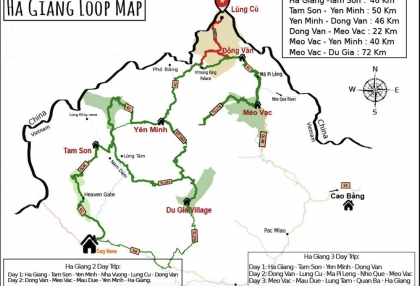
To explore Ha Giang VN comfortably without burning out, your daily travel distances should be carefully calculated.
The essential Ha Giang Loop (3 Days 2 Nights)
Day 1: Ha Giang City > Quan Ba > Yen Minh > Dong Van. Stop at the Heaven Gate, ride through the winding Ha Giang to Yen Minh road, conquer Tham Ma Pass, and spend the night in the historic Dong Van Old Quarter.
Day 2: Dong Van > Lung Cu > Ma Pi Leng Pass > Meo Vac. Head up to the Lung Cu Flag Tower, ride across the breath-taking Ma Pi Leng Pass, hike the Skywalk Ha Giang, and take a boat trip on the Nho Que River. Sleep in Meo Vac.
Day 3: Meo Vac > Yen Minh > Ha Giang City. Take a scenic ride from Meo Vac to Ha Giang via the Mau Due route, head back to the city center, grab dinner, and board your night bus back to Hanoi.
The deep-dive northern expedition (4 Days 3 Nights)
Days 1 & 2: Follow the same main route through Quan Ba, Dong Van, and Lung Cu, but at a more relaxed pace to spend time visiting local villages.
Day 3: Meo Vac > Ha Giang City > Hoang Su Phi. Head back down from the main loop and transition toward the remote valleys of Hoang Su Phi to see the local culture of the Dao and La Chi people.
Day 4: Hoang Su Phi > Hanoi. Wake up early to catch the sunrise over the sea of clouds blanketing the terraced fields before heading back to the city to finish your 4-day loop.
Must-try mountain specialties & local cuisine
The culinary landscape of the northern highlands offers rich, smoky flavors that reflect local mountain life.
Thang Co: The most famous traditional dish of the H'mong people. It is a hearty stew made from horse meat, offal, and a blend of over a dozen local mountain herbs and spices. Enjoying a hot bowl of Thang Co with a shot of local corn wine at a weekend ethnic market is a definitive cultural experience.
Thit Trau Gac Bep (Smoked Buffalo Meat): Strips of buffalo or pork are marinated with native spices like Mac Khen (wild mountain pepper) and Hat Doi, then hung above wood-burning stoves to smoke for months. The result is a fragrant, jerky-like meat that is savory, smoky, and mildly spicy.
Buckwheat cakes (Bánh Tam Giác Mạch): Made from harvested buckwheat seeds that are dried, ground into flour, and shaped into flat rounds. They are steamed and then grilled over hot coals, yielding a soft, nutty, and slightly sweet cake.
Mint honey & Ha Giang oranges: Two highly prized local products. Mint honey has a translucent olive-green hue and a crisp, refreshing sweetness because the bees feed on wild mint blossoms. Meanwhile, King Oranges (Cam Sành) have a thick, rustic rind but boast incredibly juicy, sweet, and slightly tart flesh.
Essential travel tips for solo travelers
Mountain safety comes first: The roads feature continuous hair-pin turns and steep gradients. Never drive on the passes after 6:00 PM, as heavy mountain fog rolls in quickly and there is zero street lighting.
Pack layered clothing: Temperatures drop drastically at night in the mountains. A high-quality, windproof, and water-resistant jacket is essential to protect your health during long rides.
Respect local traditions: When exploring ethnic villages, ask for permission before photographing children or locals. Never touch sacred items, house altars, or spirit gates at village entrances.
Visit Ha Giang to conquer legendary roads, witness raw natural beauty, and collect memories that will stay with you for a lifetime. Pack your bags, check your maps, and get ready to explore the wild frontier of Northern Vietnam today!
Understanding the layout and physical distances between key attractions is essential for a safe and successful journey along the northern frontier. This comprehensive guide details the most famous check-in locations, logically arranged according to the actual flow of the North-East loop highway. Discover everything you need to know about admission fees, estimated travel times, and precise distances between each iconic stop.



 Ha Giang